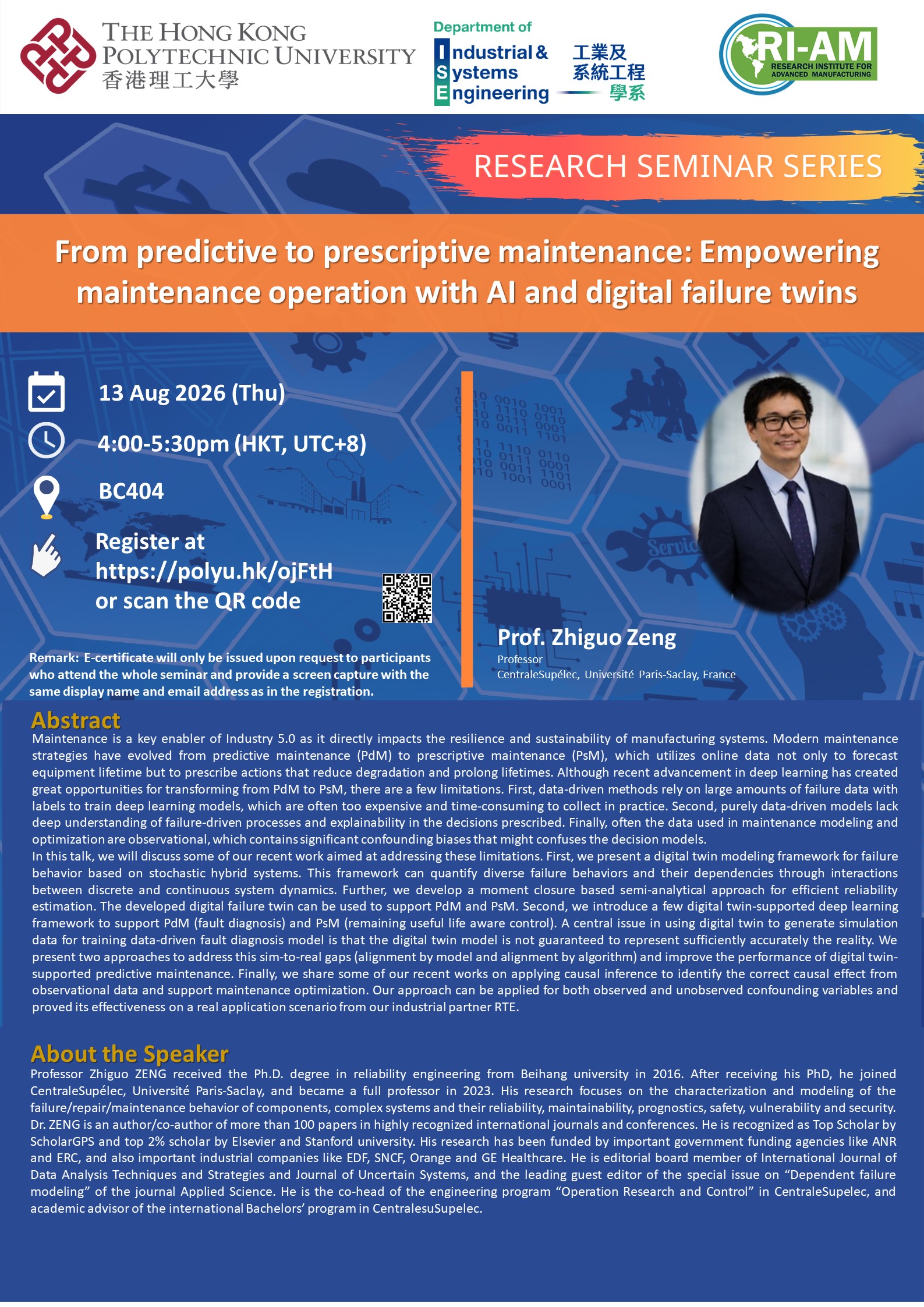
From predictive to prescriptive maintenance: Empowering maintenance operation with AI and digital failure twins
Research Seminar Series

-
Date
13 Aug 2026
-
Organiser
Department of Industrial and Systems Engineering, PolyU
-
Time
16:00 - 17:30
-
Venue
BC404
Speaker
Prof. Zhiguo ZENG
Remarks
If you have enquiries regarding E-certificate after the seminar, please contact david.kuo@polyu.edu.hk.
Summary
Maintenance is a key enabler of Industry 5.0 as it directly impacts the resilience and sustainability of manufacturing systems. Modern maintenance strategies have evolved from predictive maintenance (PdM) to prescriptive maintenance (PsM), which utilizes online data not only to forecast equipment lifetime but to prescribe actions that reduce degradation and prolong lifetimes. Although recent advancement in deep learning has created great opportunities for transforming from PdM to PsM, there are a few limitations. First, data-driven methods rely on large amounts of failure data with labels to train deep learning models, which are often too expensive and time-consuming to collect in practice. Second, purely data-driven models lack deep understanding of failure-driven processes and explainability in the decisions prescribed. Finally, often the data used in maintenance modeling and optimization are observational, which contains significant confounding biases that might confuses the decision models.
In this talk, we will discuss some of our recent work aimed at addressing these limitations. First, we present a digital twin modeling framework for failure behavior based on stochastic hybrid systems. This framework can quantify diverse failure bQehaviors and their dependencies through interactions between discrete and continuous system dynamics. Further, we develop a moment closure based semi-analytical approach for efficient reliability estimation. The developed digital failure twin can be used to support PdM and PsM. Second, we introduce a few digital twin-supported deep learning framework to support PdM (fault diagnosis) and PsM (remaining useful life aware control). A central issue in using digital twin to generate simulation data for training data-driven fault diagnosis model is that the digital twin model is not guaranteed to represent sufficiently accurately the reality. We present two approaches to address this sim-to-real gaps (alignment by model and alignment by algorithm) and improve the performance of digital twin-supported predictive maintenance. Finally, we share some of our recent works on applying causal inference to identify the correct causal effect from observational data and support maintenance optimization. Our approach can be applied for both observed and unobserved confounding variables and proved its effectiveness on a real application scenario from our industrial partner RTE.
Keynote Speaker

Prof. Zhiguo ZENG
Professor
CentraleSupélec, Université Paris-Saclay, France
Professor Zhiguo ZENG received the Ph.D. degree in reliability engineering from Beihang university in 2016. After receiving his PhD, he joined CentraleSupélec, Université Paris-Saclay, and became a full professor in 2023. His research focuses on the characterization and modeling of the failure/repair/maintenance behavior of components, complex systems and their reliability, maintainability, prognostics, safety, vulnerability and security. Dr. ZENG is an author/co-author of more than 100 papers in highly recognized international journals and conferences. He is recognized as Top Scholar by ScholarGPS and top 2% scholar by Elsevier and Stanford university. His research has been funded by important government funding agencies like ANR and ERC, and also important industrial companies like EDF, SNCF, Orange and GE Healthcare. He is editorial board member of International Journal of Data Analysis Techniques and Strategies and Journal of Uncertain Systems, and the leading guest editor of the special issue on “Dependent failure modeling” of the journal Applied Science. He is the co-head of the engineering program “Operation Research and Control” in CentraleSupelec, and academic advisor of the international Bachelors’ program in CentralesuSupelec.
You may also like