Artificial intelligence-assisted development of high-energy lithium metal batteries
Research Seminar Series

-
Date
15 Jul 2026
-
Organiser
Department of Industrial and Systems Engineering, PolyU
-
Time
14:00 - 15:30
-
Venue
BC303
Speaker
Prof. Guangmin Zhou
Remarks
If you have enquiries regarding E-certificate after the seminar, please contact david.kuo@polyu.edu.hk.
Summary
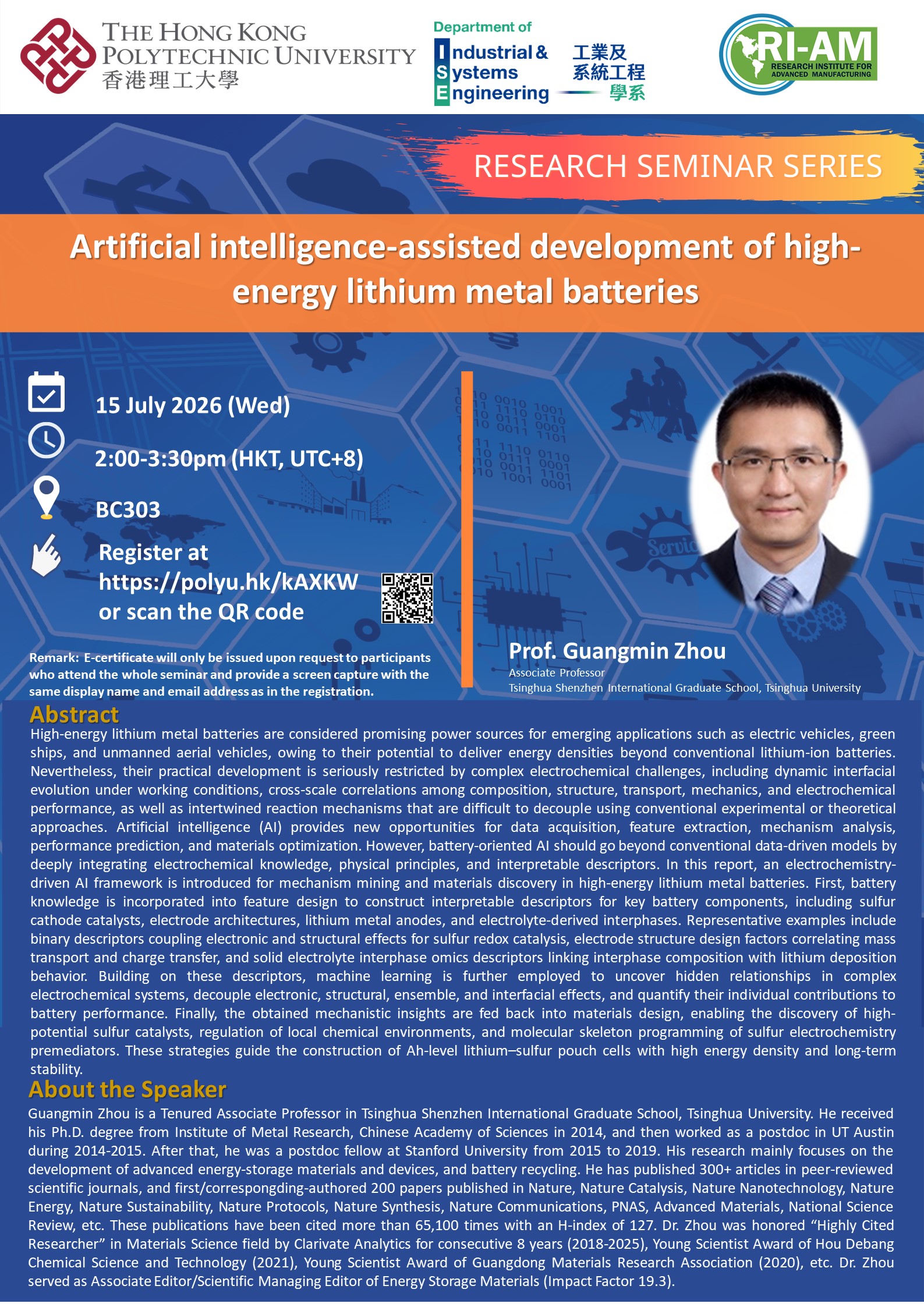
High-energy lithium metal batteries are considered promising power sources for emerging applications such as electric vehicles, green ships, and unmanned aerial vehicles, owing to their potential to deliver energy densities beyond conventional lithium-ion batteries. Nevertheless, their practical development is seriously restricted by complex electrochemical challenges, including dynamic interfacial evolution under working conditions, cross-scale correlations among composition, structure, transport, mechanics, and electrochemical performance, as well as intertwined reaction mechanisms that are difficult to decouple using conventional experimental or theoretical approaches. Artificial intelligence (AI) provides new opportunities for data acquisition, feature extraction, mechanism analysis, performance prediction, and materials optimization. However, battery-oriented AI should go beyond conventional data-driven models by deeply integrating electrochemical knowledge, physical principles, and interpretable descriptors. In this report, an electrochemistry-driven AI framework is introduced for mechanism mining and materials discovery in high-energy lithium metal batteries. First, battery knowledge is incorporated into feature design to construct interpretable descriptors for key battery components, including sulfur cathode catalysts, electrode architectures, lithium metal anodes, and electrolyte-derived interphases. Representative examples include binary descriptors coupling electronic and structural effects for sulfur redox catalysis, electrode structure design factors correlating mass transport and charge transfer, and solid electrolyte interphase omics descriptors linking interphase composition with lithium deposition behavior. Building on these descriptors, machine learning is further employed to uncover hidden relationships in complex electrochemical systems, decouple electronic, structural, ensemble, and interfacial effects, and quantify their individual contributions to battery performance. Finally, the obtained mechanistic insights are fed back into materials design, enabling the discovery of high-potential sulfur catalysts, regulation of local chemical environments, and molecular skeleton programming of sulfur electrochemistry premediators. These strategies guide the construction of Ah-level lithium–sulfur pouch cells with high energy density and long-term stability.
Keynote Speaker

Prof. Guangmin Zhou
Associate Professor
Tsinghua Shenzhen International Graduate School, Tsinghua University
Guangmin Zhou is a Tenured Associate Professor in Tsinghua Shenzhen International Graduate School, Tsinghua University. He received his Ph.D. degree from Institute of Metal Research, Chinese Academy of Sciences in 2014, and then worked as a postdoc in UT Austin during 2014-2015. After that, he was a postdoc fellow at Stanford University from 2015 to 2019. His research mainly focuses on the development of advanced energy-storage materials and devices, and battery recycling. He has published 300+ articles in peer-reviewed scientific journals, and first/correspongding-authored 200 papers published in Nature, Nature Catalysis, Nature Nanotechnology, Nature Energy, Nature Sustainability, Nature Protocols, Nature Synthesis, Nature Communications, PNAS, Advanced Materials, National Science Review, etc. These publications have been cited more than 65,100 times with an H-index of 127. Dr. Zhou was honored “Highly Cited Researcher” in Materials Science field by Clarivate Analytics for consecutive 8 years (2018-2025), Young Scientist Award of Hou Debang Chemical Science and Technology (2021), Young Scientist Award of Guangdong Materials Research Association (2020), etc. Dr. Zhou served as Associate Editor/Scientific Managing Editor of Energy Storage Materials (Impact Factor 19.3).
You may also like