Haptic technology for immersive reality
Distinguished Research Seminar Series

-
Date
11 Nov 2026
-
Organiser
Department of Industrial and Systems Engineering, PolyU
-
Time
10:00 - 11:30
-
Venue
BC203
Speaker
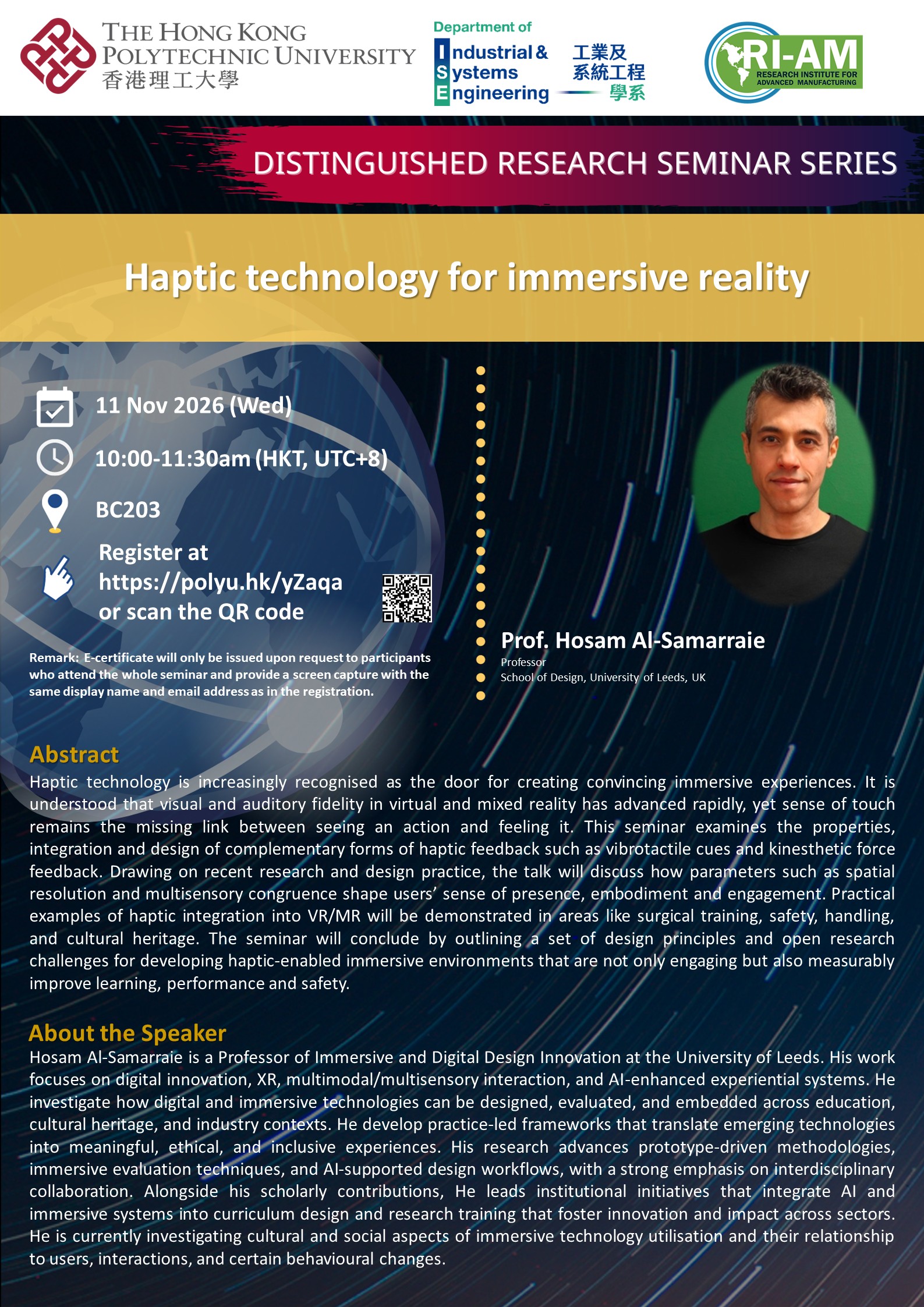
Prof. Hosam Al-Samarraie
Remarks
If you have enquiries regarding E-certificate after the seminar, please contact david.kuo@polyu.edu.hk.
Summary
Haptic technology is increasingly recognised as the door for creating convincing immersive experiences. It is understood that visual and auditory fidelity in virtual and mixed reality has advanced rapidly, yet sense of touch remains the missing link between seeing an action and feeling it. This seminar examines the properties, integration and design of complementary forms of haptic feedback such as vibrotactile cues and kinesthetic force feedback. Drawing on recent research and design practice, the talk will discuss how parameters such as spatial resolution and multisensory congruence shape users’ sense of presence, embodiment and engagement. Practical examples of haptic integration into VR/MR will be demonstrated in areas like surgical training, safety, handling, and cultural heritage. The seminar will conclude by outlining a set of design principles and open research challenges for developing haptic-enabled immersive environments that are not only engaging but also measurably improve learning, performance and safety.
Keynote Speaker

Prof. Hosam Al-Samarraie
Professor
School of Design, University of Leeds, UK
Hosam Al-Samarraie is a Professor of Immersive and Digital Design Innovation at the University of Leeds. His work focuses on digital innovation, XR, multimodal/multisensory interaction, and AI‑enhanced experiential systems. He investigate how digital and immersive technologies can be designed, evaluated, and embedded across education, cultural heritage, and industry contexts. He develop practice‑led frameworks that translate emerging technologies into meaningful, ethical, and inclusive experiences. His research advances prototype‑driven methodologies, immersive evaluation techniques, and AI‑supported design workflows, with a strong emphasis on interdisciplinary collaboration. Alongside his scholarly contributions, He leads institutional initiatives that integrate AI and immersive systems into curriculum design and research training that foster innovation and impact across sectors. He is currently investigating cultural and social aspects of immersive technology utilisation and their relationship to users, interactions, and certain behavioural changes.
You may also like