AI-embodied Flexible Electronic Systems: From Sensors to Robots
Distinguished Research Seminar Series

-
Date
06 Nov 2026
-
Organiser
Department of Industrial and Systems Engineering, PolyU
-
Time
14:00 - 15:30
-
Venue
TU101
Speaker
Prof. YongAn Huang
Remarks
If you have enquiries regarding E-certificate after the seminar, please contact david.kuo@polyu.edu.hk.
Summary
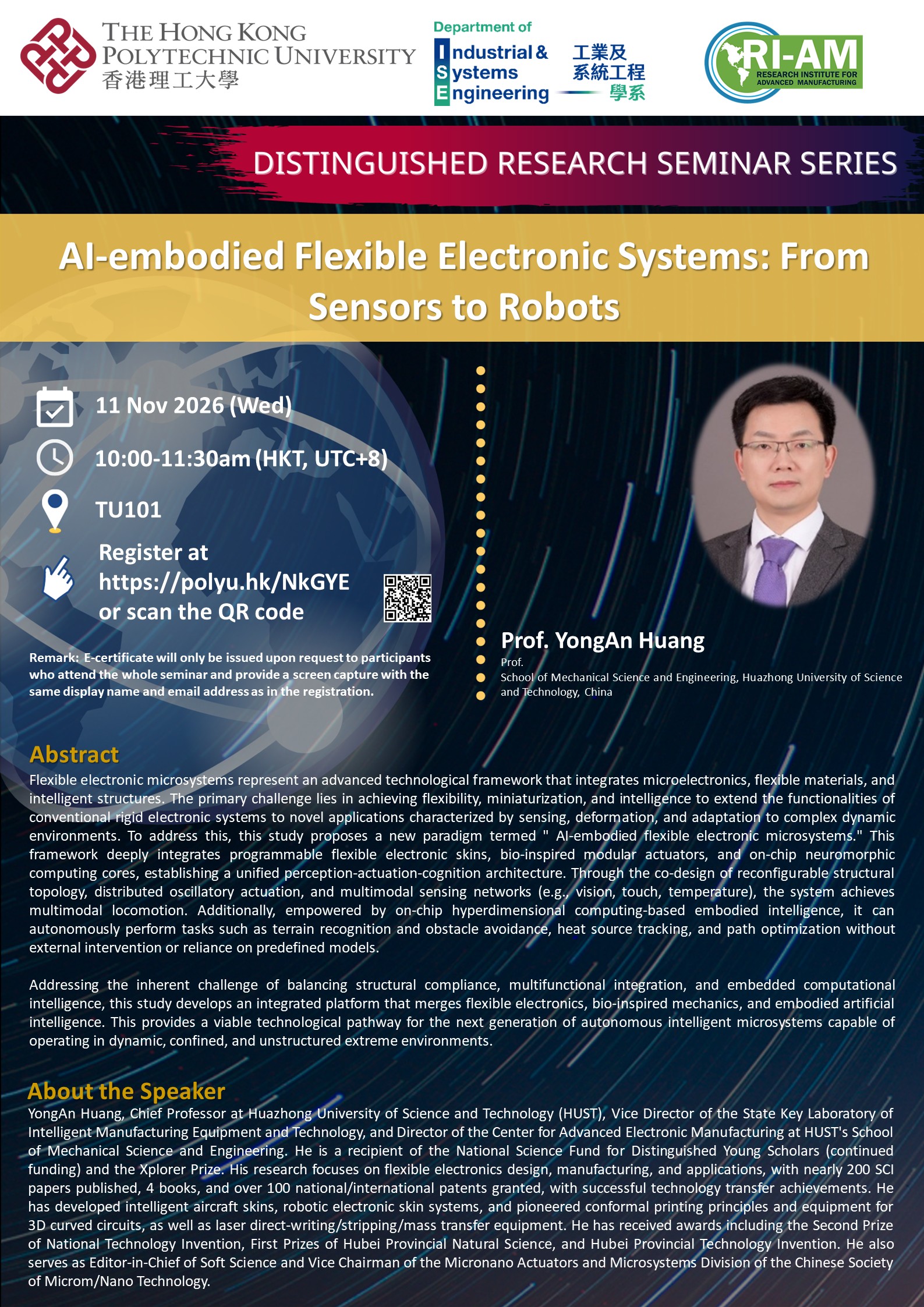
Flexible electronic microsystems represent an advanced technological framework that integrates microelectronics, flexible materials, and intelligent structures. The primary challenge lies in achieving flexibility, miniaturization, and intelligence to extend the functionalities of conventional rigid electronic systems to novel applications characterized by sensing, deformation, and adaptation to complex dynamic environments. To address this, this study proposes a new paradigm termed " AI-embodied flexible electronic microsystems." This framework deeply integrates programmable flexible electronic skins, bio-inspired modular actuators, and on-chip neuromorphic computing cores, establishing a unified perception-actuation-cognition architecture. Through the co-design of reconfigurable structural topology, distributed oscillatory actuation, and multimodal sensing networks (e.g., vision, touch, temperature), the system achieves multimodal locomotion. Additionally, empowered by on-chip hyperdimensional computing-based embodied intelligence, it can autonomously perform tasks such as terrain recognition and obstacle avoidance, heat source tracking, and path optimization without external intervention or reliance on predefined models.
Addressing the inherent challenge of balancing structural compliance, multifunctional integration, and embedded computational intelligence, this study develops an integrated platform that merges flexible electronics, bio-inspired mechanics, and embodied artificial intelligence. This provides a viable technological pathway for the next generation of autonomous intelligent microsystems capable of operating in dynamic, confined, and unstructured extreme environments.
Keynote Speaker

Prof. YongAn Huang
Professor
School of Mechanical Science and Engineering, Huazhong University of Science and Technology, China
YongAn Huang, Chief Professor at Huazhong University of Science and Technology (HUST), Vice Director of the State Key Laboratory of Intelligent Manufacturing Equipment and Technology, and Director of the Center for Advanced Electronic Manufacturing at HUST's School of Mechanical Science and Engineering. He is a recipient of the National Science Fund for Distinguished Young Scholars (continued funding) and the Xplorer Prize. His research focuses on flexible electronics design, manufacturing, and applications, with nearly 200 SCI papers published, 4 books, and over 100 national/international patents granted, with successful technology transfer achievements. He has developed intelligent aircraft skins, robotic electronic skin systems, and pioneered conformal printing principles and equipment for 3D curved circuits, as well as laser direct-writing/stripping/mass transfer equipment. He has received awards including the Second Prize of National Technology Invention, First Prizes of Hubei Provincial Natural Science, and Hubei Provincial Technology Invention. He also serves as Editor-in-Chief of Soft Science and Vice Chairman of the Micronano Actuators and Microsystems Division of the Chinese Society of Microm/Nano Technology.
You may also like