Silent and often undetected in its early stages, adolescent idiopathic scoliosis (AIS) affects millions of young people globally.
This abnormal spinal condition causes twisting and sideways curvature, typically forming "C" or "S" shapes, and has emerged as one of the three leading health threats facing Chinese youth today, alongside obesity and myopia. In Mainland China alone, millions of children and adolescents live with scoliosis. Despite ongoing screening programmes identifying new cases each year, the persistently high detection rates underscore both the condition’s prevalence and the critical importance of early prevention.
The challenge is clear: providing safe, accurate spinal assessment without exposing adolescent patients to harmful radiation. Traditional X-ray imaging, the diagnostic standard, captures only two-dimensional images while most scoliosis cases involve complex three-dimensional deformities. More critically, repeated radiation exposure during adolescence carries cancer risks, limiting examinations to 6-12 month intervals. According to a report published in 2016, an average of 16 X-ray exposures for scoliosis subjects can provoke cancer prevalence from 0.9% (subjects without scoliosis) to 4.3% in their middle age after 25 years. This constraint creates obstacles for young patients whose condition may rapidly deteriorate during growth spurts. Conversely, traditional radiation-free examination methods based on body surface lack the precision needed for accurate diagnosis, treatment planning, and treatment outcome measuring, creating a persistent medical dilemma.
Cutting-edge Innovation in Medical Imaging
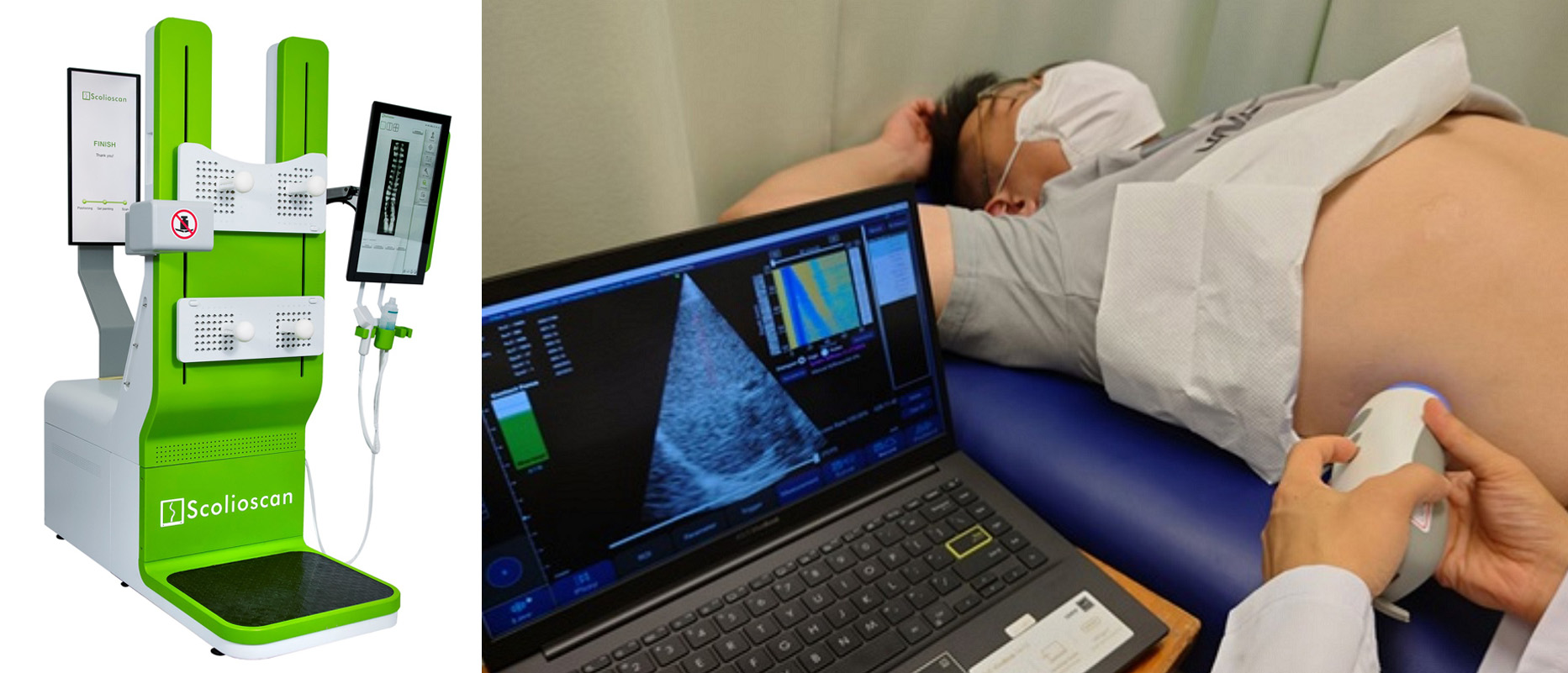
Scolioscan® (on left) can measure spinal curve as accurately as X-ray while Liverscan® (on right) helps detect liver fibrosis and fatty liver.
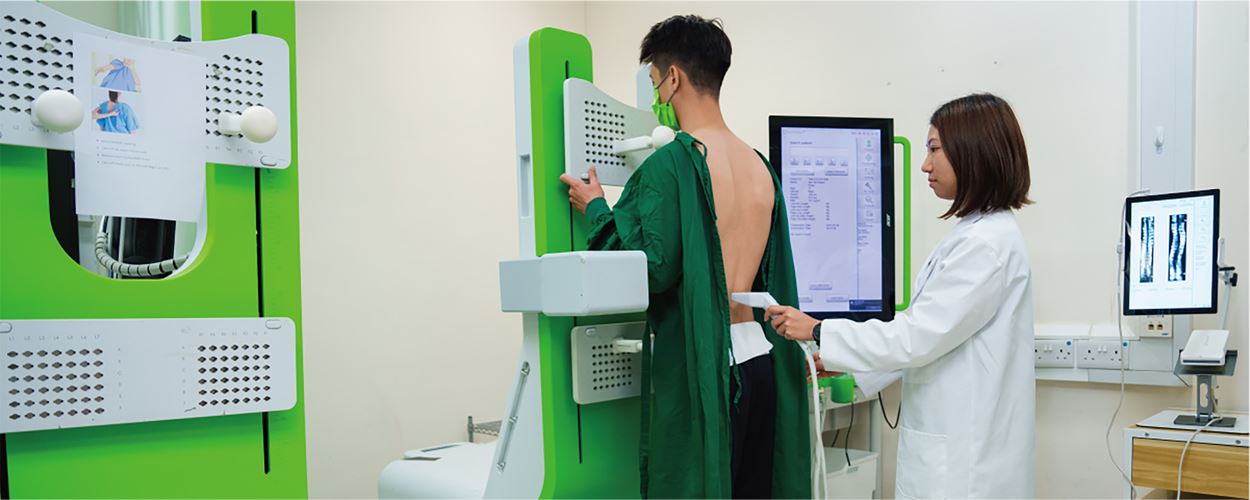
The Hong Kong Polytechnic University (PolyU) stands at the forefront of addressing this pressing challenge, advancing spinal health detection worldwide. Developed under Ir Professor Zheng Yongping’s leadership, PolyU researchers have pioneered Scolioscan®, the world’s first radiation-free 3D ultrasound imaging solution designed specifically for spinal assessment. This novel technology resolves a medical dilemma that has challenged healthcare professionals for decades, providing a safer and more cost-effective alternative for patients.
Professor Zheng’s innovative approach stems from a deep curiosity for invention since childhood, driven by a desire to create products of genuine value to society. During his undergraduate and master’s studies, he collaborated with research teams to develop and commercialise ultrasound equipment. After arriving in Hong Kong in 1993 to pursue his doctoral degree at PolyU, he focused on ultrasound technology research, gradually transitioning from industrial applications to medical solutions, ultimately specialising in application-oriented ultrasound devices for healthcare. Because of his excellent achievements, Professor Zheng was the recipient of the inaugural PolyU Outstanding Graduate Alumni Award in 2022.
This personal journey drove Professor Zheng’s breakthrough approach. By applying advanced 3D ultrasound imaging technology to generate radiography-quality spinal images, his research team successfully bridged the gap between safety and precision. “We reimagined how ultrasound technology could address this fundamental challenge, creating an innovative solution that delivers X-ray-level accuracy while eliminating radiation exposure,” Professor Zheng emphasised.
Building on this success, Professor Zheng and his team expanded their innovation to develop Liverscan®, combining transient elastography diagnostic technology with a real-time ultrasound image-guided systems for non-invasive liver fibrosis assessment.
From Laboratory to Global Impact
Professor Zheng’s journey from academic research to commercialisation exemplifies PolyU’s excellence in fostering innovation and entrepreneurial success. In 2012, he co-founded Telefield Medical Imaging Limited (Telefield), transforming decades of ultrasound research into tangible benefits for people worldwide.
The impact has been exceptional. With over 120 patents filed or granted, Scolioscan® now operates in more than 15 countries and regions, including the United States, European Union, Australia, Malaysia, Indonesia, Hong Kong, Macao and Mainland China. The technology has helped over 50,000 scoliosis patients reduce radiation exposure while maintaining diagnostic accuracy, with more than 20 international medical publications validating its reliability.
Telefield’s success includes over HK$100 million in funding and recognition in “Forbes Asia 100 To Watch 2023”, underscoring its growing international prominence. The Scolioscan® technology continues evolving with artificial intelligence integration, introducing automatic measurement and 3D visualisation capabilities. The portable Scolioscan Air, weighing just one kilogram, delivers convenient and instant spinal assessment in just 30 seconds.
Transforming Preventive Healthcare
Professor Zheng’s trajectory reflects PolyU’s unique strength in nurturing academic leaders who translate impactful research into real-world solutions. Awarded the inaugural BOCHK Science and Technology Innovation Prize in the field of Life and Health in 2022, he exemplifies the University’s commitment to research excellence while maintaining a practical philosophy of creating novel solutions for the betterment of the community.
“My vision is to develop more application-oriented ultrasound inventions for helping people with different diseases, particularly in brain imaging applications for dementia early diagnosis, stroke assessment, and brain research.” said Ir Professor Zheng Yongping
As preventive healthcare becomes increasingly important nowadays, Professor Zheng’s inventions in medical imaging represent more than technological achievements—they embody PolyU’s commitment to translating research excellence into solutions that make meaningful contributions to Hong Kong, the Nation and the world.