- Home
- Research
- Research Centres and Laboratories
- JC STEM Lab of Innovative Light Therapy for Eye Diseases
- Myopia control
- For Patients
- Violet and Cyan Light Therapy for Myopia Control
Violet and Cyan Light Therapy for Myopia Control
What is Violet Light Therapy?
Violet light, which falls within the wavelength range of 360-400 nm, is another promising therapy being studied for myopia control. Research, including studies in animal models, has shown that exposure to violet light may help slow down the progression of myopia by reducing axial elongation, a key factor in the development of the condition.
What Does Research Say?
In animal studies, violet light has demonstrated the ability to prevent the myopic shift and limit axial length growth. In human trials, children wearing violet light-transmitting lenses showed significantly shorter axial lengths compared to those wearing violet-blocking lenses. A particularly interesting study used special eyeglasses that emitted violet light from the frames, with the light being applied for 3 hours daily from 11 a.m. to 2 p.m. After 6 months, a subgroup of children aged 8 to 10 years showed
positive changes in axial elongation, choroidal thickness, and refraction. However, the overall results in the study were not as conclusive, indicating that more research is needed to fully understand the effectiveness of violet light therapy.

Fig 1. The schema and mechanism of the VL-emitting glasses. Image from the Paper Short-Term Exposure to Violet Light Emitted from Eyeglass Frames in Myopic Children: A Randomized Pilot Clinical Trial(5).
What About Cyan Light Therapy?
Cyan light therapy, around 483 nm, has also been explored as a potential tool for myopia management. Studies conducted on zebrafish have shown that exposure to cyan light results in significant reductions in axial length, suggesting its potential in slowing myopia progression. In human studies, short-term exposure to cyan light has led to promising outcomes, including reductions in axial length and increases in choroidal thickness. A small study involving young adults and children who wore cyan-light-emitting glasses showed encouraging results, although more long-term research is needed to assess its full potential and safety.
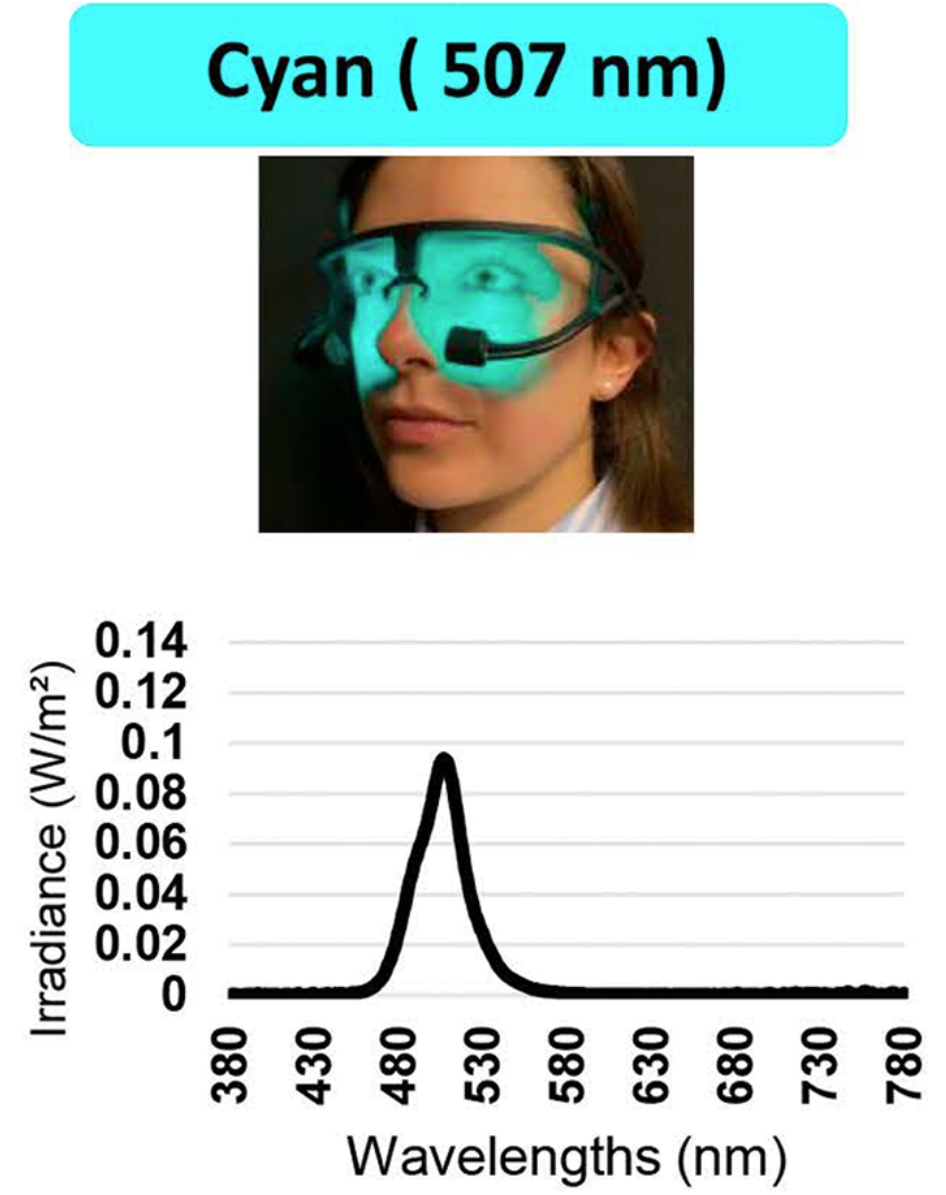
Fig 3.In the clinical trial about cyan light, On three days, participants were exposed to narrowband cyan (507 nm, 3.06 W/m2 at corneal plane) in a dark room and the ocular effects of light exposure were examined over a period of 120 min. Data from Axial length reduction and choroidal thickening with short- term exposure to cyan light in human subjects(7).
Devices for Violet and Cyan Light Therapy
Currently, there are a few devices designed for violet and cyan light therapy, although their use is still limited and experimental.
- Violet-Light Devices: A study by Mori and colleagues used violet-light-transmitting glasses, developed by Tsubota Laboratory, Inc. in collaboration with JINS HOLDINGS, Inc. These glasses allowed violet light to pass through and potentially assist in myopia control. Another device, developed by Tsubota Laboratory in collaboration with NEWOPTO CORPORATION, emits violet light directly from the eyeglass frames. While these devices have shown potential in small-scale studies, their effectiveness and safety have yet to be confirmed in larger trials, and their use should be approached with caution.
- Cyan-Light Devices: Cyan-light-emitting glasses were tested in a study by Chakraborty and colleagues. As with violet light devices, the research on cyan light therapy is still in its early stages. More comprehensive studies are needed to evaluate their long-term effectiveness.
The Bottom Line
Both violet and cyan light therapies show promise in controlling myopia progression, but more research is required to confirm their benefits and safety. At present, these therapies should be considered as part of an ongoing investigation into new treatments for myopia, and patients should consult with their eye care professionals to determine the best options for their specific needs.
References
1. Strickland R, Landis EG, Pardue MT. Short-Wavelength (Violet) Light Protects Mice From Myopia Through Cone Signaling. Investig Opthalmology Vis Sci. 2020 Feb 12;61(2):13. 2. Torii H, Kurihara T, Seko Y, Negishi K, Ohnuma K, Inaba T, et al. Violet Light Exposure Can Be a Preventive Strategy Against Myopia Progression. EBioMedicine. 2017 Feb;15:210–9. 3. Jiang X, Pardue MT, Mori K, Ikeda S ichi, Torii H, D’Souza S, et al. Violet light suppresses lens-induced myopia via neuropsin (OPN5) in mice. Proc Natl Acad Sci. 2021 Jun;118(22):e2018840118. 4. Jeong H, Lee D, Jiang X, Negishi K, Tsubota K, Kurihara T. Opsin 5 mediates violet light-induced early growth response-1 expression in the mouse retina. Sci Rep. 2023 Oct 19;13(1):17861. 5. Torii H, Mori K, Okano T, Kondo S, Yang HY, Yotsukura E, et al. Short-Term Exposure to Violet Light Emitted from Eyeglass Frames in Myopic Children: A Randomized Pilot Clinical Trial. J Clin Med. 2022 Oct 11;11(20). 6. Quint WH, Van Buuren R, Kokke NCCJ, Meester-Smoor MA, Willemsen R, Broersma R, et al. Exposure to cyan or red light inhibits the axial growth of zebrafish eyes. Exp Eye Res. 2023 May;230:109437. 7. Chakraborty R, Baranton K, Pic E, Didone J, Kim W, Lam K, et al. Axial length reduction and choroidal thickening with short-term exposure to cyan light in human subjects. Ophthalmic Physiol Opt J Br Coll Ophthalmic Opt Optom. 2024 Sep 8; 8. Mori K, Torii H, Hara Y, Hara M, Yotsukura E, Hanyuda A, et al. Effect of Violet Light-Transmitting Eyeglasses on Axial Elongation in Myopic Children: A Randomized Controlled Trial. J Clin Med. 2021 Nov 22;10(22).