- Home
- Research
- Research Centres and Laboratories
- JC STEM Lab of Innovative Light Therapy for Eye Diseases
- Myopia control
- For Clinicians
- Violet and Cyan Light Therapy for Myopia Control
Violet and Cyan Light Therapy for Myopia Control
Violet Light Therapy: Insights from animal model and clinical trials
Violet light (VL)(360-400 nm) represents another wavelength explored for myopia control, though it is less understood than red light. Initial findings suggest that exposure to blue and violet light was found to inhibit myopic shift and axial elongation in animal models. Experiments in chicken and mice myopia models found an upregulation of the myopia suppressive gene Early Growth Response-1(EGR1) with VL exposure, and VL-Induced EGR-1 Expression in the retina was mediated by Opsin 5(1–3). Another study by Strickland et al. suggested mechanism involves the modulation of biochemical pathways that influence the scleral remodeling process, potentially through changes in retinal dopamine levels(4).
Moving from animal models to human subjects, the evidence on violet light therapy's effectiveness remains intriguing yet preliminary. Retrospective analysis comparing children using VL-transmitting lenses to those with VL-blocking lenses found significantly shorter Al in the VL-transmitting groups(1).
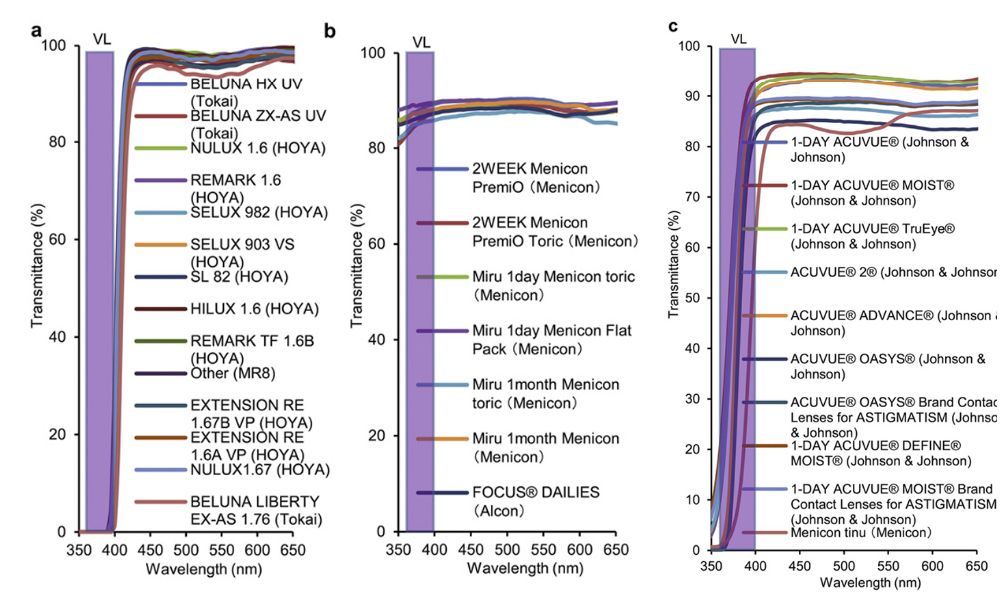
Fig 1. The schema and mechanism of the VL-emitting glasses. (a) the transmittance light spectrum of the most commonly used eyeglasses in Japan. No violet light transmittance could be detected in all lenses. (b) glasses with complete violet light transmittance. (c) glasses with partial transmittance. Image from the Paper Violet Light Exposure Can Be a Preventive Strategy Against Myopia Progression.
One particular study involved novel eyeglasses that emit VL from the frames. The VL was irradiated for 3h daily from 11 am to 2 pm. It found a subgroup of 8- to 10-year-old children showed significant changes in axial elongation, choroidal thickness, and cycloplegic refractions in favor of the VL-emitting group after 6 months, although no significant differences were observed in the overall group.(5). While violet light may have some beneficial effects, it is less potent compared to red light. Further research of VL-emitting or VL-transmitting glasses is still in progress.
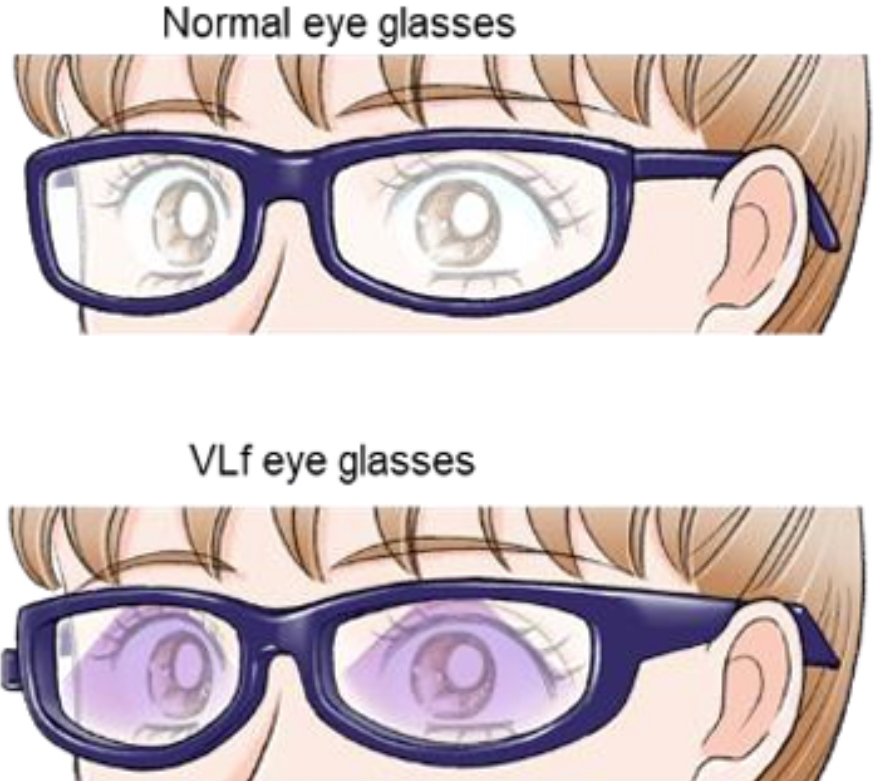
Fig 2. The schema and mechanism of the VL-emitting glasses. Image from the Paper Short-Term Exposure to Violet Light Emitted from Eyeglass Frames in Myopic Children: A Randomized Pilot Clinical Trial(5).
Cyan Light Therapy: Insights from animal model and clinical trials
Cyan light therapy, around 483 nm, has recently been studied for its potential in myopia management. In a study conducted on zebrafish to cyan light and observed significant reductions in AL by approximately -46.67 µm, suggesting potential applications in myopia control strategies. In human subjects, clinical trials have also shown encouraging results(6). One particular study involving young adults and children tested the effects of short-term exposure to cyan light through light-emitting glasses(7). Specifically, cyan light at 507 nm resulted in a significant reduction in axial length (-0.010 mm in adults and -0.016 mm in children) and an increase in choroidal thickness (+0.008 mm in adults and +0.014 mm in children) compared to white light after 120 minutes of exposure. However, the long-term effects of cyan light on eye growth and the development of myopia are still unknown and require further investigation. Despite these promising results, it's important to note that all light therapies, including cyan light, should be used with caution until more extensive safety and efficacy data are available.
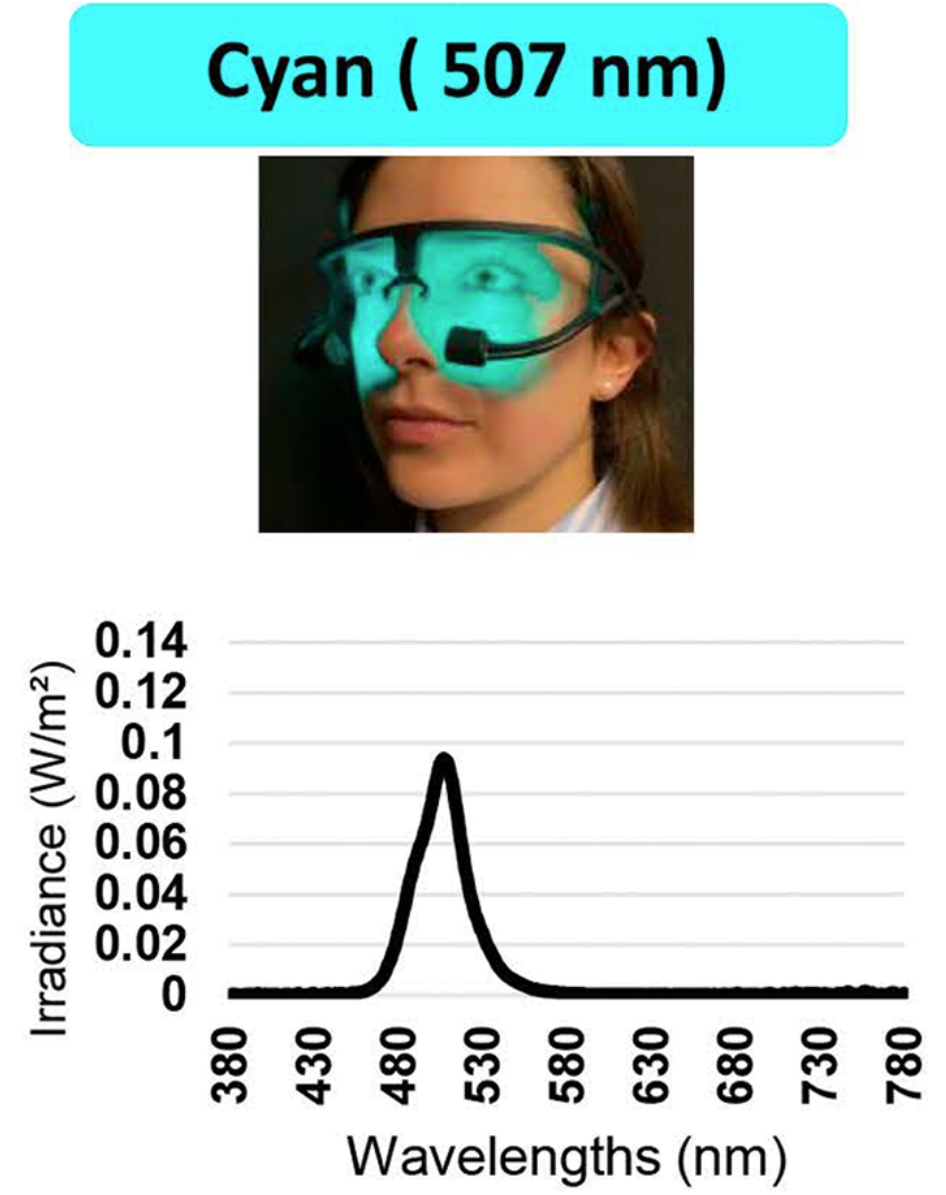
Fig 3.In the clinical trial about cyan light, On three days, participants were exposed to narrowband cyan (507 nm, 3.06 W/m2 at corneal plane) in a dark room and the ocular effects of light exposure were examined over a period of 120 min. Data from Axial length reduction and choroidal thickening with short- term exposure to cyan light in human subjects(7).
Violet and Cyan Light therapy devices
- Violet-light therapy: One of the Violet-transmitting glasses was used in the study by Mori et al(13). The Tsubota Laboratory, Inc. (Japan) in collaboration with JINS HOLDINGS, Inc (Japan) invent violet light-transmitting eyeglasses (VL glasses). They reported that this device can transmit violet light (VL), 360–400 nm in wavelength, for the suppression of myopia, and can meanwhile block harmful ultraviolet waves from sunlight (Patent No. WO2017/090128). The Violet-light-emitting glasses was only used in the study by Torri et al(5). The Tsubota Laboratory, Inc. (Japan) in collaboration with NEWOPTO CORPORATION (Japan) devised a novel device that emits VL from eyeglass frames (patent no. 6175210). The glass frame emits VL irradiance of 0.31 mW/cm2. However, the international consensus on the division of ultraviolet (UV) light is wavelengths below 400nm, and many studies suggest that the damage caused by UV light should not be overlooked. Both studies mentioned above were based on small sample size RCTs, and their effectiveness and safety require further confirmation. At present, the treatment with violet light should be approached with caution.
- Cyan-light therapy: The Cyan-light-emitting glasses was only used in the study by Chakraborty et al. The specialized device utilized in the study are innovative devices designed to expose participants' eyes to specific narrowband light conditions. These glasses are 3D-printed using Nylon 12 polymer. The glasses feature two multi-color light-emitting diode (LED) emitters, one for each eye, covered with white diffusers and positioned at the lower part of the frame approximately 4 cm in front of the eye. The glasses are powered by a USB power bank, and the desired wavelengths are controlled by a Java-based Android smartphone application connected to the device via Bluetooth, allowing for precise exposure to specific light conditions. At present, the treatment with violet light should be approached with caution.
References
1. Torii H, Kurihara T, Seko Y, Negishi K, Ohnuma K, Inaba T, et al. Violet Light Exposure Can Be a Preventive Strategy Against Myopia Progression. EBioMedicine. 2017 Feb;15:210–9.
2. Jiang X, Pardue MT, Mori K, Ikeda S ichi, Torii H, D’Souza S, et al. Violet light suppresses lens-induced myopia via neuropsin (OPN5) in mice. Proc Natl Acad Sci. 2021 Jun;118(22):e2018840118.
3. Jeong H, Lee D, Jiang X, Negishi K, Tsubota K, Kurihara T. Opsin 5 mediates violet light-induced early growth response-1 expression in the mouse retina. Sci Rep. 2023 Oct 19;13(1):17861.
4. Strickland R, Landis EG, Pardue MT. Short-Wavelength (Violet) Light Protects Mice From Myopia Through Cone Signaling. Investig Opthalmology Vis Sci. 2020 Feb 12;61(2):13.
5. Torii H, Mori K, Okano T, Kondo S, Yang HY, Yotsukura E, et al. Short-Term Exposure to Violet Light Emitted from Eyeglass Frames in Myopic Children: A Randomized Pilot Clinical Trial. J Clin Med. 2022 Oct 11;11(20).
6. Quint WH, Van Buuren R, Kokke NCCJ, Meester-Smoor MA, Willemsen R, Broersma R, et al. Exposure to cyan or red light inhibits the axial growth of zebrafish eyes. Exp Eye Res. 2023 May;230:109437.
7. Chakraborty R, Baranton K, Pic E, Didone J, Kim W, Lam K, et al. Axial length reduction and choroidal thickening with short-term exposure to cyan light in human subjects. Ophthalmic Physiol Opt J Br Coll Ophthalmic Opt Optom. 2024 Sep 8.