- Home
- Research
- Research Centres and Laboratories
- JC STEM Lab of Innovative Light Therapy for Eye Diseases
- Myopia control
- For Clinicians
- Research on Pre-Myopia, High Myopia, and Combination Therapy
Research on Pre-Myopia, High Myopia, and Combination Therapy
Three crucial areas of research are the use of RLRL in pre-myopia, high myopia, and the adjunct use of RLRL with other myopia control treatments. Recent findings from three RCTs published in the journal Ophthalmology and JAMA Network Open highlight advancements in these areas.
A 12-month, school-based, randomized-controlled trial in Shanghai evaluated the efficacy and safety of RLRL therapy in preventing myopia onset in pre-myopic children aged 6 to 11 years. RLRL treatment showed substantial relative reduction in myopia incidence of 33.4% over a span of 12 months(16). More appealing, for children in the intervention group who did not have treatment interruption secondary to the COVID-19 pandemic, up to 54.1% reduction in myopia incidence within 12 months was observed, indicating RLRL is a novel and effective intervention for myopia prevention.
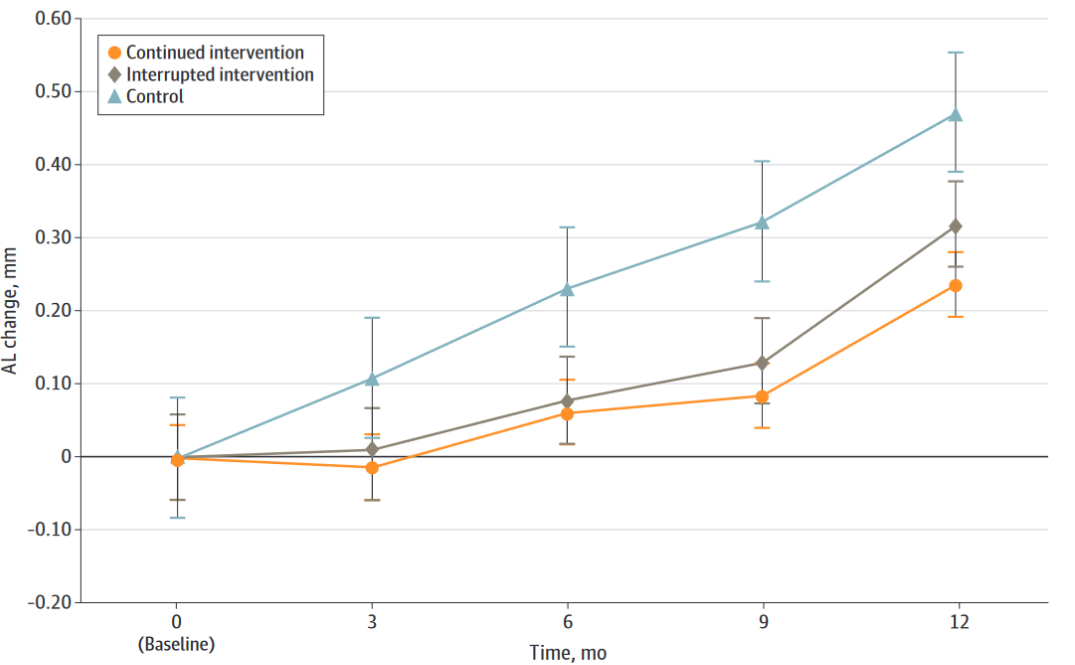
Fig 2. Axial length (AL) change between the intervention and control groups over 12 months in high myopic children. Data from the paper Effect of Repeated Low-level Red Light on Myopia Prevention Among Children in China With Pre-myopia: A Randomized Clinical Trial(17).
For high myopic children and adolescents, RLRL therapy also demonstrates a stronger treatment efficacy. The 12-month RCT evaluated the effectiveness of RLRL therapy in 192 highly myopic children, with a Spherical Equivalent Refraction (SER) of at least -4D across six tertiary hospitals in China(17). The children, aged 6 to 16, in the RLRL group saw an average axial length reduction of -0.06 mm, with over half experiencing a reduction greater than 0.05 mm. In contrast, the control group exhibited an average axial elongation of 0.34 mm. After 12 months, the mean SER improvement in the RLRL group was 0.11D compared to -0.75D in the control group, with a median treatment compliance rate of 84%. The study found RLRL to be significantly effective in treating high myopia without any adverse effects. Besides, over half of the treated group (53.3%) experiencing axial shortening of more than 0.05mm at the 12-month follow-up, providing an excellent solution for the management of high myopia progression.
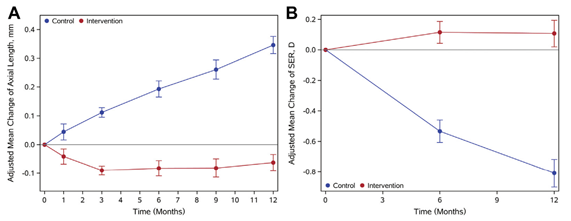
Fig 3. Axial length (AL) elongation and spherical equivalent myopic shifts over 12 months between the intervention (RLRL) and control (SVS) groups in high myopic children. Data from the paper Repeated Low-Level Red Light Therapy for Myopia Control in High Myopia Children and Adolescents: A Randomized Clinical Trial(17).
Finally, for the combination with orthokeratology, a 12-month RCT investigated the efficacy of combined use in 48 children aged 8 to 13, who had shown axial elongation of at least 0.50 mm over the previous year despite orthokeratology (Ortho-k) treatment alone(18). Results indicated that after 12 months, the combined group (RCO) experienced an average axial length change of -0.02mm, compared to 0.27mm in the Ortho-k only group. The trial documented progressive axial length reduction in the RCO group, with a 14.2% increase in choroidal thickness, while the OK group showed choroidal thinning. The results suggest that RLRL therapy in combination with Ortho-k may offer a promising approach to optimizing axial elongation control in myopic children. It may also enable children to achieve satisfactory visual acuity and reduce reliance on corrective spectacles during the day.
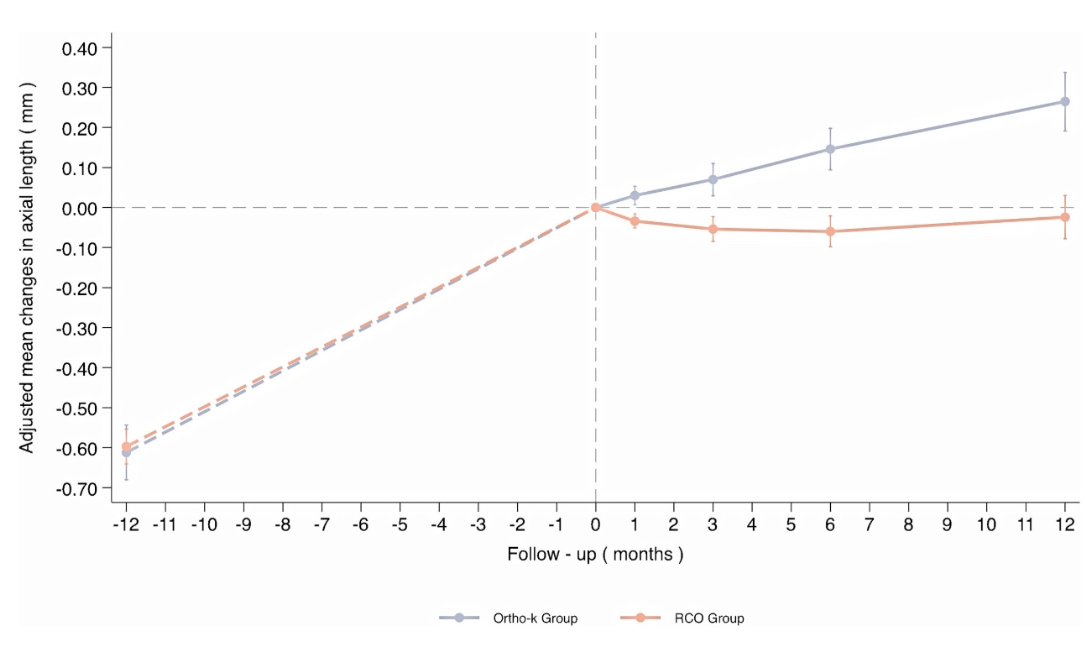
Fig 4. Adjusted mean changes in axial length (AL) at each time point in the repeated low-level red-light therapy combined with orthokeratology (RCO) group and the orthokeratology group. Data from the paperMyopia Control Effect of Repeated Low-Level Red-Light Therapy Combined with Orthokeratology: A Multicenter Randomized Controlled Trial(18).
Reference:
16. He X, Wang J, Zhu Z, Xiang K, Zhang X, Zhang B, et al. Effect of Repeated Low-level Red Light on Myopia Prevention Among Children in China With Premyopia: A Randomized Clinical Trial. JAMA Netw Open. 2023 Apr 26;6(4):e239612.
17. Xu Y, Cui L, Kong M, Li Q, Feng X, Feng K, et al. Repeated Low-Level Red Light Therapy for Myopia Control in High Myopia Children and Adolescents. Ophthalmology. 2024 Jun;S016164202400318X.
18. Xiong R, Wang W, Tang X, He M, Hu Y, Zhang J, et al. Myopia Control Effect of Repeated Low-Level Red-Light Therapy Combined with Orthokeratology. Ophthalmology. 2024 May;S0161642024003087.