- Home
- Research
- Research Centres and Laboratories
- JC STEM Lab of Innovative Light Therapy for Eye Diseases
- Myopia control
- For Clinicians
- Full-Spectrum Light therapy: does it have similar effect as natural sunlight?
Full-Spectrum Light therapy: does it have similar effect as natural sunlight?
Full-spectrum light therapy, which includes a wide range of the electromagnetic spectrum much like natural sunlight, is increasingly being examined for its potential in controlling myopia. This therapy's premise is based on the hypothesis that exposure to a broad range of wavelengths in full-spectrum light can effectively slow down both the incidence and progression of myopia in children.
For clinical studies, sunlight exposure (including increasing the time and light-intensity outdoors) has been consistently linked with lower rates of myopia in various epidemiological studies(8,9). This has led to curiosity about whether increasing indoor light intensity could achieve similar effects in myopia control. To explore this, a study was conducted in rural China involving 317 students aged 6 to 14 from four schools. Children in the intervention group had rebuilt elevated lighting systems (440–558 lux) in their classrooms(10). After one year, the intervention group had a lower incidence of new myopia onset (4% vs 10%), less decrease in refractive error among non-myopic subjects, and slower axial length growth in both non-myopic and myopic subjects compared to the control group. However, the idea that enhancing indoor lighting could mirror the positive effects of sunlight in preventing myopia should be approached with caution. This is because outdoor light conditions are inherently more intense, ranging from 1000 to 150,000 lux, and present a more uniform dioptric demand compared to indoor environments(11). Moreover, natural outdoor light, which is full-spectrum, also emits a higher amount of short-wavelength radiation than most artificial lighting used indoors. Current research on full-spectrum does not yet provide conclusive evidence on their efficacy in myopia control. Therefore, further investigation is needed to understand the interaction between light's spectral composition, intensity and their potential role in myopia control.
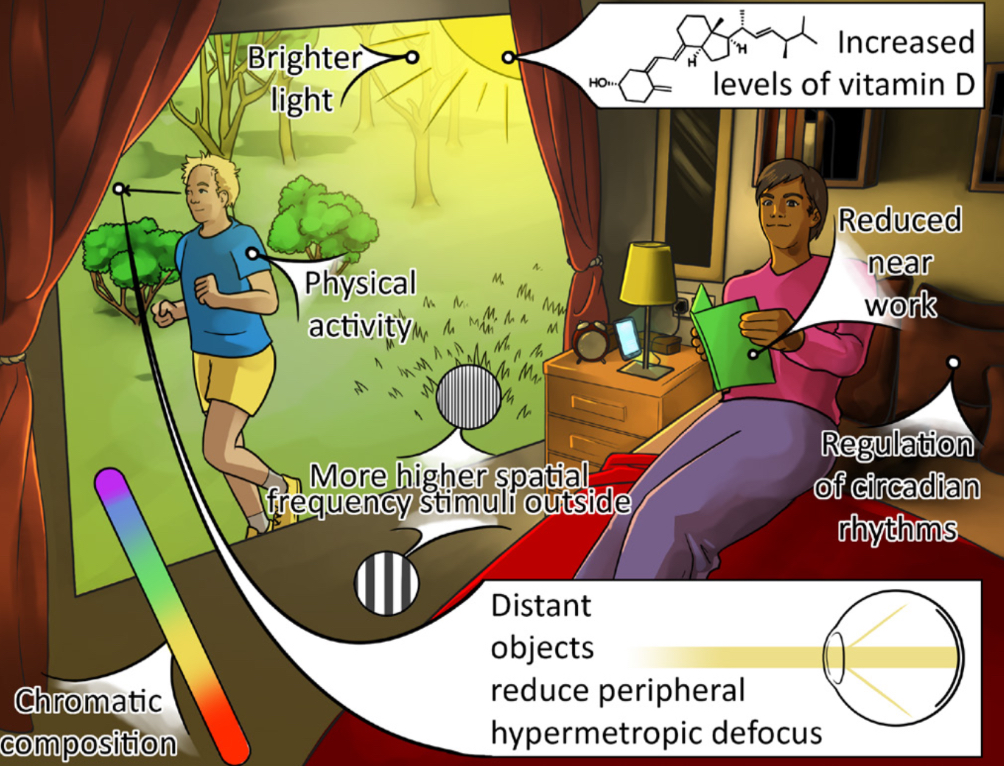
Fig 4. Spending more time outdoors may reduce risk of myopia via multiple means. Image from the Paper How does spending time outdoors protect against myopia? A review(12).
The Future of Light Therapy
Light therapy offers a promising avenue for myopia control. Red light shows the most significant evidence of efficacy, followed by emerging data supporting the benefits of full-spectrum light. Violet light and cyan light, while less effective, still contributes to the spectrum of light-based interventions available for managing myopia. Continued research and large-scale randomized controlled trials are necessary to further elucidate the mechanisms, optimize treatment protocols, and establish long-term safety and efficacy profiles for each type of light therapy. This holistic approach could potentially transform the management strategies for myopia, providing non-invasive, accessible, and effective treatment options for millions affected worldwide.
References
8. He M, Xiang F, Zeng Y, Mai J, Chen Q, Zhang J, et al. Effect of Time Spent Outdoors at School on the Development of Myopia Among Children in China: A Randomized Clinical Trial. JAMA. 2015 Sep 15;314(11):1142.
9. He X, Sankaridurg P, Wang J, Chen J, Naduvilath T, He M, et al. Time Outdoors in Reducing Myopia. Ophthalmology. 2022 Nov;129(11):1245–54.
10. Hua W, Jin J, Wu X, Yang J, Jiang X, Gao G, et al. Elevated light levels in schools have a protective effect on myopia. Ophthalmic Physiol Opt. 2015 May;35(3):252–62.
11. Zaabaar E, Zhang XJ, Zhang Y, Bui CHT, Tang FY, Kam KW, et al. Light exposure therapy for myopia control: a systematic review and Bayesian network meta-analysis. Br J Ophthalmol. 2024 Aug;108(8):1053–9.
12. Lingham G, Mackey DA, Lucas R, Yazar S. How does spending time outdoors protect against myopia? A review. Br J Ophthalmol. 2020 May;104(5):593–9.
13. Mori K, Torii H, Hara Y, Hara M, Yotsukura E, Hanyuda A, et al. Effect of Violet Light-Transmitting Eyeglasses on Axial Elongation in Myopic Children: A Randomized Controlled Trial. J Clin Med. 2021 Nov 22;10(22).