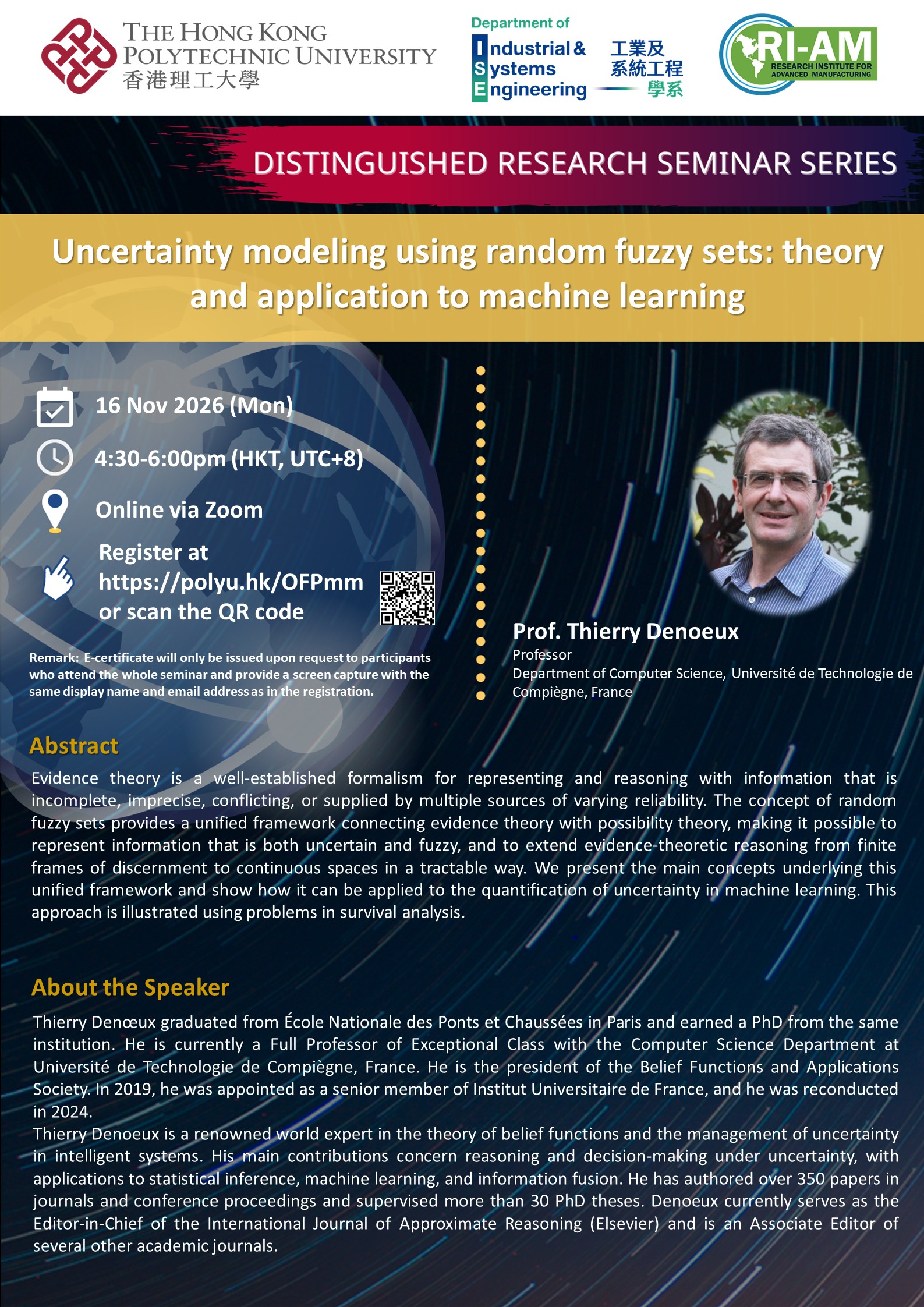
Uncertainty modeling using random fuzzy sets: theory and application to machine learning
Distinguished Research Seminar Series

-
Date
16 Nov 2026
-
Organiser
Department of Industrial and Systems Engineering, PolyU
-
Time
16:30 - 18:00
-
Venue
Online via ZOOM
Speaker
Prof. Thierry Denœux
Remarks
Meeting link will be sent to successful registrants. If you have enquiries regarding E-certificate after the seminar, please contact david.kuo@polyu.edu.hk.
Summary
Evidence theory is a well-established formalism for representing and reasoning with information that is incomplete, imprecise, conflicting, or supplied by multiple sources of varying reliability. The concept of random fuzzy sets provides a unified framework connecting evidence theory with possibility theory, making it possible to represent information that is both uncertain and fuzzy, and to extend evidence-theoretic reasoning from finite frames of discernment to continuous spaces in a tractable way. We present the main concepts underlying this unified framework and show how it can be applied to the quantification of uncertainty in machine learning. This approach is illustrated using problems in survival analysis.
Keynote Speaker

Prof. Thierry Denœux
Professor
Department of Computer Science, Université de Technologie de Compiègne, France
Thierry Denœux graduated from École Nationale des Ponts et Chaussées in Paris and earned a PhD from the same institution. He is currently a Full Professor of Exceptional Class with the Computer Science Department at Université de Technologie de Compiègne, France. He is the president of the Belief Functions and Applications Society. In 2019, he was appointed as a senior member of Institut Universitaire de France, and he was reconducted in 2024. Thierry Denoeux is a renowned world expert in the theory of belief functions and the management of uncertainty in intelligent systems. His main contributions concern reasoning and decision-making under uncertainty, with applications to statistical inference, machine learning, and information fusion. He has authored over 350 papers in journals and conference proceedings and supervised more than 30 PhD theses. Denoeux currently serves as the Editor-in-Chief of the International Journal of Approximate Reasoning (Elsevier) and is an Associate Editor of several other academic journals.
You may also like