AI-Assisted Thematic Analysis of Transcripts with Multi-Stakeholder Triangulation
Distinguished Research Seminar Series

-
Date
22 Jul 2026
-
Organiser
Department of Industrial and Systems Engineering, PolyU
-
Time
17:00 - 18:00
-
Venue
DE402
Speaker
Prof. Abdullah Konak
Remarks
If you have enquiries regarding E-certificate after the seminar, please contact david.kuo@polyu.edu.hk.
Summary
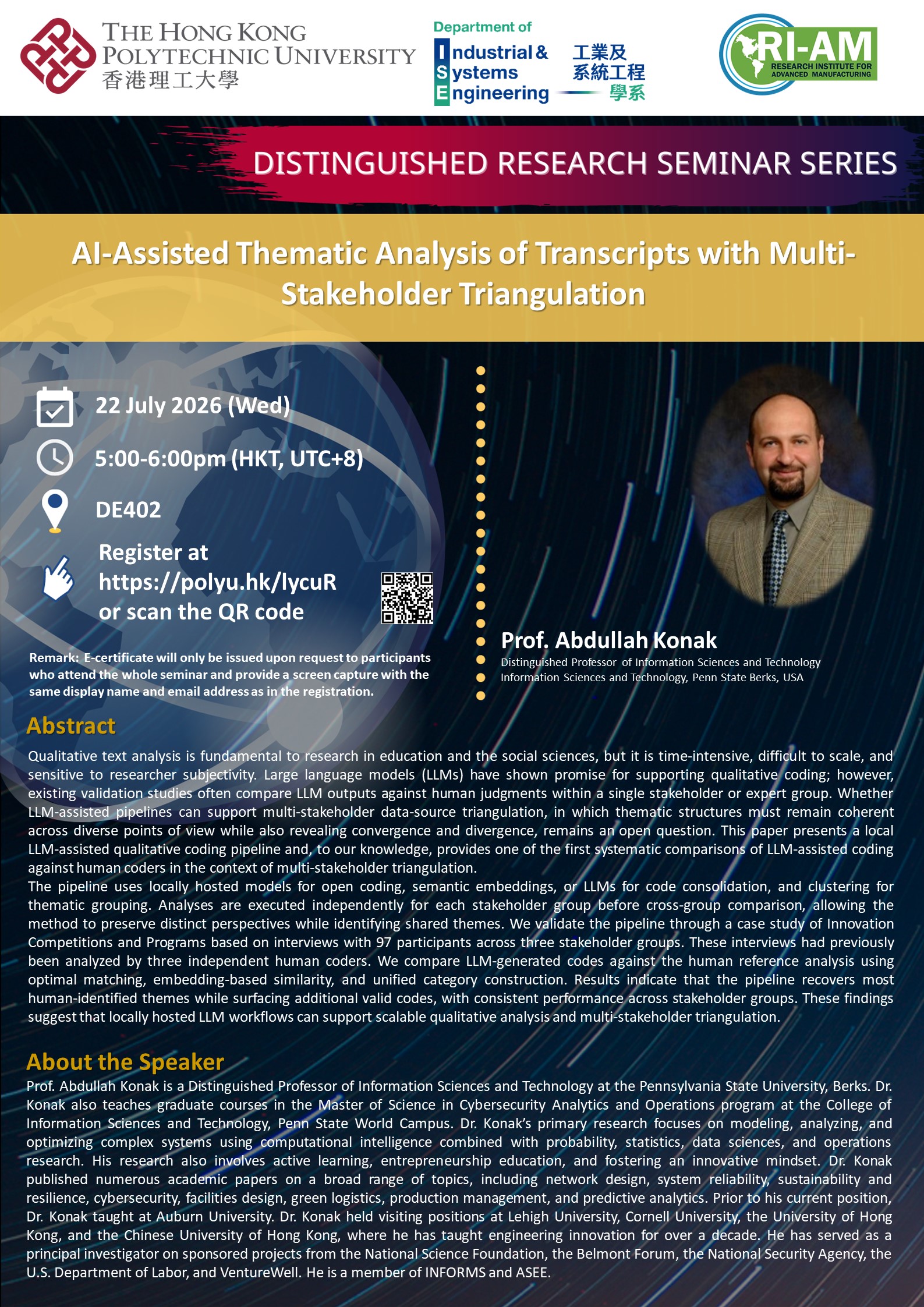
Qualitative text analysis is fundamental to research in education and the social sciences, but it is time-intensive, difficult to scale, and sensitive to researcher subjectivity. Large language models (LLMs) have shown promise for supporting qualitative coding; however, existing validation studies often compare LLM outputs against human judgments within a single stakeholder or expert group. Whether LLM-assisted pipelines can support multi-stakeholder data-source triangulation, in which thematic structures must remain coherent across diverse points of view while also revealing convergence and divergence, remains an open question. This paper presents a local LLM-assisted qualitative coding pipeline and, to our knowledge, provides one of the first systematic comparisons of LLM-assisted coding against human coders in the context of multi-stakeholder triangulation.
The pipeline uses locally hosted models for open coding, semantic embeddings, or LLMs for code consolidation, and clustering for thematic grouping. Analyses are executed independently for each stakeholder group before cross-group comparison, allowing the method to preserve distinct perspectives while identifying shared themes. We validate the pipeline through a case study of Innovation Competitions and Programs based on interviews with 97 participants across three stakeholder groups. These interviews had previously been analyzed by three independent human coders. We compare LLM-generated codes against the human reference analysis using optimal matching, embedding-based similarity, and unified category construction. Results indicate that the pipeline recovers most human-identified themes while surfacing additional valid codes, with consistent performance across stakeholder groups. These findings suggest that locally hosted LLM workflows can support scalable qualitative analysis and multi-stakeholder triangulation.
Keynote Speaker

Prof. Abdullah Konak
Distinguished Professor of Information Sciences and Technology
Information Sciences and Technology, Penn State Berks, USA
Dr. Abdullah Konak is a Distinguished Professor of Information Sciences and Technology at the Pennsylvania State University, Berks. Dr. Konak also teaches graduate courses in the Master of Science in Cybersecurity Analytics and Operations program at the College of Information Sciences and Technology, Penn State World Campus. Dr. Konak’s primary research focuses on modeling, analyzing, and optimizing complex systems using computational intelligence combined with probability, statistics, data sciences, and operations research. His research also involves active learning, entrepreneurship education, and fostering an innovative mindset. Dr. Konak published numerous academic papers on a broad range of topics, including network design, system reliability, sustainability and resilience, cybersecurity, facilities design, green logistics, production management, and predictive analytics. Prior to his current position, Dr. Konak taught at Auburn University. Dr. Konak held visiting positions at Lehigh University, Cornell University, the University of Hong Kong, and the Chinese University of Hong Kong, where he has taught engineering innovation for over a decade. He has served as a principal investigator on sponsored projects from the National Science Foundation, the Belmont Forum, the National Security Agency, the U.S. Department of Labor, and VentureWell. He is a member of INFORMS and ASEE.
You may also like