Stepping into Safety: How Immersive VR Can Help Prevent Falls in Older Adults
Other Articles

VR Training Improves Cognitive-Motor Performance and Gains Strong User Acceptance Among Older Adults
Study conducted by Prof. Kenneth Nai Kuen FONG  and his research team
Virtual reality is moving steadily beyond entertainment and into the mainstream, including in healthcare. Over the past decade, clinicians and researchers have explored how immersive digital environments can support rehabilitation, pain management, mental health interventions and physical training. In ageing care, VR is attracting particular interest because it can create safe, controllable and engaging environments in which older adults can practise everyday tasks without facing the real-world consequences of a mistake. That matters especially in fall prevention, where both physical and cognitive factors play a role.
This is highly relevant for older adults with mild cognitive impairment (MCI), a group known to face elevated fall risk. Changes in attention, executive function and judgement can make walking in complex environments more hazardous, while fear of falling can further reduce confidence and mobility.
Against this backdrop, Prof. Kenneth Nai Kuen FONG, Associate Head (Research, Innovation and Knowledge Transfer) and Professor of the Department of Rehabilitation Sciences at The Hong Kong Polytechnic University (PolyU), and his research team, in collaboration with the University of Southern Queensland, have explored whether a fully immersive VR training programme could provide a meaningful new approach to fall prevention. The first study is published in Sensor [1]. Their work not only examines whether VR could improve fall-related outcomes, but also whether older adults would actually accept and engage with the technology, which is an essential consideration for real-world adoption in smart ageing services.
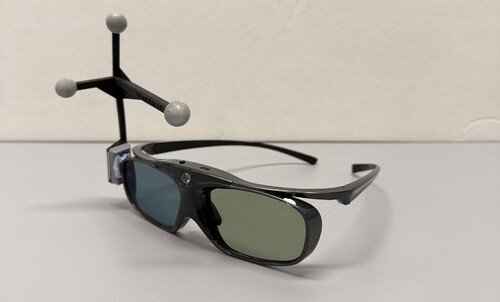
Figure 1. 3D stereoscopic glasses for the VirCube VR application
At the centre of the project was a full-immersive Cave Automatic Virtual Environment, or VR CAVE, using the VirCube VR for Rehab programme. Unlike conventional head-mounted VR systems, the CAVE setup is designed as a room-scale immersive environment in which users wear 3D stereoscopic glasses rather than a headset (Figure 1). This age-friendly design is vital for older users, as it may reduce discomfort, dizziness and simulator sickness often associated with head-mounted displays. Motion sensing and interactive game modules allow participants to move through simulated scenarios while receiving close supervision from trained staff.
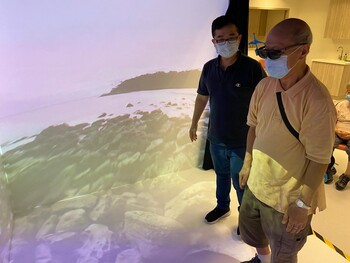
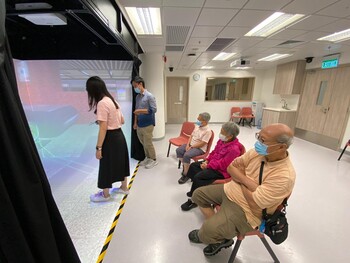
Figure 2. Participants in a supervised training session
The PolyU fall prevention programme was developed as a cognitive-motor intervention for older adults at risk of falls, particularly those with MCI. The VR modules included outdoor walking, balance activities, fire emergency handling and daily community practice (Figure 2). These were not simple games for entertainment; they were designed to require dual-task performance, combining movement with attention, judgement and executive functioning. Participants in the intervention group attended two sessions per week, completing 16 sessions over eight weeks. Each session lasted around 45 minutes and included three to four modules, with breaks between activities to avoid fatigue.
The first study examined whether this training could reduce risk factors for falls among older adults with MCI in Hong Kong. Fifty-five eligible participants were assigned either to the VR group or to a control group receiving non-VR falls prevention support in community aged care settings. Outcomes were measured at baseline, post-intervention and three-month follow-up. The primary outcome was the number of falls post-programme, while secondary outcomes included cognition, executive function, balance, walking performance, functional mobility and fear of falling.
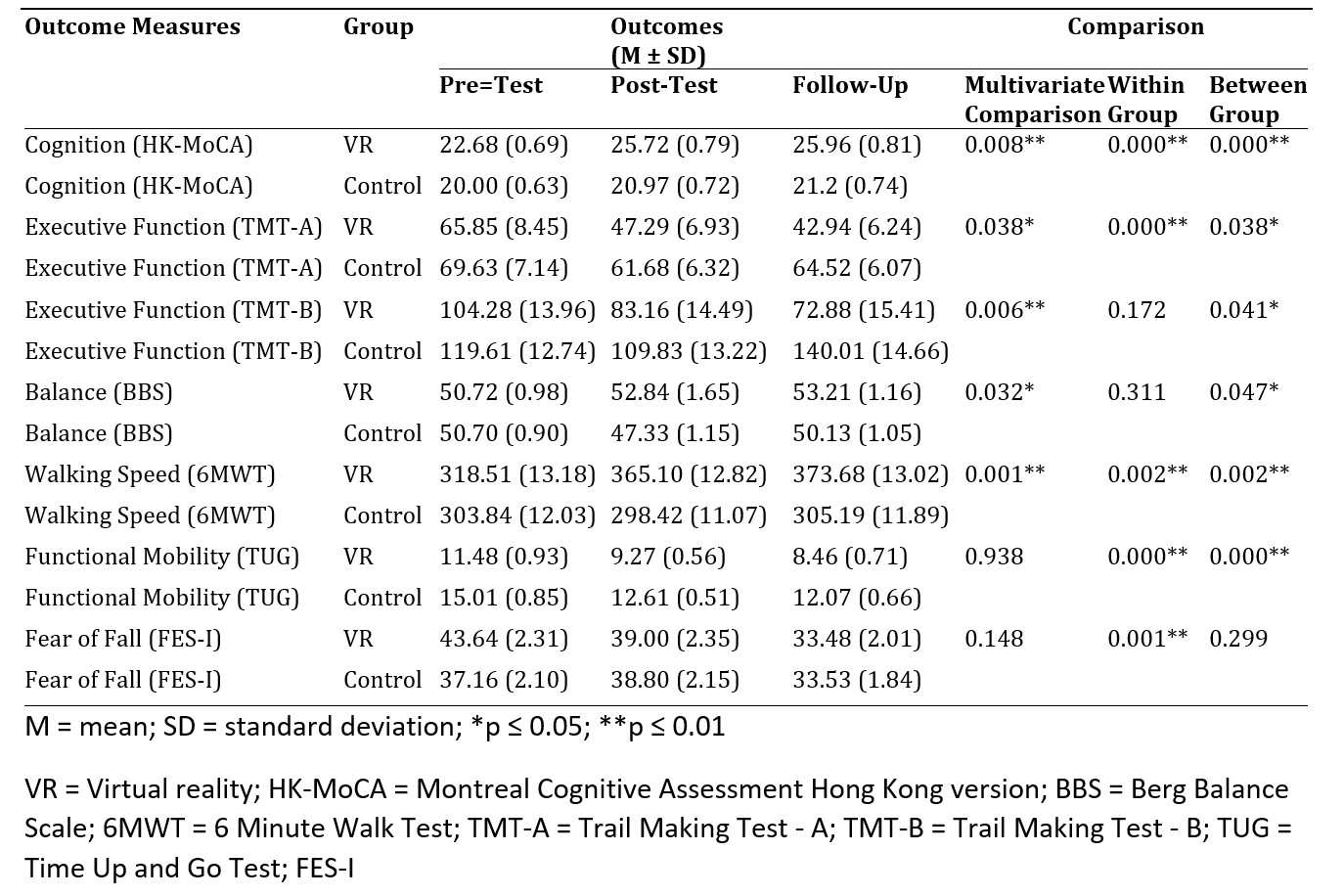
Table 1. Comparison of outcome measures between and within groups
The findings are encouraging (Table 1). Most notably, the VR group showed significantly greater improvement than the control group in several cognitive-motor measures across time. Cognitive performance, measured by the Hong Kong Montreal Cognitive Assessment (HK-MoCA), improved more strongly in the VR group. Executive function, assessed by Trail Making Tests A and B (TMT-A & B), also showed favourable changes, suggesting that immersive dual-task training may help stimulate the kinds of higher-order functions linked to safer navigation and movement in daily life. This is a crucial point for smart ageing professionals, because it reinforces the idea that fall prevention is not only about muscle strength or balance drills, but also cognition matters.
Physical performance measures also pointed in a positive direction. Participants in the VR group showed significantly greater gains in balance, as measured on the Berg Balance Scale (BBS), and in walking endurance and speed, measured by a six-minute walk test (6 MWT). These improvements suggest that immersive VR can support meaningful functional training rather than only serving as a motivational add-on. In practical terms, the programme appears to have helped participants practise safer movement in a stimulating environment that integrates both physical and cognitive demands. The primary outcome adds another layer of promise. Post-study, the VR group recorded two fall incidents, compared with five in the control group.
The second study, published in Virtual Reality [2], compared the effects of full-immersive VR training with group-based exercise (Baduanjin) training on falls prevention for 18 older adults with MCI and a history of falls in the past two years. Both groups participated in 16 falls prevention training sessions over eight weeks. The VR group showed significantly greater improvement than the non-VR group on measures of cognitive-motor performance, such as global cognition, functional mobility, balance and walk speed over time. However, no significant differences were observed between the two groups in executive functions and fall efficacy.
Although these two feasibility studies were not powered to make definitive claims about fall reduction itself, the direction of the results is clinically relevant. For professionals working in rehabilitation, community care and age-tech innovation, even a suggestion of a reduction in the number of falls is worthy of attention, given the enormous health, social and economic consequences of falls in later life.
Fall efficacy showed less consistent differences between groups, and fear of falling remained relatively high despite some improvement. This may reflect the complexity of fear-related outcomes, which are shaped not only by physical capability but also by past experiences, confidence, social restrictions and living environments. Even so, the overall pattern is noteworthy: immersive VR training appears to have delivered stronger gains in the areas most closely tied to cognitive-motor performance.
This study is significant not simply because it reports positive outcomes, but also because it illustrates how an emerging technology can be translated into a practical programme for older adults. The intervention protocol was structured, supervised and feasible, with participants attending repeated sessions and engaging with a demanding but manageable format. This matters for industry and service providers considering implementation. A smart ageing technology is only useful if it can be integrated into workflows, adapted for older users and sustained over time.
There is also a broader strategic implication. Falls prevention services were heavily disrupted during the pandemic, exposing the fragility of traditional face-to-face delivery models. In this context, technologies such as VR offer not just novelty, but resilience. Immersive platforms can diversify intervention options, enrich therapist-led programmes and potentially support more personalised and engaging rehabilitation pathways. This work therefore contributes to a larger conversation about how digital and sensing technologies can strengthen aged care systems.
The team's third study, published in Human Behavior and Emerging Technologies [3], addressed the adoption question directly by examining usability and acceptance of the same VR CAVE programme among older adults in Hong Kong. Thirty-one participants completed 16 training sessions (Figure 3) and were assessed using a VR usability questionnaire based on the Technology Acceptance Model.
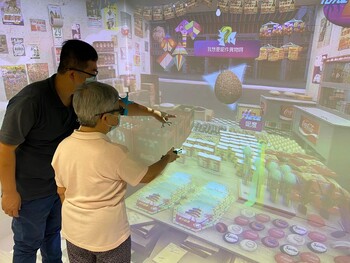
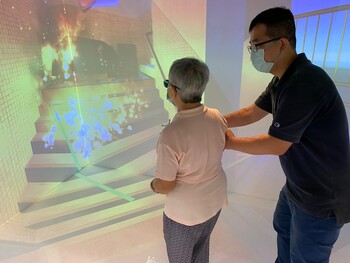
Figure 3. Participants engaging in the VR game activities
The results showed significant positive changes over time in perceived usefulness, perceived enjoyment, user experience and intention to use. In other words, participants not only completed the programme but also increasingly viewed it as worthwhile, engaging and something they would consider using in future. Perceived ease of use and social norms were less consistent, which is unsurprising for a relatively unfamiliar and technically supported system introduced during the socially restrictive conditions of COVID-19. Even so, the overall trend was positive. Participants also showed significant improvements in balance, walking speed, functional mobility and fear of falling within the single-arm study. For smart ageing stakeholders, this is a crucial message: acceptance cannot be assumed, but when the design is age-friendly and support is built in, older users may be far more open to immersive technology than commonly believed.
The study makes a compelling case for the role of immersive VR in future smart ageing practice. First, the team suggests that full-immersive VR CAVE training can function as more than an attention-grabbing interface. It may support measurable improvements in cognition, executive function, balance and walking performance among older adults with MCI. Second, they show that older participants can find the technology useful, enjoyable and worth continuing. This combination of clinical promise and user acceptance is exactly what the field needs if innovation is to move beyond pilots and into service models.
VR will not replace human care, nor should it, but as populations age and demand for preventive, engaging and scalable interventions continues to rise, immersive technologies may become a major part of the ageing care toolkit. The study offers an early but persuasive glimpse of that future. One in which older adults can step into a virtual world not to escape reality but to move through it more safely.
Prof. Fong was recognised by Stanford University as one of the top 2% most-cited scientists worldwide (single-year) in the field of rehabilitation for two consecutive years, from 2024 to 2025. He was also ranked world no. 1 in upper limb (prior five years) by ScholarGPS in 2025 and received the Hong Kong ICT Award’s Smart People (Smart Ageing) Certificate of Merit in 2023. Prof. Fong has led his teams to win numerous awards for the design of assistive technology products, including a prestigious Innovation Award at the Consumer Electronics Show 2026 in Las Vegas, a Bronze Medal at the 3rd Asia Exhibition of Innovations and Inventions Hong Kong in 2023, a Silver Prize in Social & Community Engagement and the Social Capital Builder Logo Award at the 2nd Smart Ageing Award 2022 as a team member, and the Best Dementia Care Programme award at the 10th Asia Pacific Eldercare Innovation Award 2022.
| References |
|---|
[1] Ip, W. K., Soar, J., Fong, K., Wang, S.-Y., James, C. An exploratory study on virtual reality technology for fall prevention in older adults with Mild Cognitive Impairment. Sensors 2025, 25, 3123. https://doi.org/10.3390/s25103123
[2] Ip, W. K., Soar, J., James, C., Wang, S., Fong, K. N. K. Virtual reality game-based training for preventing falls among community-dwelling older adults with Mild Cognitive Impairment: A pilot randomized control trial study. Virtual Reality 2025. https://doi.org/10.1007/s10055-024-01084-y
[3] Ip, W. K., Soar, J., James, C., Wang, Z., Fong, K. N. K., Innovative virtual reality (VR) application for preventing of falls among Chinese older adults: A usability and acceptance exploratory study, Human Behavior and Emerging Technologies, 2024, 5556767, 11 pages, 2024. https://doi.org/10.1155/2024/5556767
 | Prof. Kenneth Nai Kuen FONG Associate Head (Research, Innovation and Knowledge Transfer) and Professor, |