Redefining Effective Stress Measurement
Other Articles

Novel Transducers Enabling Direct Monitoring of Effective Stress of Saturated Soils Across Various Geotechnical Scenarios
Study conducted by Ir Prof. Jian-hua YIN  and his research team
Karl von Terzaghi, the "father" of soil mechanics and modern geotechnical engineering, first introduced the principle of effective stress in 1925. This fundamental concept has since become the cornerstone of geotechnical engineering. Effective stress, determined as the stress borne by a soil particle skeleton, is recognised as the most important field variable, directly governing deformation, strength and stability of soils. Accurate determination of effective stress plays a vital role in safety and stability assessments in geotechnical structures.
In the past, the effective stress was commonly considered "unmeasurable" and was obtained using an indirect approach, whereby total earth pressure and pore-water pressure are measured separately using an earth pressure cell (EPC) and a pore-water pressure transducer (PPT), respectively. The effective stress is then obtained indirectly by subtracting pore-water pressure from the total earth pressure. However, certain deviations might exist between indirectly measured results and true values due to different reaction times and responses for PPT and EPC.
Based on fibre Bragg grating (FBG) sensing technology, Ir Prof. Jian-hua YIN, Emeritus Professor (Soil Mechanics) of the Department of Civil and Environmental Engineering at The Hong Kong Polytechnic University, and his team invented the first effective stress cell (ESC) in the world, making a significant contribution to the direct measurement of effective stress [1, 2].
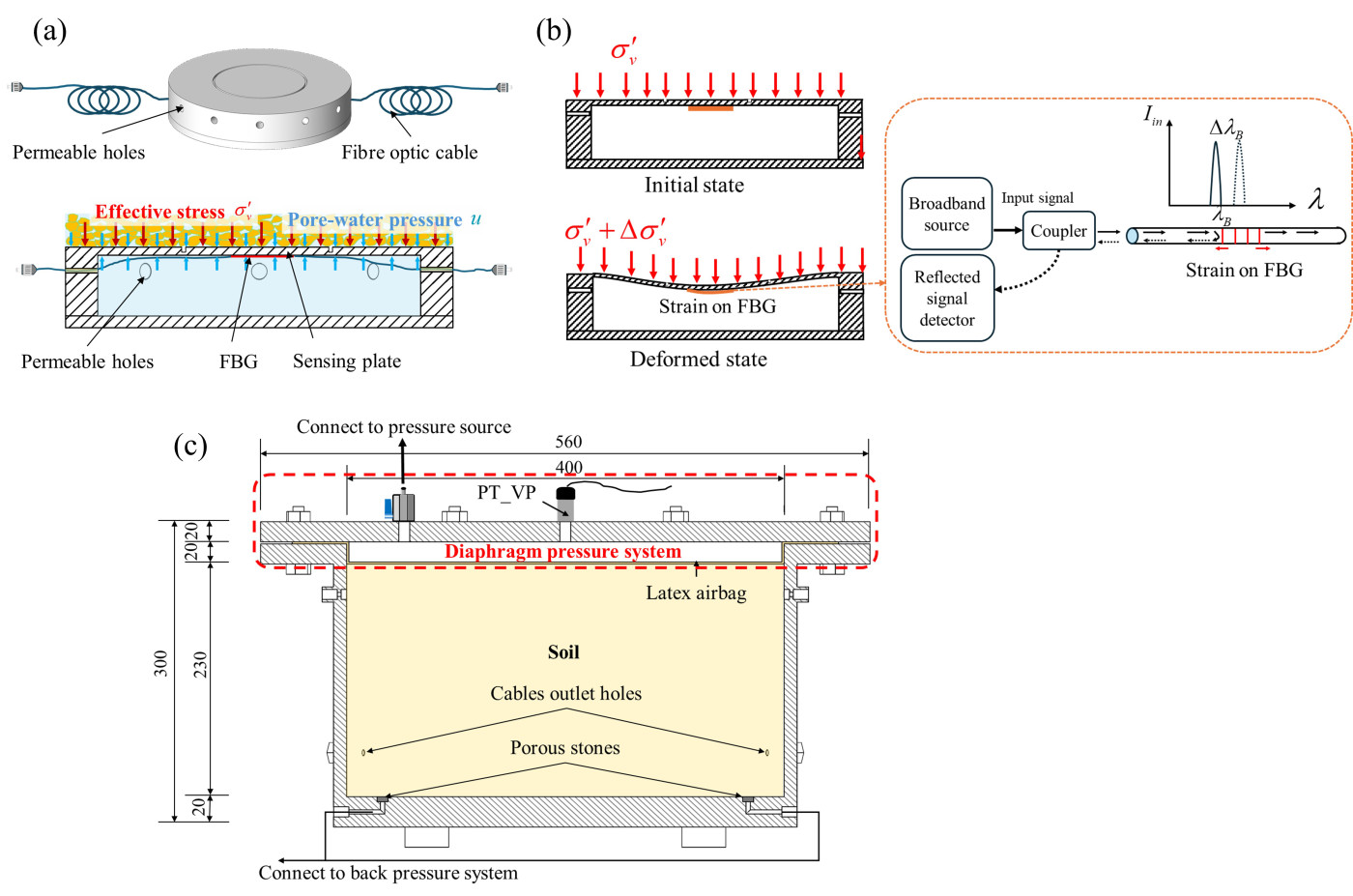
Figure 1.(a) Design of ESC, (b) working principles of ESC, and (c) schematic diagram of novel calibration chamber for ESC calibration
Figure 1 illustrates the design and working principle of the novel ESC. It features a circular sensing plate supported by a rim with permeable holes, to the back surface of which an FBG sensor is attached, and a base plate that encloses the entire cell. Like EPCs, the ESCs experience earth pressure on the front surface of the sensing plate when placed in saturated soil. What makes the ESCs distinct from EPCs is that water can enter the cell through the permeable holes and counteract the water pressure acting on the front surface of the sensing plate, resulting in the sensing plate deforming solely in response to effective stress. Based on thin plate theory [3], the action of effective stress on the sensing plate can be converted to radial strain, which can then be detected by the change in optical signal (e.g., Bragg wavelength) of the FBG sensor. Prof. Yin and his team derived the theoretical relationship between the change in effective stress  and the shift in Bragg wavelength
  [1].
[1].
To ensure that ESCs can accurately measure the effective stress, reliable correlation between the effective stress acting on the ESCs and the shift in Bragg wavelength detected by FBG sensors needs to be obtained by conducting calibration tests. Although conventional calibration tests on pressure-related transducers are commonly conducted in liquid media, the calibration results against liquid pressure should not be applied to ESCs intended for use in soil. On the other hand, the effect of boundary conditions has often been overlooked, particularly for effective stress measurement for different geotechnical applications.
Depending on the purpose, the ESCs can be either mounted to a surface of structure to measure the effective stress at the soil-structure interfaces or placed within the soil to monitor the effective stress at specific locations. Due to the difference in stiffness among transducers, soils and structures, the effective stress distribution varies at different boundary conditions. It is, therefore, anticipated that the calibration factors of the ESCs would also differ based on the boundary conditions.
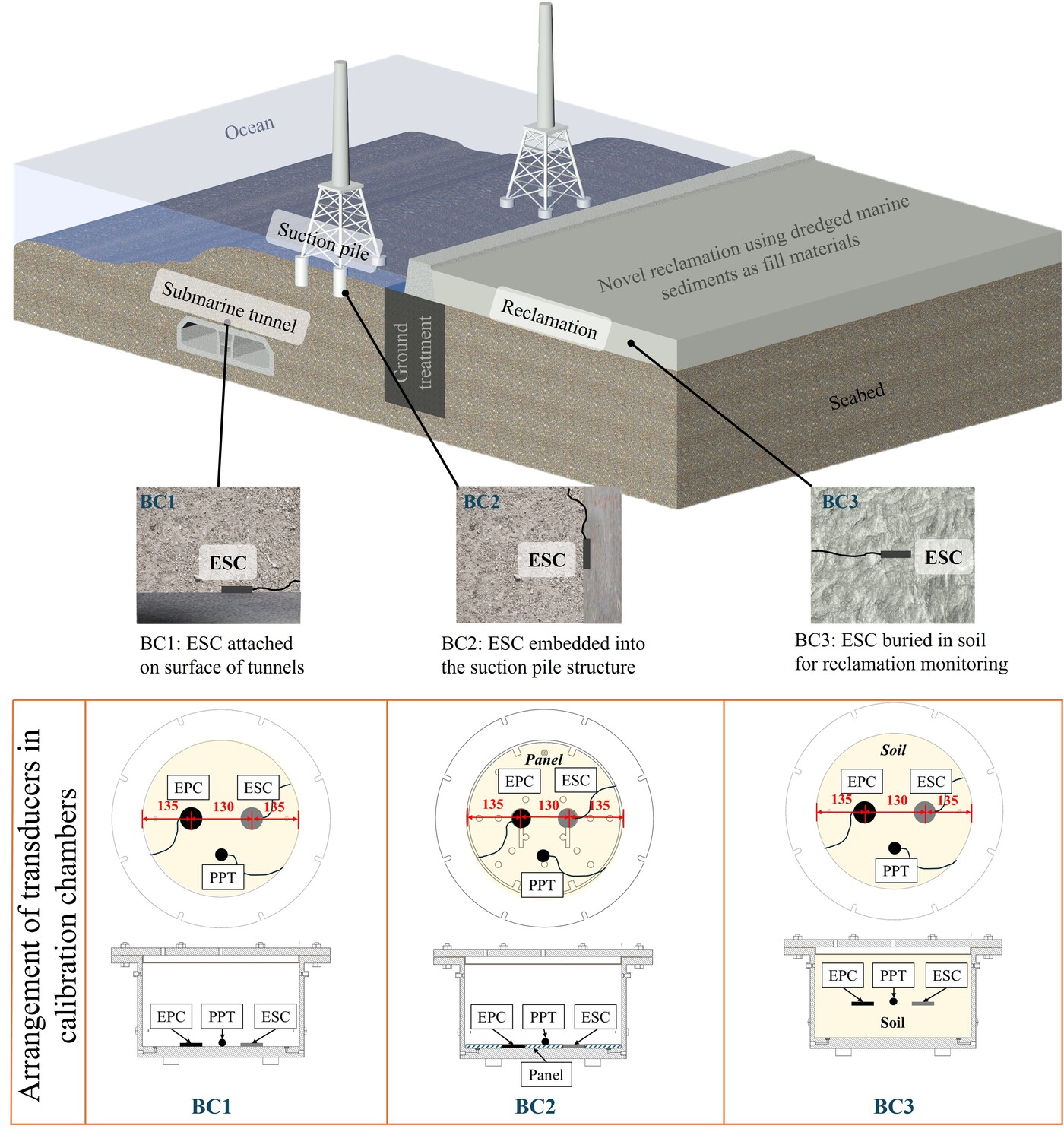
Figure 2. Typical geotechnical scenarios, boundary conditions and corresponding calibration settings
In light of the above considerations, the research team designed a novel calibration chamber (Figure 1c) to calibrate ESCs under three typical calibration settings, corresponding to three typical boundary conditions and working scenarios in geotechnical engineering [4]. The boundary conditions are: (1) ESCs placed on a stiff structure surface (BC1); (ii) ESCs embedded in a stiff structure with its sensing surface flush with the structure surface (BC2); and (iii) ESCs embedded within a soil layer (BC3), as illustrated in Figure 2.
For example, in offshore geotechnical projects, ESCs attached to the surfaces of submarine tunnels to monitor the effective stress during operation can be represented by calibration tests in BC1; ESCs embedded into suction piles to monitor the lateral effective stress could be simulated by calibration tests in BC2; ESCs placed within soil to monitor the effective stress change during reclamation can be represented by calibration tests in BC3.
The novel calibration chamber features (i) a stainless-steel chamber for hosting soil samples, ESCs and other transducers, (ii) a diaphragm pressure system that applies uniform vertical pressure on the soil sample, and (iii) a back pressure system that can facilitate the saturation process of the soil sample and adjust the effective stress. The calibration settings corresponding to three typical boundary conditions are illustrated in Figure 2.
The soil samples used in the calibration tests were reconstituted Hong Kong marine deposits (HKMD). During the calibration, effective stress increased from 0 to 200 kPa in increments of 50 kPa by controlling the vertical pressure and back pressure in the calibration chamber. ESCs were used for direct measurement of effective stress, while PPTs and EPCs were used for indirect measurement of effective stress.
The calibration factors Csoil of ESCs in saturated HKMD are 178.25 kPa/nm, 221.40 kPa/nm and 262.16 kPa/nm under BC1, BC2 and BC3, respectively. To eliminate the influence of other factors, such as the different sensitivities of the ESCs used in the calibration tests, the calibration factors Csoil are normalised against the calibration factors in water Cwater. The normalised calibration factors Cn = Csoil/Cwater of ESCs for boundary conditions BC1, BC2 and BC3 are 0.952, 1.183 and 1.254, respectively.
Different values of the normalised calibration factors of ESCs are attributed to the varying soil arching effects under the three different boundary conditions.
Under BC1, the soil settlement above the ESC is less than that near the drainage boundary, yielding a passive arching above the ESC and resulting in the effective stress above the sensing surface of the ESC being greater than the applied one. Under BC2 and BC3, however, the effective stress distribution on the ESCs may be dominantly affected by active soil arching to varying extents, resulting in measured effective stress above the sensing surface being lower than the applied one. Therefore, to accurately monitor the effective stress, it is crucial to conduct calibration tests with representative boundary conditions that reflect the specific geotechnical scenarios where ESCs will be implemented.
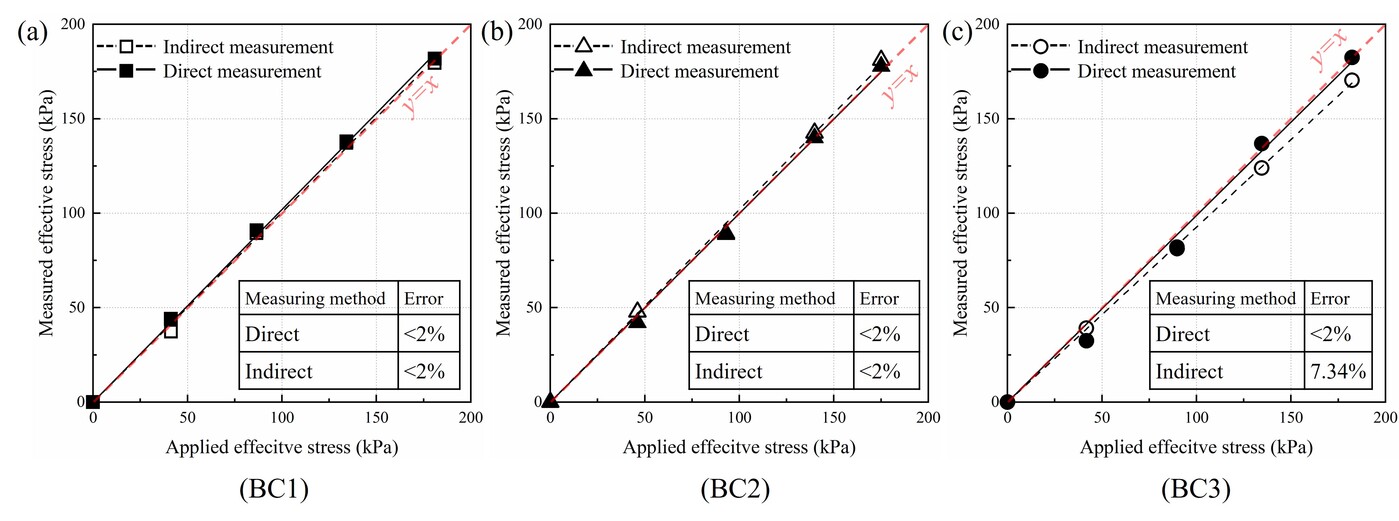
Figure 3. Comparison between direct and indirect measurement of effective stress under: (a) BC1, (b) BC2 and (c) BC3
Figure 3 presents the effective stresses measured by direct and indirect methods under three boundary conditions. Good agreement between the directly and indirectly measured effective stresses can be found for boundary conditions BC1 and BC2, with the errors within 2% compared to the applied effective stress. Under BC3, however, the indirect measurement of effective stress exhibits much higher levels of error (>7%), while the error of direct measurement method remains below 2%, indicating that the reliability of ESCs for direct measurement of effective stress is higher than that of the conventional indirect method.
This study has demonstrated that effective stress can be directly measured using the ESCs developed by Prof. Yin and his team. Compared to the conventional indirect measurement method using one EPC and one PPT, the direct measurement of the effective stress can reduce errors and reduce costs by nearly a half since only one transducer is needed. This study also investigated the effect of boundary conditions on effective stress measurement in saturated soils and further enhanced the accuracy of ESCs under different boundary conditions by introducing normalised calibration factors.
The innovation of ESCs has been widely recognised and patents have been awarded in both the US and China. Shen (2023) commented that the development of ESCs provided experimental confirmation of Terzaghi's hypotheses, marking an unprecedented achievement in the field of soil mechanics and geotechnical engineering following Terzaghi's pioneering work [5]. We are therefore confident that this invention will have both broad applications in geotechnical engineering and significant impact on both scientific studies and on the advancement of measurement technologies for smart buildings and geomechanics.
Prof. Yin is an Emeritus Professor (Soil Mechanics) (Chair Professor of Soil Mechanics from 2013 to 2024) of the Department of Civil and Environmental Engineering. He is a Fellow of the Hong Kong Academy of Engineering and a Fellow of the Hong Kong Institution of Engineers. He has been recognised by Stanford University as one of the top 2% most-cited scientists worldwide (career-long and single-year) for seven consecutive years, from 2019 to 2025. He is Vice-President of the International Association for Computer Methods and Advances in Geomechanics (IACMAG) and co-editor of the International Journal of Geomechanics. He received the prestigious John Booker Medal in 2008, the Chandra S. Desai Excellence Award in 2011, and an Outstanding Contributions Medal in 2017 from IACMAG. In China, Prof. Yin received the 2000 "Mao Yi-Sheng Soil Mechanics and Foundation Engineering Youth Award". He delivered the most prestigious "Huang Wen-Xi Lecture" in China in 2011 and, in 2023, the "4th Distinguished Lecture" of the Soil Mechanics and Foundation Division of the Canadian Geotechnical Society.
Acknowledgement: The author thanks Dr Elvis Pei-Chen Wu and Mr Hong-Jiang Ye for conducting tests presented in the figures and for their help in preparing this article.
| References |
|---|
[1] Yin, J. H., Qin, J. Q., & Feng, W. Q. (2020). Novel FBG-based effective stress cell for direct measurement of effective stress in saturated soil. International Journal of Geomechanics, 20(8), 04020107.
[2] Qin, J. Q., Feng, W. Q., Wu, P. C., & Yin, J. H. (2020). Fabrication and performance evaluation of a novel FBG-based effective stress cell for directly measuring effective stress in saturated soils. Measurement, 155, 107491.
[3] Timoshenko, S., & Woinowsky-Krieger, S. (1959). Theory of plates and shells.
[4] Ye, H. J., Lin, S. Q., Yin, J. H., & Wu, P. C. (2026). Accurate calibration of effective stress cells using a novel chamber for monitoring effective stresses in three different boundary conditions. Ocean Engineering, 343, 123154.
[5] Shen, S. L. (2023). Research attitudes at a crossroads: advancing research on smart and sustainable cities. Smart Construction and Sustainable Cities, 1(1), 1.
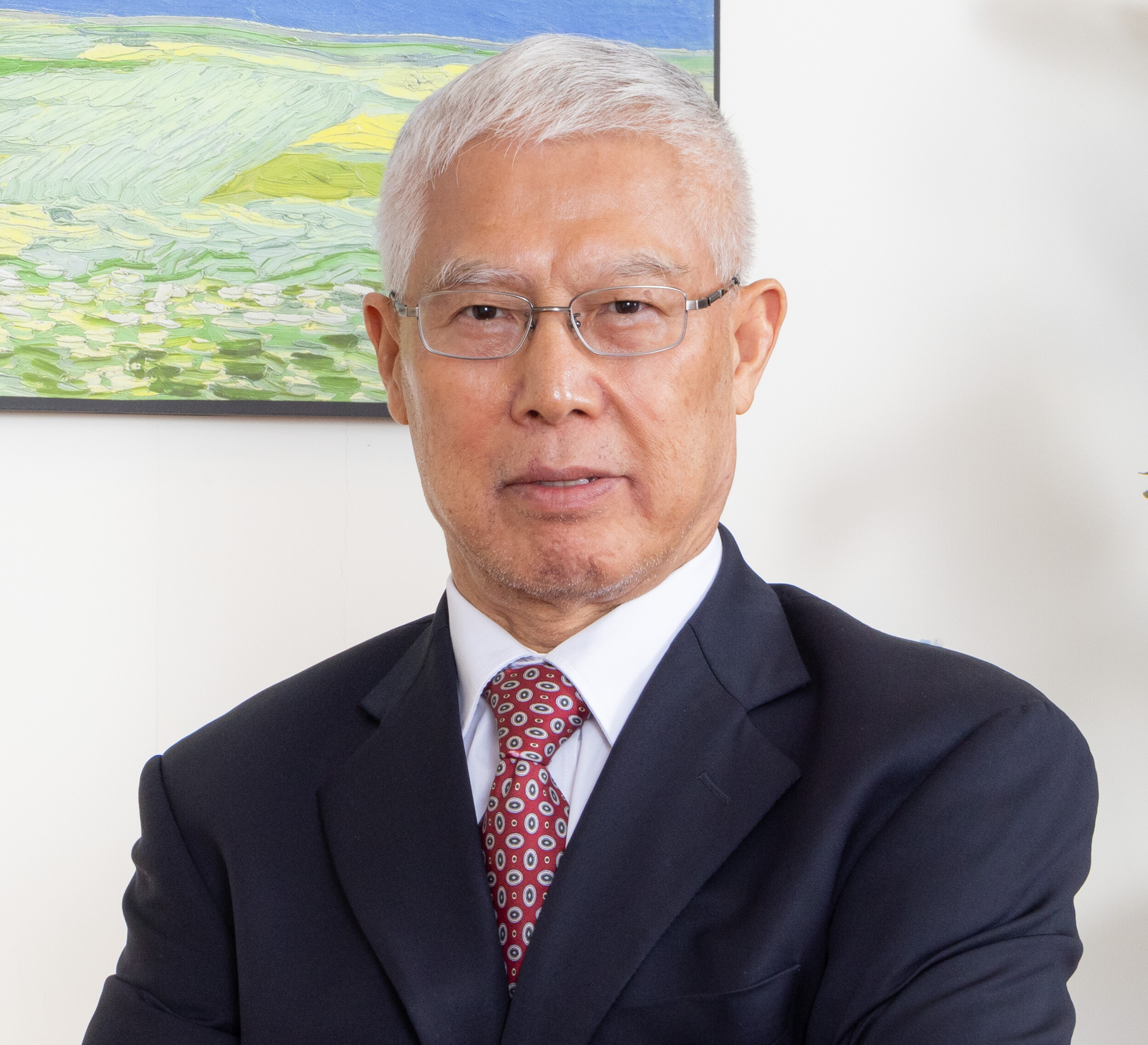 | Ir Prof. Jian-hua YIN Emeritus Professor (Soil Mechanics), |