
Seismic Metamaterials: The Smart Guardians of Urban Infrastructure
Other Articles

Unveiling the Forming Mechanism of Zero-frequency Bandgap for Seismic Metamaterial to Guide Next-generation Earthquake Protection
Study conducted by Prof. Kaiming BI  and his research team
Rapid urbanisation has led to a surge in construction and infrastructure development, intensifying the challenge of managing vibrations from both natural sources, such as earthquakes, and human activities, including traffic and industrial operations. Among these, low-frequency surface waves are particularly problematic due to their ability to travel long distances with minimal attenuation and their tendency to resonate with the natural frequencies of many structures, posing significant risks to urban safety and durability. Traditional engineering solutions—such as reinforced frames, energy absorbers and various damping systems—have improved structural resilience but often face limitations in cost, scalability and effectiveness against low-frequency waves.
These challenges underscore the urgent need for innovative approaches capable of efficiently isolating or attenuating low-frequency surface waves. In this context, seismic metamaterials have emerged as a promising alternative, offering new possibilities for seismic protection in urban infrastructures. The most exciting aspect of seismic metamaterial is its potential to form a bandgap (BG), a frequency range through which seismic waves cannot propagate. Recent research has proposed advanced designs of seismic metamaterials that enable low-frequency and even zero-frequency bandgap (ZFBG). While these have significantly advanced the field of seismic metamaterials, the underlying mechanism for the formation of ZFBG remains inadequately explained.
Published in Journal of Sound and Vibration [1], Prof. Kaiming BI, Associate Professor of the Department of Civil and Environmental Engineering at The Hong Kong Polytechnic University, and his research team clarified the forming mechanism of the ZFBG by revisiting two typical designs—the seismic metamaterial-clamped barrier and the resonant meta-barrier. Through analytical and numerical testing, the team aimed to determine whether ZFBGs are truly unique to metamaterials or if they can be achieved through other means. Moreover, the combination of these two designs was also discussed to determine whether a superimposed shielding effect could be achieved.
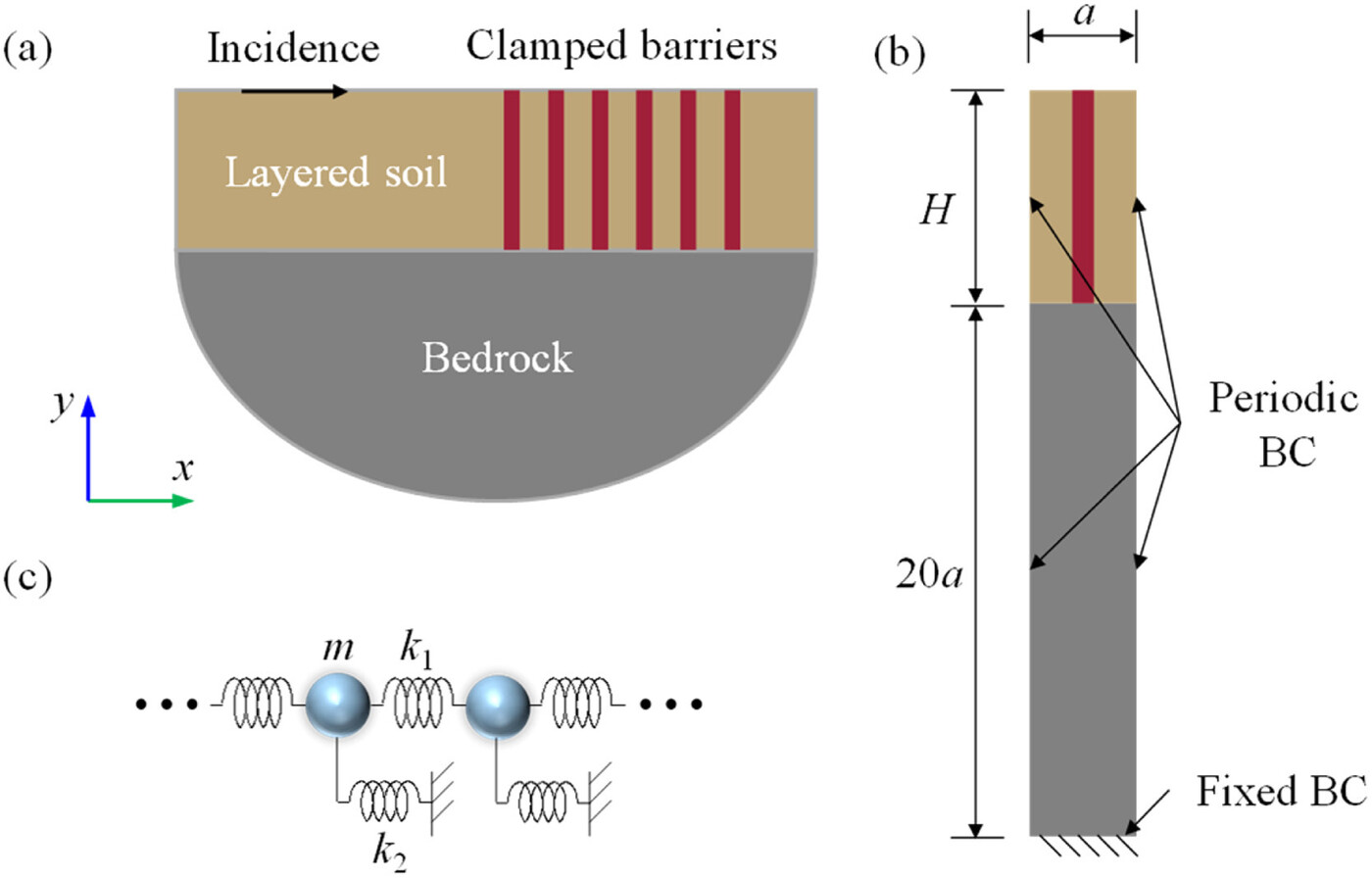
Figure 1. Diagrams of (a) continuum model, (b) unit cell model and (c) discrete model of clamped barrier design
The clamped barrier model consisted of periodic rows of fly ash barriers, each 0.2 m wide and 5 m deep, situated in layered soil above a bedrock half-space and anchored to bedrock with a spacing of 1 m along the x direction (Figure 1a&b). These barriers were designed to mimic the effect of fixed constraints at the base of the soil layer imposed by the rigid bedrock. To better understand the physics, the team developed a discrete spring-mass model (Figure 1c), representing the soil and barriers as masses connected by springs, with the bedrock acting as a fixed boundary.
Analytical results revealed that in the ultra-low-frequency region, the effective mass of the system became negative, leading to a stop band that blocked prohibited wave propagation. The cutoff frequency for this stop band was given by  , where k2 is the stiffness of the grounded spring and m is the mass of the unit cell. Notably, even a homogeneous soil layer over bedrock (without clamped barriers) exhibited a similar stop band, albeit with a slightly lower cutoff frequency due to reduced stiffness.
To further evidence findings revealed by theoretical analysis, the team conducted numerical simulations. The dispersion curves for both models with and without clamped barriers showed stop bands, with cutoff frequencies of 3.6 Hz and 3.3 Hz (Figure 2), respectively. This small difference highlighted that the presence of clamped barriers increased system stiffness, but the essential mechanism for the ZFBG was the rigid boundary condition imposed by the bedrock, not the metamaterial structure itself.
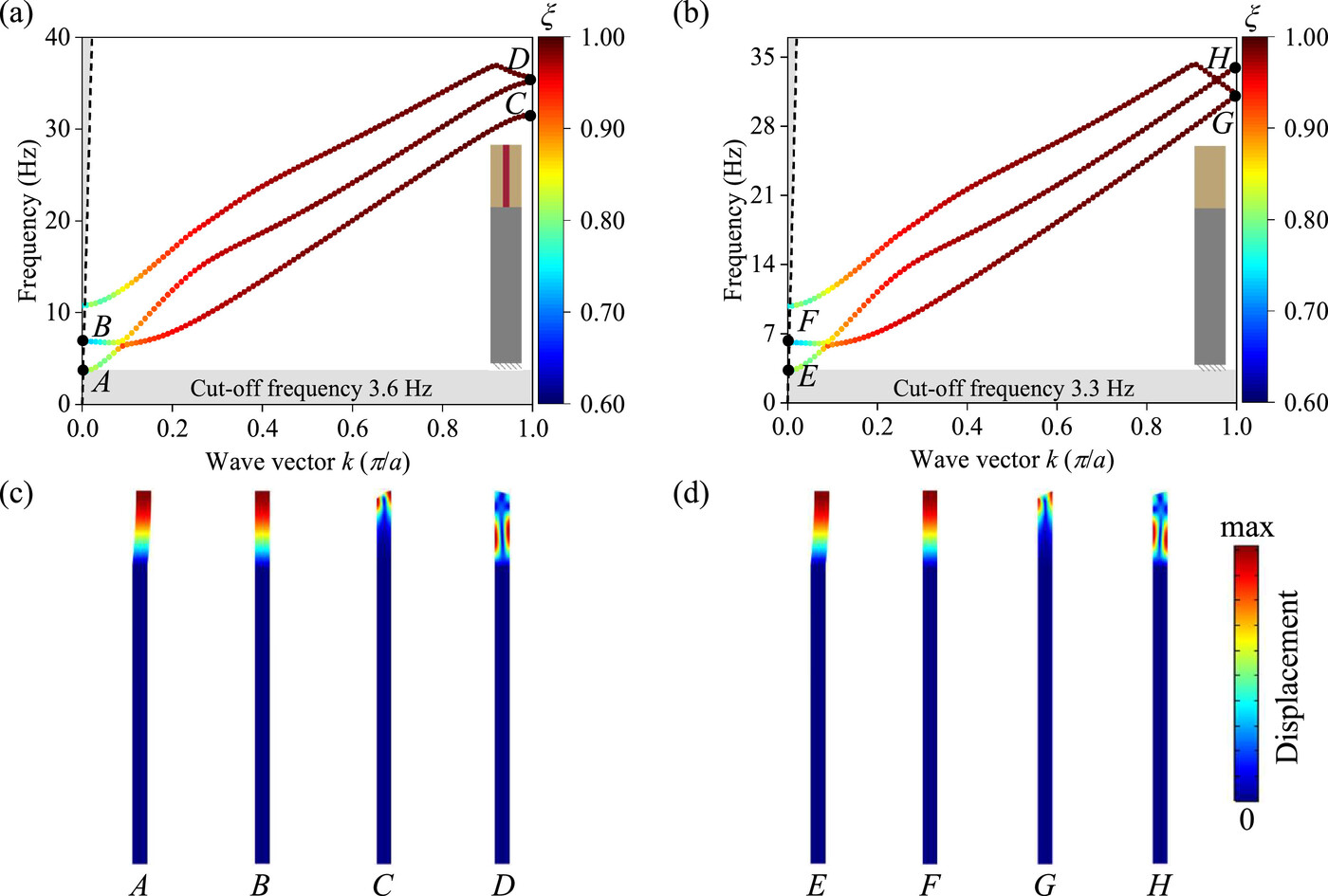
Figure 2. Dispersion curves of (a) clamped barrier model and (b) bedrock model, and typical modes of (c) clamped barrier model and (d) bedrock model. The parameter ξ ranges from 0 to 1, where a value of ξ close to 1 indicates that the energy centre is near the free surface (a surface mode), and a value close to 0 indicates a bulk mode.
Further frequency domain analysis demonstrated that the amplitude ratio spectrum was negative from 0 Hz to 3.3 Hz in both models, indicating strong attenuation of Rayleigh waves within the ZFBG range. Time domain simulations with a 2 Hz-central excitation confirmed that both models exhibited significant wave attenuation again, with negligible differences between them. These results collectively showed that the ZFBG in clamped barrier systems was fundamentally due to the rigid boundary condition, rather than the dynamic interaction of the metamaterial unit cells.
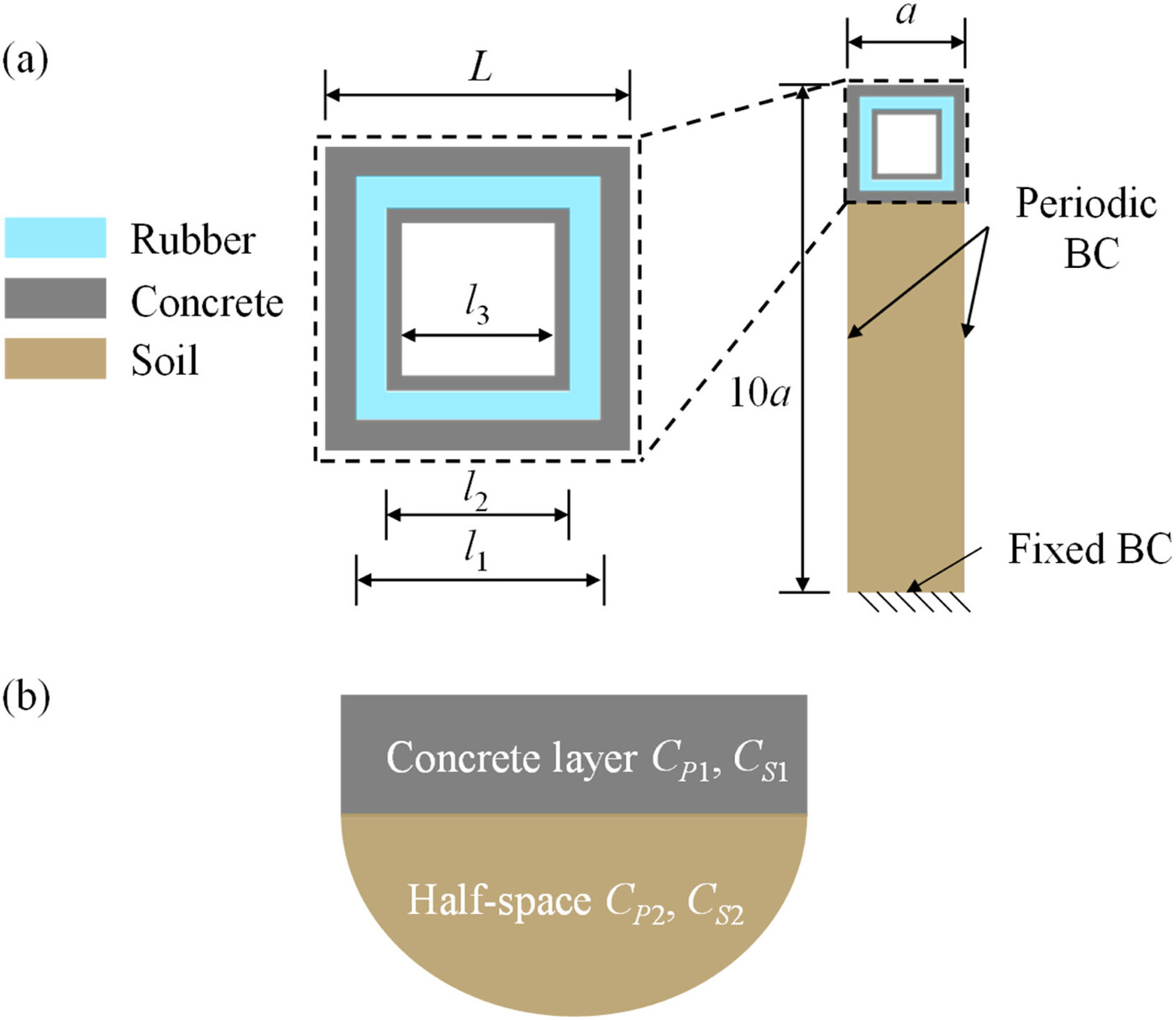
Figure 3. Diagrams of (a) unit cell model of resonant meta-barrier and (b) equivalent layer model
The resonant meta-barrier model featured unit cells composed of rubber-coated concrete blocks embedded in a concrete matrix, placed atop a soil half-space (Figure 3). These cells are periodically arranged with a lattice spacing of 1.0 m. To simplify theoretical analysis, the team modelled the meta-barrier layer as a uniform concrete layer overlying soft soil and focused on the long wavelength limit. Classical elastic wave theory predicted that when a stiff layer was placed over a soft substrate, the system could not support pure Rayleigh wave modes at low frequencies. Instead, only pseudo-surface waves and bulk waves were present.
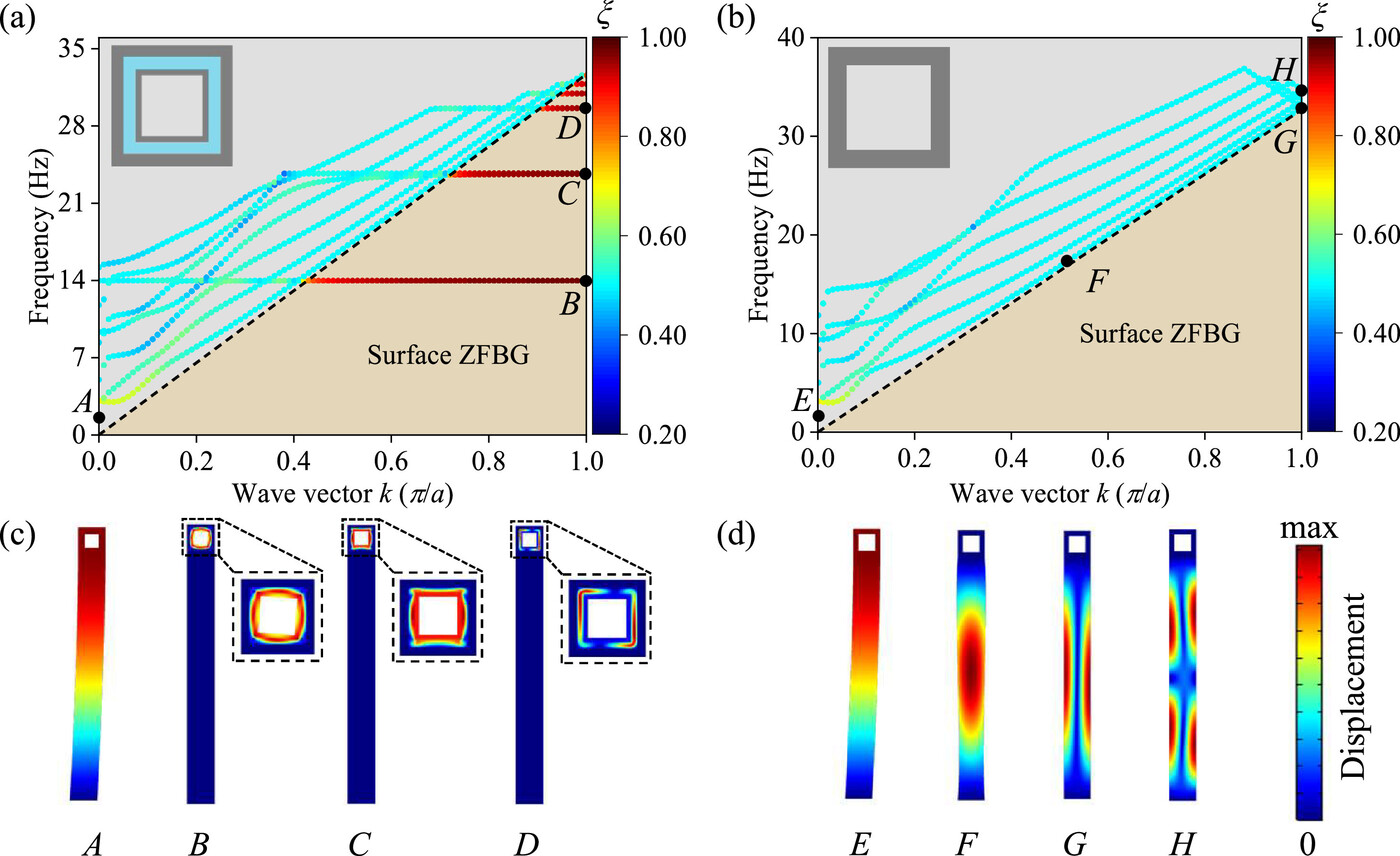
Figure 4. Dispersion curves of (a) meta-barrier model and (b) concrete box model, and typical modes of (c) meta-barrier model and (d) concrete box model
Numerical dispersion analysis confirmed this: all eigenmodes in both the meta-barrier and pure concrete box models were bulk modes situated above the sound line (the shear velocity of the substrate), with no propagating surface wave modes (Figure 4).
The ZFBG in these models was evident in the amplitude ratio spectra, which showed negative values in the relevant frequency range. Both the meta-barrier and concrete box models exhibited nearly identical attenuation characteristics, indicating that local resonance effects were negligible. Time domain simulations with a 5 Hz-central excitation further demonstrated that incident Rayleigh waves were converted into bulk waves in both models, with significant attenuation compared to a pure soil reference model.
These findings led to a crucial conclusion: the surface ZFBG in resonant meta-barrier systems is not a unique property of the metamaterial design, but rather an intrinsic feature of having a stiff upper layer over a soft half-space. This mechanism holds true even for gradient meta-barrier models, where the height of the unit cells varies, as confirmed by additional frequency domain analyses.
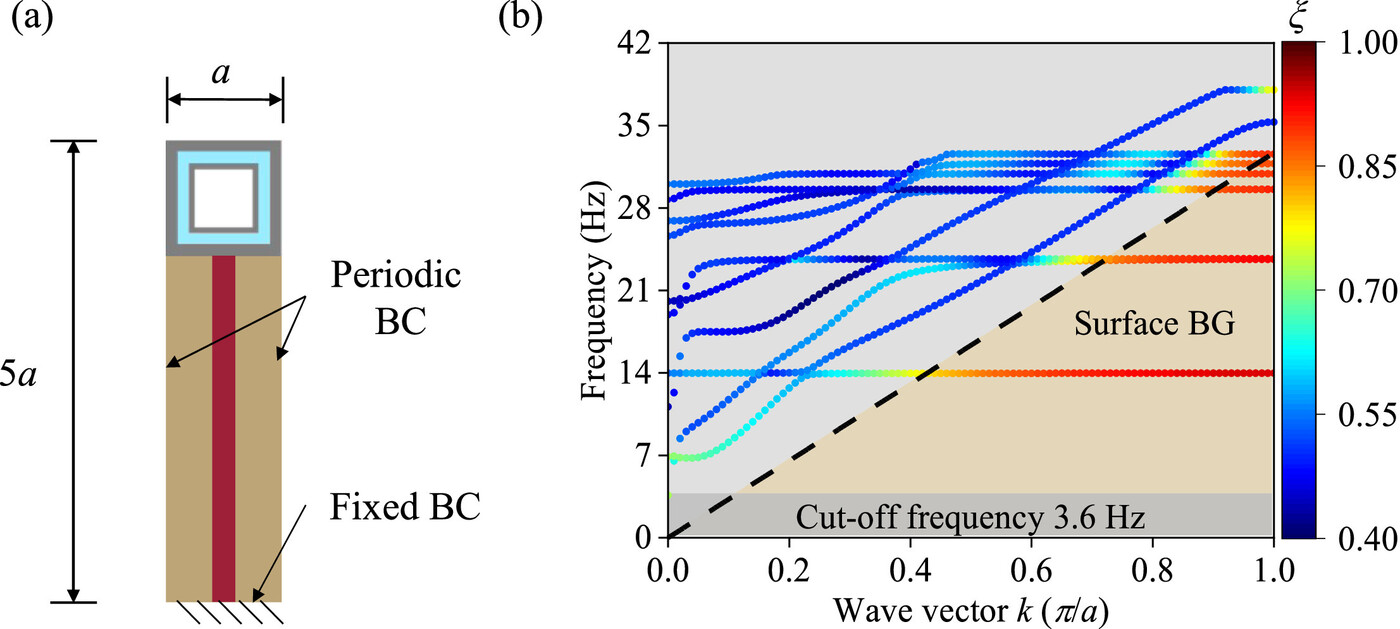
Figure 5.(a) Diagrams of a unit cell of the combined model. (b) Dispersion curves of the combined model
Building on insights derived from analysis of the operation of the clamped barrier and resonant meta-barrier models, the team proposed a combined model incorporating elements of both designs: fly ash, rubber, concrete and soil (Figure 5a). Analytical and numerical tests showed that the combined model exhibited a stop band with a cutoff frequency of 3.6 Hz, identical to the clamped barrier model. Local resonance modes were also observed, similar to the resonant meta-barrier model, and all other eigenmodes lay above the sound line, confirming the existence of a surface ZFBG (Figure 5b). The combined model thus achieved a superimposed shielding effect, leveraging the strengths of both clamped barriers and resonant meta-barriers.
This approach offered greater flexibility in design and could be tailored to specific site conditions, such as regions with deep bedrock or soft soil layers.
This study redefined our understanding of how ZFBGs can be achieved in two representative designs of seismic metamaterial. By systematically analysing both clamped barriers and resonant meta-barriers models, the team demonstrated that the creation of ZFBGs does not originate from complex seismic metamaterial elements, but rather from fundamental boundary conditions and intrinsic material configurations. This insight clarified previous misconceptions, opening up new and practical pathways for designing "smart shields" to protect urban infrastructures. As earthquakes remain a persistent threat, these insights lay a solid foundation for developing the next generation of resilient, vibration-resistant cities, ensuring safer and more sustainable communities worldwide.
Prof. Bi has been ranked among the top 2% most-cited scientists worldwide (career-long) by Stanford University in the field of engineering for two consecutive years, from 2024 to 2025, and one of the top 2% most-cited scientists worldwide (single-year) for six consecutive years, from 2020 to 2025. He won the prestigious Australian Research Council Future Fellowship (2020) and the Discovery Early Career Research Award Fellowship (2014). He received the JM Ko Medal from the international journal Advances in Structural Engineering in 2016, and was selected as one of the finalists of the Western Australia Premier’s Science Awards Early Career Scientist of the Year in the same year. He also received the High Achieving Young Investigator Award from The University of Western Australia in 2012. He is an Associate Editor of the flagship structural engineering journal Engineering Structures.
| References |
|---|
[1] Luo, J., Bi, K. & Pu, X. (2025). On the zero frequency bandgap of seismic metamaterials, Journal of Sound and Vibration, 607 (2025) 119064. https://doi.org/10.1016/j.jsv.2025.119064
 | Prof. Kaiming BI Associate Professor, |