Human-Robot Collaboration Shaping the Future of Smart Manufacturing
Manufacturing is entering a new era, moving beyond Industry 4.0’s focus on smart factories and interconnected machines towards Industry 5.0—the next wave that puts people at the centre, harnessing technology to enhance human creativity, well-being, and sustainability. Central to this shift are collaborative robots, or cobots, reshaping how humans and machines work together.
In a sunlit factory, a technician and a humanoid robot collaborate at a shared workbench. Wearing smart glasses, he reviews a 3D holographic blueprint as the robot assembles parts with precision. He suggests an improvement; the robot’s AI updates the design instantly. Around them, robots move materials and inspect products via real-time data displays seamlessly together.
In this futuristic scene of Industry 5.0, humans and robots join forces to blend creativity and technology to achieve efficient and innovative production. At PolyU, the RAIDS (Research Group of AI for Industrial Digital Servitisation) at the Department of Industrial and Systems Engineering is transforming the ideas into reality.
The dynamic team is led by Professor Zheng Pai, Wong Tit Shing Young Scholar in Smart Robotics and Associate Professor of the Department of Industrial and Systems Engineering, who was awarded the Young Engineer of the Year Award 2025 by the Hong Kong Institution of Engineers and Young Innovative Researcher Award 2023 by PolyU.
With support from the Excellent Young Scientists Fund by the National Natural Science Foundation of China in 2024, the team pioneers a new generation of human-machine symbiotic collaborative manufacturing systems that combine the adaptability and responsiveness of humans with the precision and stability of machines.
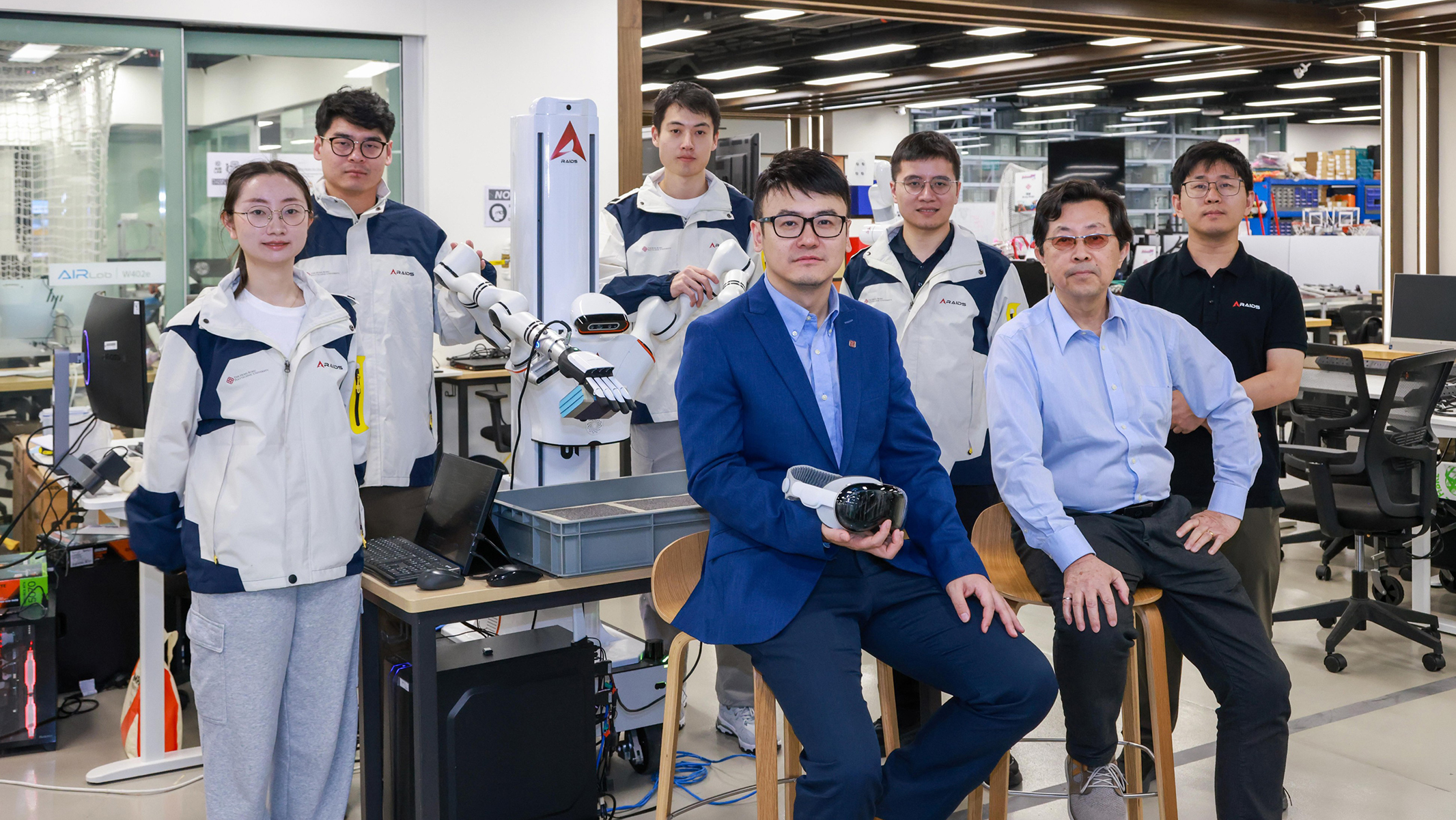
The RAIDS team led by Professor Zheng Pai (front row, centre) in collaboration with Professor Lihui Wang, Professor and Chair of Sustainable Manufacturing at KTH Royal Institute of Technology, Sweden (front row, right)
The evolution of robots in industry
Industrial robots emerged in the 1970s during the third industrial revolution, automating repetitive tasks from behind safety barriers. Today, Industry 4.0 connects factories through smart machines, IoT, and big data, enabling real-time communication and adaptation. Modern robots, equipped with AI and advanced sensors, now share workspaces with humans, learning and adjusting instantly to create collaborative, intelligent manufacturing environments.
The RAIDS group leads the transformation towards Industry 5.0. They have recently developed a novel multimodal human-robot interaction and data acquisition system, TeleX, for research and development in industrial embodied intelligence and robot learning.
Advancing fundamental research in human-robot symbiosis
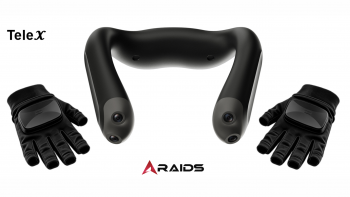
TeleX provides a practical pathway towards more generalisable embodied intelligence models.
TeleX is a smart, open platform that helps robots learn directly from human actions. It acts like a “super recorder” for human–robot interaction, capturing how people move, see, and feel objects during complex tasks. It combines precise motion tracking, visual sensing, and touch sensitive “robot hands” to synchronously collect multimodal human operation data in complex manipulation scenarios.
Designed for researchers, TeleX tackles a long standing problem in robotics: teaching robots to copy the way humans handle objects. At its core is a learning-based universal end-effector mapping algorithm developed by the team. It helps different robot arms and tools learn directly from multimodal human demonstrations, all through a single, easy-to-use interface. This means robots can learn new skills much faster, without the heavy time and computing costs usually needed to retrain systems for each platform.
TeleX has already been tested in various industrial scenarios on human-robot teamwork, imitation learning, teleoperation, and precision assembly. Industry partners use it to collect large amounts of real human operation data, helping robots learn how to feel, judge, and act more accurately. The long-term goal is an open platform that speeds up the rise of smarter, more human-like robots in future manufacturing.
“The global manufacturing industry is shifting towards a human-machine symbiotic paradigm emphasising more flexible automation,” Professor Zheng said. “Our research develops a paradigm offering multimodal natural perception, cross-scenario skill transfer and domain foundation-model autonomous execution, so robots are no longer just tools but intelligent agents that can evolve with human operators. This provides smart factories a path beyond pre-programmed automation.”
The future of smart manufacturing is not about machines getting smarter to replace humans, but about creating systems where humans and robots learn, adapt and succeed together to achieve higher productivity and flexibility.
~ Professor Zheng Pai
Startup to widen impact
With a mission to develop advanced robotics, digitalisation and AI for more natural interactions, efficient collaboration and symbiotic human-machine systems, the RAIDS team under Professor Zheng’s leadership has founded CobotAI Limited to commercialise their achievements.
By building a deeply human-centric intelligent manufacturing system and expanding it into more key domains, the PolyU team aims to guide society towards a technology-empowered, empathetic and human-oriented smart era.
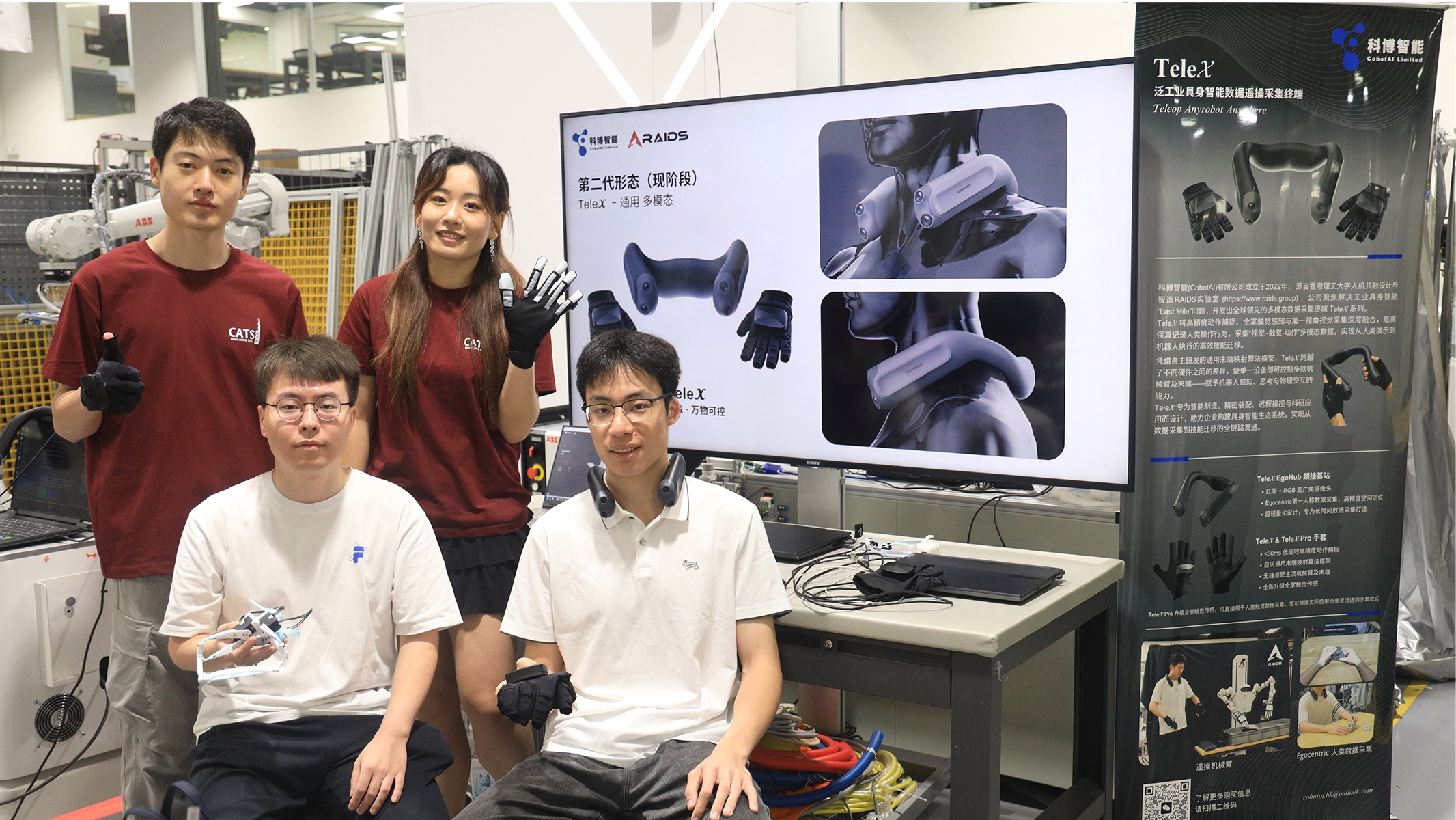
Members of the startup team CobotAI