PolyU Education 4.0: Putting Students in the Driving Seat with AI

PolyU Education 4.0 is redefining learning and teaching through a student-centred, AI-enabled approach that is driving innovation across disciplines. From the Department of Applied Social Sciences' partnership-based pedagogy to the Department of Land Surveying and Geospatial Science's discipline-specific tools, the initiative combines University-wide platforms with tailored solutions to meet diverse learning needs.
Over 170 years ago, the English cleric and scholar John Henry Newman argued in his classic work The Idea of a University (1852) that education must extend beyond the mere transmission of facts or preparation for a profession. It should educate students to question, judge, and seek truth. That ideal remains strikingly relevant today. While artificial intelligence (AI) can now deliver instant answers, access alone does not foster understanding, wisdom or sound judgment.
Today, a more pressing challenge has emerged: not the scarcity of knowledge, but its overwhelming abundance. As information floods every screen, the question is no longer how to obtain, but how to interpret, evaluate, and apply it with purpose. What if students could move beyond receiving knowledge to shaping how they learn? This vision lies at the heart of PolyU Education 4.0 (PolyU E4.0), a student-centred model that redefines learning and teaching through the integration of AI and smart technologies, and a more personalised experience.
From learners to co-creators
University students are digital natives nowadays, reshaping how learning happens. Educators must rethink teaching to engage and empower them through technology. Creating flexible learning environments that work across disciplines and support diverse needs anytime and anywhere remains a key challenge in higher education. To address this, Dr Rodney Chu, Senior Lecturer in the Department of Applied Social Sciences (APSS), and his team have developed a technology-mediated pedagogy to enhance learning and teaching outcomes.
True to the vision of PolyU E4.0, which places students at the centre of the learning experience, Dr Chu’s pedagogy moves beyond the traditional model of attending lectures and absorbing content. Instead, students are encouraged to work critically with AI tools and smart technologies, contribute to course design, and generate new ideas as they take greater ownership of their learning.
“We want students to move beyond being passive learners in the classroom and instead apply what they learn in real-world contexts, making meaningful contributions to the communities and issues they care about,” Dr Chu says.
A key component of this approach is the Student-Staff Partnership (SSP) model, which focuses on shared responsibility and flexibility across disciplines. It promotes collaborative, community-based learning and redefines the roles of both students and educators. Within this model, students take an active role in shaping knowledge and contributing both within and beyond the classroom. As Dr Chu notes, the aim is for students to be more than “a learner sitting in the classroom”, encouraging them to make meaningful contributions even outside scheduled learning.
TIMS framework that keeps the approach adaptable
A key strength of this pedagogy lies in its flexibility within a clearly defined framework. It is supported by the TIMS framework—Technology Integration, Interdisciplinary Collaboration, Multimodal Assessment, and Student-Staff Partnership—which provides clear direction while allowing adaptability across disciplines.
Dr Chu notes that different disciplines require different approaches. Social science may involve fieldwork, while computer science may not. Rather than imposing a one-size-fits-all model, this framework accommodates such differences, enabling students to see the relevance of their learning in context. It also supports educators using AI purposefully, ensuring learning rather than being used without clear value.
VAT: using generative AI to extend learning support
One of the most visible implementations is the Virtual Assistant TIMS (VAT), a generative AI chatbot, launched in early 2024 as generative AI expanded in education. VAT does not replace educators. Instead, it supports their work by giving students immediate access to tools such as lecture summaries, podcasts, multimodal search, and instant Q&A.
Early performance data is encouraging, with strong engagement metrics. VAT responds in about 11 seconds, and its answers are, on average, 16 times more detailed than the students’ original questions. Students also engage in sustained exchanges, averaging 10.9 interactions per session. These interactions generate valuable insights into students’ learning needs and interests, which are used to refine courses and teaching approaches based on what they are asking and exploring.
As a result, students receive faster and more detailed support, while staff gain a clearer understanding of learning needs—turning student activity into continuous improvement.
Students shaping the platform and the learning community
The platform becomes more impactful when students contribute not only as users, but as partners. To date, around 50 students from different departments have been recruited as campus partners, helping to develop the platform and support their peers. This ensures the tools remain student-centred in both design and use.

Student helper to co-develop an immersive learning platform outside the classroom
In the 2025/26 academic year, 12 student helpers from six departments across four faculties and schools co-produced more than 70 podcasts. This scale of collaboration shows that when students help create content, learning becomes more connected, diverse, and aligned with real academic interests.
“What is especially meaningful about this model is that it helps build a learning community beyond individual cohorts,” Dr Chu says. “Students contribute through peer mentoring—for example, fourth-year students support newcomers—and some graduates even continue to stay involved.”
Recognition through QS Awards, other awards in Asian regional competitions, and academic conferences suggests that this approach is more than a short-term initiative. It is developing into a flexible model that can be applied more widely. International collaborators—with partners such as Goldsmiths, University of London, and the University of Toronto—reinforce a shared view: students thrive as cocreators, and this benefits the wider academic community.
Department-led innovation: student-centred AI in geomatics
While PolyU E4.0 provides a strong foundation for transformation, it continues to evolve across disciplines, with departments adapting its principles to their unique contexts. Different disciplines are developing customised approaches that reflect their own teaching methods and learning cultures. While the core principles remain consistent, each discipline applies them in ways that suit its subject and students.
A clear example can be seen in the Department of Land Surveying and Geospatial Science (LSGS). Under the leadership of Professor Chen Wu, Chair Professor of Satellite Navigation and Head of LSGS, the department is taking a thoughtful and forward-looking approach to AI integration into both teaching and research.
Geomatics is built on spatial data, spanning field measurements, camera imaging, remote sensing, and geographic information systems. In this context, AI is not simply an added tool, but a natural evolution in how data is collected, analysed, and applied. LSGS recognises that future professionals will need to be as fluent in AI as they are in traditional geomatics methods.
This perspective shapes how students learn. AI is embedded in the learning process, with a strong emphasis on critical engagement and responsible use. Students are encouraged to question AI-generated outputs, examine underlying assumptions, and apply them thoughtfully in realworld geospatial contexts. Used as a supporting tool rather than a substitute for thinking, AI enables learning to become an active process of experimentation, analysis, and informed judgement.
Ethics, integrity, and responsible innovation
Students are introduced not only to AI tools, but also to the ethical framework governing their use. As spatial data can be sensitive, topics such as privacy, data security, and compliance with relevant policies and regulations are treated as core components of the curriculum. Academic integrity is also clearly defined. When students use AI in their work, they are expected to acknowledge and reference it appropriately. AI is positioned as a supporting tool—for developing ideas and enhancing analysis—instead of replacing critical thinking.
Through this approach, students develop more than technical skills. They learn to practise responsible innovation, recognising that professional capability includes judgement as well as technical output.
GeoAI Mentor: turning answers into exploration
This approach is already visible across the curriculum. Eighteen of LSGS’s 33 subjects now include AI elements, giving students regular opportunities to shape their learning.
A prime example is GeoAI Mentor, which transforms access to Hong Kong’s government-backed Common Spatial Data Infrastructure (CSDI) portal—a smart city platform launched in 2022 that centralises spatial data from Hong Kong government departments, such as transportation, land use, and water management. While the core infrastructure is in place, CSDI has faced challenges with data accessibility for non-specialists.
Instead of navigating complex systems or following fixed workflows, students can ask questions in natural language and generate analyses with visualisations via GeoAI Mentor. This shifts the role of the learner. Students define their own lines of inquiry rather than simply follow instructions. In this way, GeoAI Mentor becomes less a tool that delivers answers and more a platform for exploration, supporting deeper and more active engagement.
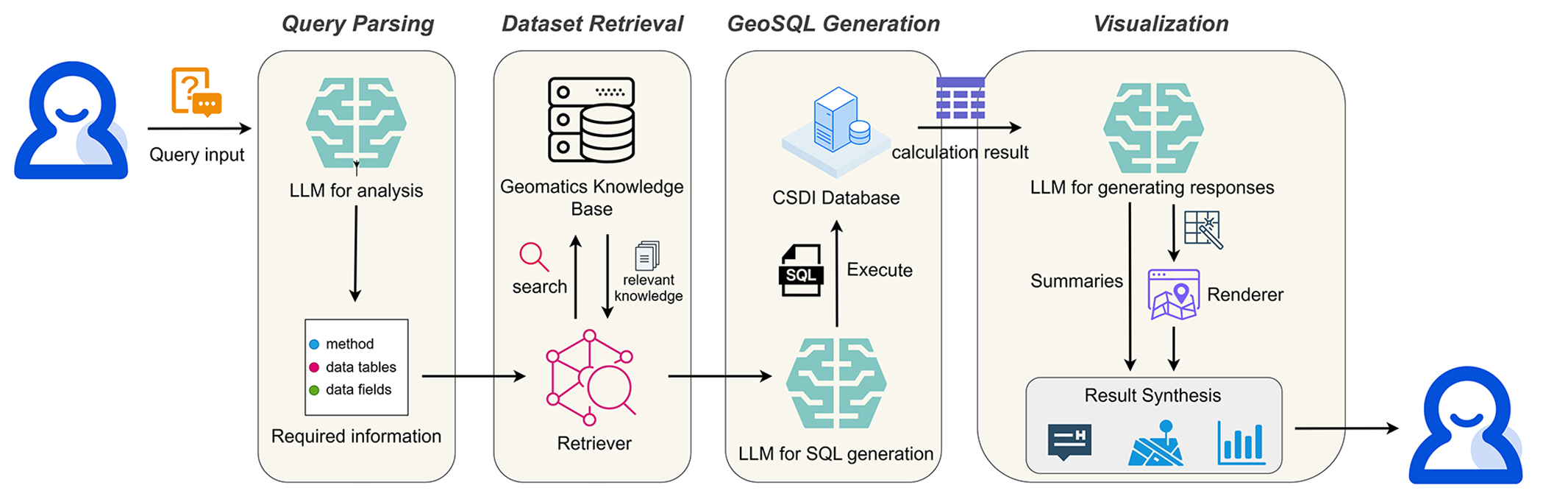
From natural language query to geospatial insight, GeoAI Mentor streamlines complex workflows into accessible, visual reports.
AI-Tutor and IntelliPBL: smarter learning support
Alongside GeoAI Mentor, LSGS offers the Spatial Data Science AI-Tutor, an LLM-powered education platform developed with the Department of Computing. This tool acts as a 24/7 learning companion, providing support across key areas of geomatics. Drawing on textbooks, research publications, and course materials, it delivers responses grounded in reliable domain knowledge. It also allows students to learn at their own pace—revisiting topics, testing ideas, and seeking guidance beyond class time.
LSGS further strengthens collaborative learning through IntelliPBL, an AI-Powered Platform for Cross-Disciplinary Project Management and Authentic Assessment. While group projects offer strong learning value, they can also present challenges in coordination and participation. To address this, IntelliPBL uses a survey informed by Myers-Briggs Type Indicator (MBTI), a personality-type framework, to form balanced teams with complementary strengths.
In group projects, IntelliPBL supports teamwork from planning to completion through scheduling, milestone tracking, and risk identification. An AI-powered chatbot provides instant feedback and preliminary reviews before final teacher assessment, allowing students to refine their work iteratively. Already used in several courses, including a Service-Learning subject, IntelliPBL helps create a more responsive, student-driven environment where learners share ownership and build teamwork skills alongside subject knowledge.
Taken together, these initiatives point to a clear direction for education. Rather than replacing teaching, PolyU E4.0 encourages the use of AI to extend and enrich learning. It equips students not only to live with AI, but to think with it—to question outputs, consider ethical implications, and apply knowledge responsibly.
In doing so, students grow as learners and as socially responsible professionals and future leaders, who are ready to contribute, co-create, and apply knowledge in ways that advance innovation and benefit society.