Entrepreneurship in Family Firms
Distinguished Research Seminar Series

-
Date
26 Jan 2026
-
Organiser
Department of Industrial and Systems Engineering, PolyU
-
Time
17:00 - 18:30
-
Venue
Online via ZOOM
Speaker
Prof. Sascha Kraus
Remarks
Meeting link will be sent to successful registrants. If you have enquiries regarding E-certificate after the seminar, please contact david.kuo@polyu.edu.hk.
Summary
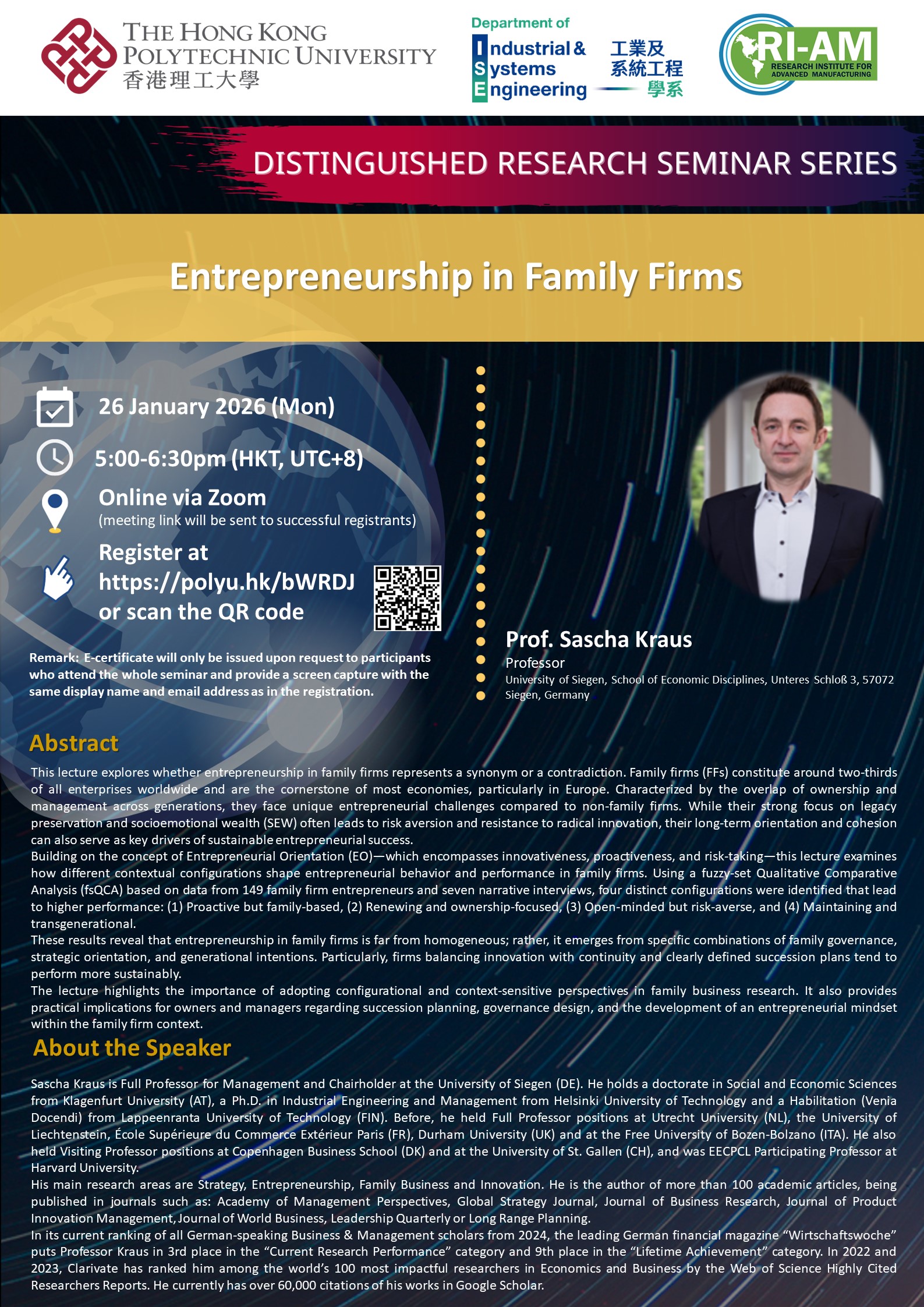
This lecture explores whether entrepreneurship in family firms represents a synonym or a contradiction. Family firms (FFs) constitute around two-thirds of all enterprises worldwide and are the cornerstone of most economies, particularly in Europe. Characterized by the overlap of ownership and management across generations, they face unique entrepreneurial challenges compared to non-family firms. While their strong focus on legacy preservation and socioemotional wealth (SEW) often leads to risk aversion and resistance to radical innovation, their long-term orientation and cohesion can also serve as key drivers of sustainable entrepreneurial success.
Building on the concept of Entrepreneurial Orientation (EO)—which encompasses innovativeness, proactiveness, and risk-taking—this lecture examines how different contextual configurations shape entrepreneurial behavior and performance in family firms. Using a fuzzy-set Qualitative Comparative Analysis (fsQCA) based on data from 149 family firm entrepreneurs and seven narrative interviews, four distinct configurations were identified that lead to higher performance: (1) Proactive but family-based, (2) Renewing and ownership-focused, (3) Open-minded but risk-averse, and (4) Maintaining and transgenerational.
These results reveal that entrepreneurship in family firms is far from homogeneous; rather, it emerges from specific combinations of family governance, strategic orientation, and generational intentions. Particularly, firms balancing innovation with continuity and clearly defined succession plans tend to perform more sustainably.
The lecture highlights the importance of adopting configurational and context-sensitive perspectives in family business research. It also provides practical implications for owners and managers regarding succession planning, governance design, and the development of an entrepreneurial mindset within the family firm context.
Keynote Speaker

Prof. Sascha Kraus
Professor
University of Siegen, School of Economic Disciplines, Unteres Schloß 3, 57072 Siegen, Germany
Sascha Kraus is Full Professor for Management and Chairholder at the University of Siegen (DE). He holds a doctorate in Social and Economic Sciences from Klagenfurt University (AT), a Ph.D. in Industrial Engineering and Management from Helsinki University of Technology and a Habilitation (Venia Docendi) from Lappeenranta University of Technology (FIN). Before, he held Full Professor positions at Utrecht University (NL), the University of Liechtenstein, École Supérieure du Commerce Extérieur Paris (FR), Durham University (UK) and at the Free University of Bozen-Bolzano (ITA). He also held Visiting Professor positions at Copenhagen Business School (DK) and at the University of St. Gallen (CH), and was EECPCL Participating Professor at Harvard University. His main research areas are Strategy, Entrepreneurship, Family Business and Innovation. He is the author of more than 100 academic articles, being published in journals such as: Academy of Management Perspectives, Global Strategy Journal, Journal of Business Research, Journal of Product Innovation Management, Journal of World Business, Leadership Quarterly or Long Range Planning. In its current ranking of all German-speaking Business & Management scholars from 2024, the leading German financial magazine “Wirtschaftswoche” puts Professor Kraus in 3rd place in the “Current Research Performance” category and 9th place in the “Lifetime Achievement” category. In 2022 and 2023, Clarivate has ranked him among the world’s 100 most impactful researchers in Economics and Business by the Web of Science Highly Cited Researchers Reports. He currently has over 60,000 citations of his works in Google Scholar.
You may also like