Optimal Abort Policy for Mission-Critical Systems under Imperfect Condition Monitoring
Distinguished Research Seminar Series

-
Date
16 Dec 2025
-
Organiser
Department of Industrial and Systems Engineering, PolyU
-
Time
17:30 - 18:30
-
Venue
DE301
Speaker
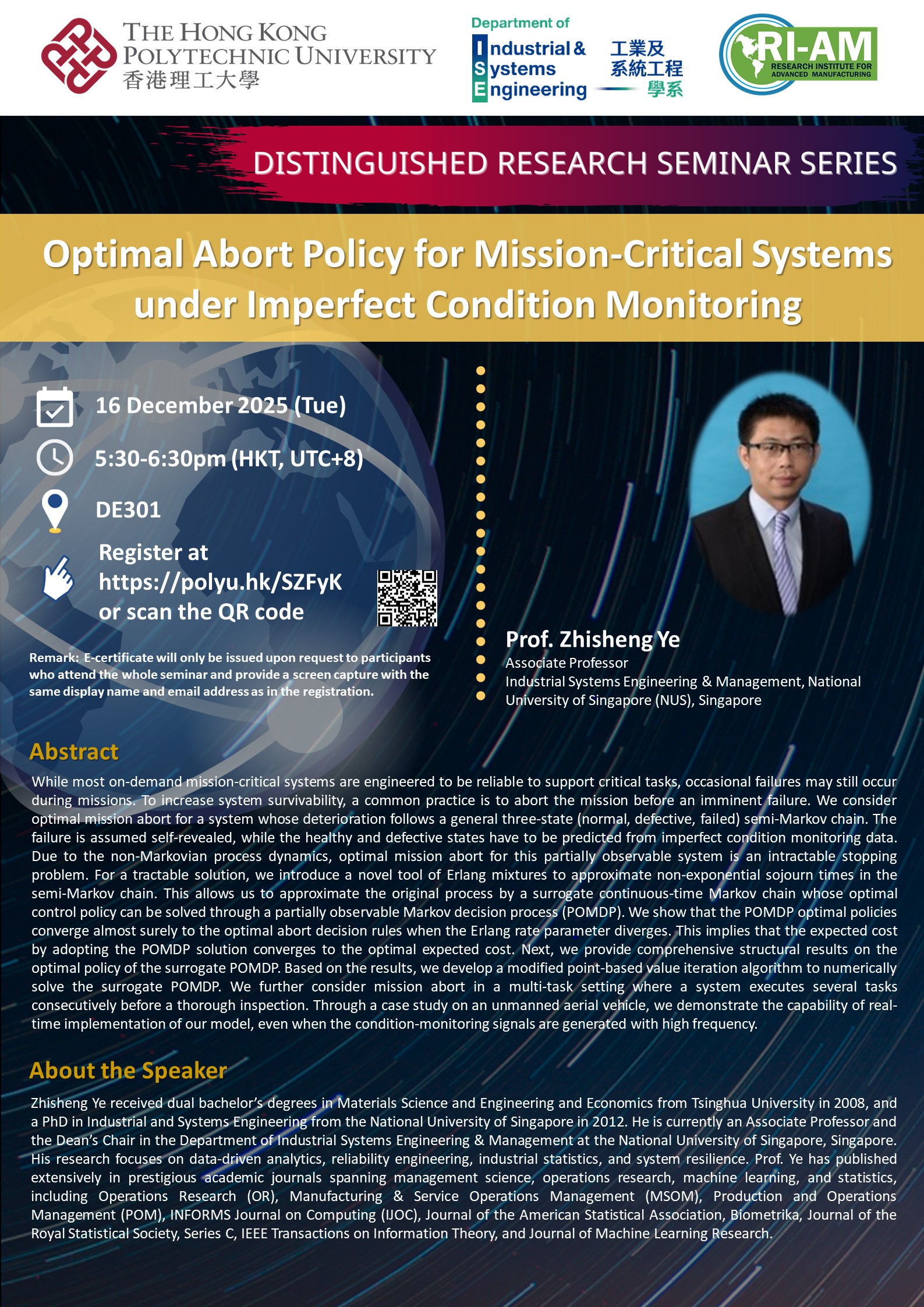
Prof. Zhisheng Ye
Remarks
If you have enquiries regarding E-certificate after the seminar, please contact david.kuo@polyu.edu.hk.
Summary
While most on-demand mission-critical systems are engineered to be reliable to support critical tasks, occasional failures may still occur during missions. To increase system survivability, a common practice is to abort the mission before an imminent failure. We consider optimal mission abort for a system whose deterioration follows a general three-state (normal, defective, failed) semi-Markov chain. The failure is assumed self-revealed, while the healthy and defective states have to be predicted from imperfect condition monitoring data. Due to the non-Markovian process dynamics, optimal mission abort for this partially observable system is an intractable stopping problem. For a tractable solution, we introduce a novel tool of Erlang mixtures to approximate non-exponential sojourn times in the semi-Markov chain. This allows us to approximate the original process by a surrogate continuous-time Markov chain whose optimal control policy can be solved through a partially observable Markov decision process (POMDP). We show that the POMDP optimal policies converge almost surely to the optimal abort decision rules when the Erlang rate parameter diverges. This implies that the expected cost by adopting the POMDP solution converges to the optimal expected cost. Next, we provide comprehensive structural results on the optimal policy of the surrogate POMDP. Based on the results, we develop a modified point-based value iteration algorithm to numerically solve the surrogate POMDP. We further consider mission abort in a multi-task setting where a system executes several tasks consecutively before a thorough inspection. Through a case study on an unmanned aerial vehicle, we demonstrate the capability of real-time implementation of our model, even when the condition-monitoring signals are generated with high frequency.
Keynote Speaker

Prof. Zhisheng Ye
Associate Professor
Industrial Systems Engineering & Management, National University of Singapore (NUS), Singapore
Zhisheng Ye received dual bachelor’s degrees in Materials Science and Engineering and Economics from Tsinghua University in 2008, and a PhD in Industrial and Systems Engineering from the National University of Singapore in 2012. He is currently an Associate Professor and the Dean’s Chair in the Department of Industrial Systems Engineering & Management at the National University of Singapore, Singapore. His research focuses on data-driven analytics, reliability engineering, industrial statistics, and system resilience. Prof. Ye has published extensively in prestigious academic journals spanning management science, operations research, machine learning, and statistics, including Operations Research (OR), Manufacturing & Service Operations Management (MSOM), Production and Operations Management (POM), INFORMS Journal on Computing (IJOC), Journal of the American Statistical Association, Biometrika, Journal of the Royal Statistical Society, Series C, IEEE Transactions on Information Theory, and Journal of Machine Learning Research.
You may also like