Rethinking Satellite Communication and Sensing: From Signal Design to Reconfigurable Hardware
Seminar

-
Date
07 Oct 2026
-
Organiser
Department of Aeronautical and Aviation Engineering
-
Time
10:30 - 11:30
-
Venue
PQ306 Map
Summary
Abstract
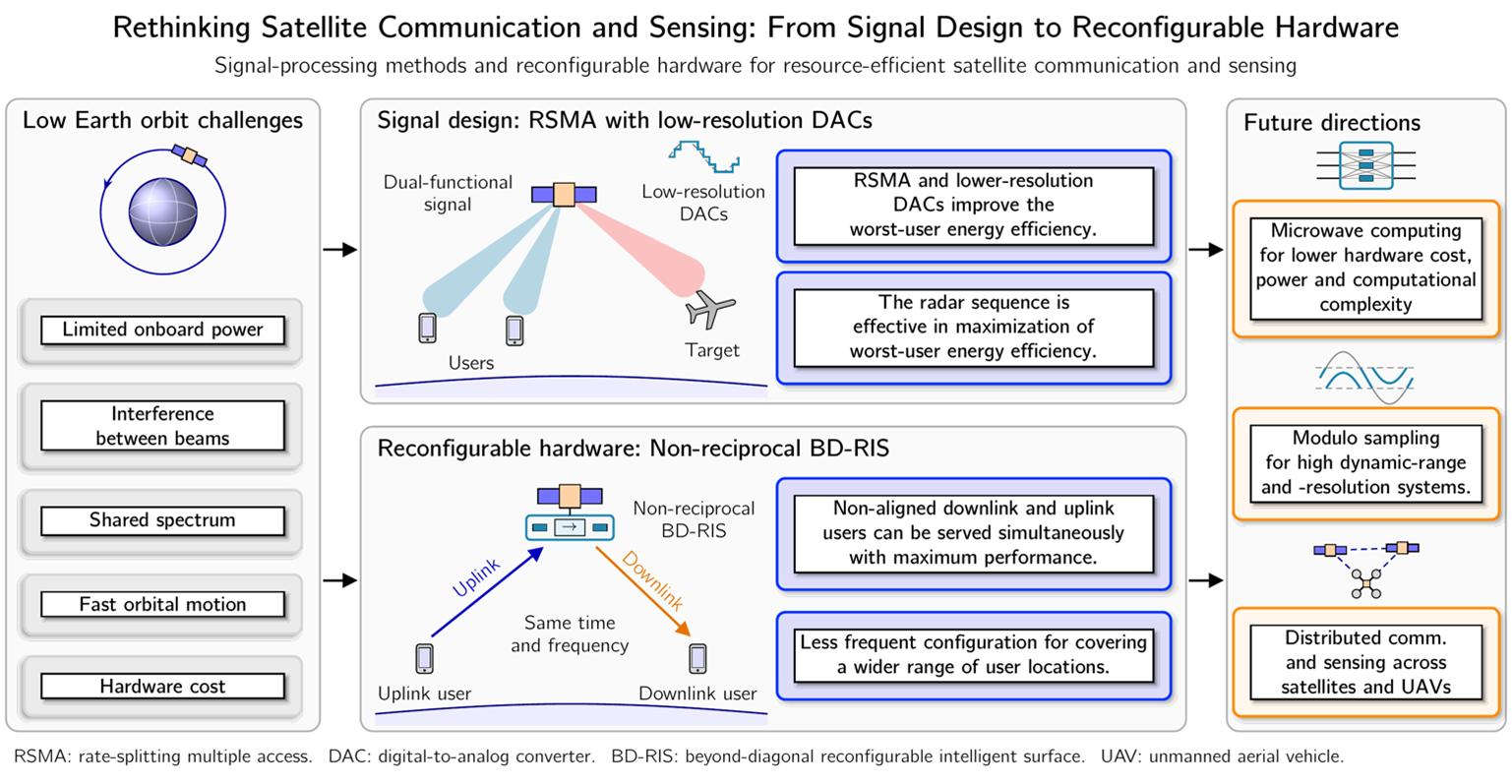
Low Earth orbit (LEO) satellites provide global connectivity and can also sense targets from space. However, each satellite has limited onboard power, and communication and sensing share the scarce spectrum. In addition, fast orbital motion requires frequent beam redesign. To address these challenges, this talk shows how signal design and reconfigurable hardware can make satellite communication and sensing more resource-efficient.
We will first show how rate-splitting multiple access and low-resolution converters provide fair and energy-efficient service from a satellite that serves several users and senses a target with one signal. We will then introduce a non-reciprocal reconfigurable intelligent surface for full-duplex satellites. It serves uplink and downlink users in different directions at the same time and needs less frequent reconfiguration as the satellite moves. Finally, we will discuss future directions for satellites and low-altitude platforms, including microwave-domain processing, modulo sampling, and distributed communication and sensing.
Speaker
Dr Ziang Liu is a Postdoctoral Research Associate in the Communications and Signal Processing Group at Imperial College London. He received the PhD degree from Imperial College London in 2024. In 2023, he was a Visiting Researcher at Cornell University. His research develops signal-processing methods and reconfigurable hardware for resource-efficient satellite communication and sensing. His work covers integrated sensing and communications, full-duplex communications, beyond-diagonal reconfigurable intelligent surfaces, microwave linear analogue computers, and modulo sampling. He received the IEEE Transportation Electronics Fellowship Award in 2024 and second place in the IEEE Internet of Things Journal PhD Thesis Competition in 2025. He serves as an Associate Editor of IEEE Wireless Communications Letters and contributes to standardisation in the ETSI Industry Specification Group on Multiple Access Techniques.