Next-Generation 3D Self-Folding Fabric for Adaptive Thermoregulation in Athletes
Other Articles

Novel Dual-Mode Textile Enables Switching Between Warming and Cooling
Study conducted by Prof. Dahua SHOU  and his research team
Athletes often train and compete in environments that change quickly. A runner may start in cool morning air and finish under intense sunlight; a hiker or high-altitude athlete may face wind, cold and strong solar radiation within the same session. Traditional sportswear is usually designed for one condition: insulation for cold weather, or breathability and cooling for heat. When the environment shifts, athletes must add, remove or carry extra layers, which is not always practical.
Thermal discomfort is more than an inconvenience. Overheating can impair endurance and increase heat-stress risk, while sudden cooling after exertion can accelerate heat loss and discomfort. To address this problem, Prof. Dahua SHOU, Lee Family Young Scholar in Advanced Textiles Technology and Associate Professor of the School of Fashion and Textiles at The Hong Kong Polytechnic University, and his research team have developed a fabric that can adapt structurally, offering both warming and cooling functions in a single textile system. The novel invention was evaluated, and the results were published in Nano-Micro Letters [1].
The Invention: A Dual-Mode Self-Folding Fabric
The team introduced an all-weather 3D self-folding knitted fabric for adaptive personal thermoregulation. In its relaxed 3D state, the fabric traps still air and provides high thermal resistance of 0.06 m2 K W-1 for warming. When stretched into a flatter 2D state, its coated surface reflects sunlight and emits infrared heat, achieving 89.5% solar reflectivity, 93.5% infrared emissivity and a 4.3 °C cooling effect under sunlight.
The key innovation is not only the material chemistry, but also the fabric architecture. Instead of relying on a static textile with fixed thermal properties, this fabric changes shape to regulate heat transfer.
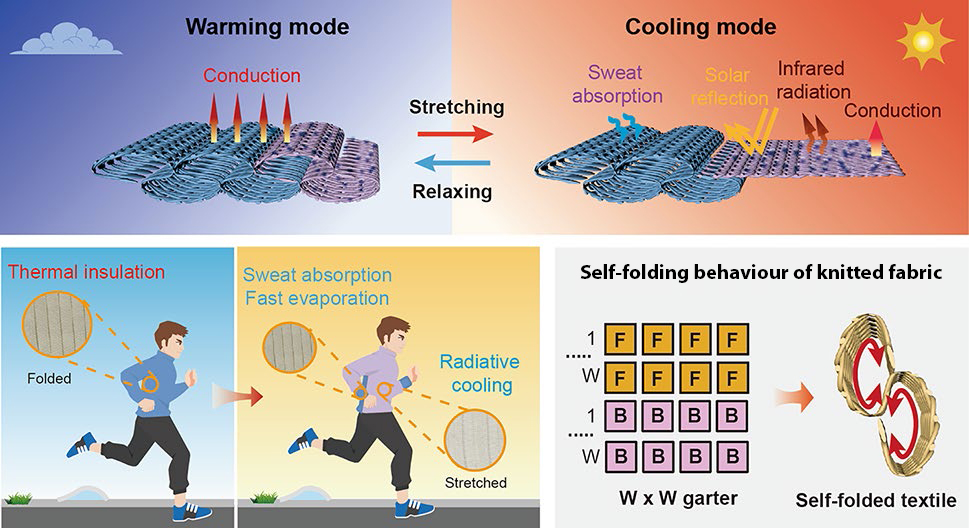
Figure 1. Schematic of a dual mode textile demonstrating warming mode and cooling mode, and the design of the fabric
As illustrated in Figure 1, in warming mode, the knitted textile remains in its natural 3D folded form, where the folded structure creates air-filled cavities within the fabric. Since still air has very low thermal conductivity, these cavities act as insulation, reducing heat loss from the body. The folded structure also limits air movement between cavities, reducing convective heat transfer.
In cooling mode, the fabric is manually stretched, changing the textile from a thick 3D structure into a thinner 2D form. The reduced thickness supports heat transfer away from the skin, while the coated surface manages radiative heat exchange. TiO2 enhances solar reflection, while polydimethylsiloxane (PDMS) supports high infrared emission. Together, they help the fabric reflect incoming solar energy and release body heat through infrared radiation.
This dual-mode concept is particularly relevant for outdoor sports, where athletes need both cold protection and solar heat management without changing garments.
3D Knitting: The Engine of Self-Folding
The fabric was manufactured using a scalable flat weft knitting technique with commercially available yarns, including cotton and Coolmax. Cotton contributed structural stability, while Coolmax supported moisture-wicking and evaporation.
The self-folding behaviour comes from the arrangement of front and back stitches in a garter structure. By combining these stitch types, the fabric naturally curls and folds after knitting, without requiring complex post-processing.
Different garter structures were tested, including 5 × 5, 7 × 7 and 10 × 10 configurations. Increasing the number of courses increased both thickness and elongation. For example, the 5 × 5, 7 × 7 and 10 × 10 fabrics reached elongation ratios of 100%, 140% and 200%, respectively, while larger structures became more prone to self-weight elongation and instability.
The study identified the 7 × 7 garter structure as a balanced design, offering effective folding, stretchability and stability. In this structure, the fabric thickness decreased from 4.37 mm in the folded state to 1.23 mm when stretched, enabling a clear switch between insulation and heat release.
Warming Mode: Trapping Still Air
In cold conditions, the fabric works as an insulating layer. The relaxed 3D structure traps still air within the folded cavities, reducing thermal conduction and convection.
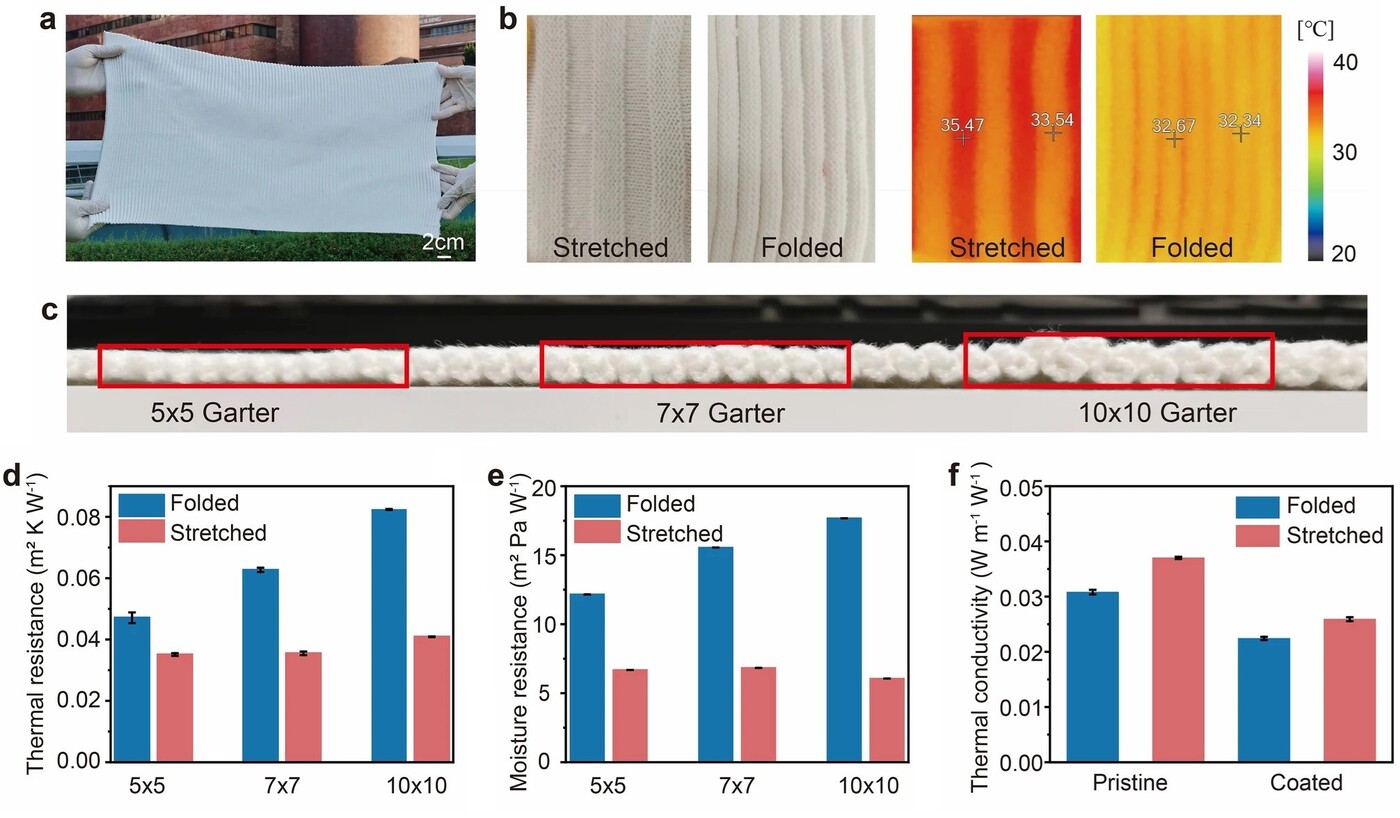
Figure 2. Thermal properties of the fabric in warming mode. (a) The textile for warming mode (b) The fabric under stretched and folded states (c) The fabric with 5 × 5, 7 × 7 and 10 × 10 garters (d-f) Thermal resistance, moisture resistance and thermal conductivity of the pristine fabric in folded and stretched states.
Figure 2 shows the fabric in warming mode and illustrates the detailed testing results. The results show that the 7 × 7 garter fabric had a thermal resistance of 0.0627 m2 K W-1 in its folded state. When stretched, thermal resistance decreased to 0.0355 m2 K W-1. This confirms that the fabric's thermal performance can be tuned simply by changing its architecture.
The thicker folded state is suitable for warming, while the thinner stretched state supports cooling. Thermal imaging also showed that folded fabric retained more heat than stretched fabric, with a temperature difference of more than 1 °C between the two states on a hotplate.
This structure-driven warming mechanism is valuable because it does not require batteries, phase-change packs or active heating elements. The fabric uses geometry and air management to reduce heat loss.
Cooling Mode: 89.5% Solar Reflectivity
For cooling, parts of the fabric were coated with TiO2 and PDMS. The optimised coating used a TiO2 particle weight ratio of 4.5% and was applied twice. This provided strong optical performance while avoiding excessive stiffness.
The coated fabric reached 89.5% solar reflectivity, compared with 78% for the pristine fabric. This higher reflectivity reduces solar heat absorption, which is crucial for athletes exposed to direct sunlight.
The coating also achieved 93.5% emissivity in the mid-infrared range. High infrared emissivity allows the fabric to release heat effectively, particularly through the atmospheric window. Under outdoor sunlight, the coated stretched fabric was up to 4.3 °C cooler than the pristine fabric. Under a solar simulator, the cooling difference reached 4.9 °C.
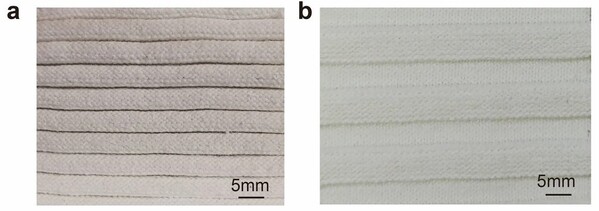
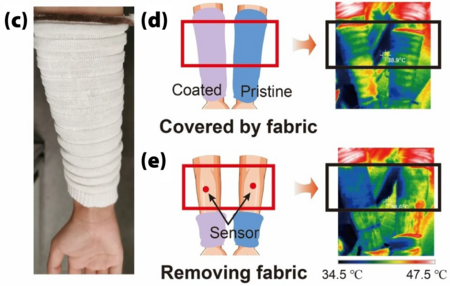
Figure 3. Thermal properties of the fabric in cooling mode. (a) The coated folded fabric (b) The coated stretched fabric (c) Arm with a sleeve made of coated fabric (d, e) Schematic and thermal images of arms covered by the coated and pristine fabrics, and the fabrics removed after exposure.
Wearable sleeve tests further demonstrated body-level relevance (Figure 3). When worn on the forearm under solar exposure, the coated fabric reduced skin temperature by more than 1 °C compared with the pristine fabric.
Breathability, Moisture and Wear Comfort
Adaptive thermal performance is only useful if the fabric remains wearable. The study thus assessed moisture transport, air permeability, stretch recovery, durability and washability.
The fabric retained good air permeability in both modes. For pristine fabric, air permeability decreased from 27.56 to 22.44 mL s-1 cm-2 when stretched. The fully stretched coated fabric still maintained 18.7 mL s-1 cm-2, indicating that the coating reduced but did not eliminate breathability.
Water vapour transmission tests showed that the fabric in cooling mode still allowed moisture to escape, helping maintain comfort during exercise. The use of Coolmax yarn also improved liquid moisture management. The 3D fabric achieved a water absorption rate of 387.89%, higher than that of the commercial comparison fabric at 210.41%. Its evaporation rate was also higher, at 1.182 g h-1 compared with 1.035 g h-1.
Durability results were encouraging. The fabric endured more than 1,000 folding and stretching cycles, with recovery improving over time. After 24 hours, coated fabrics showed stretching recovery rates below 5%, and after 48 hours the residual deformation was almost negligible. Washing tests showed minimal weight loss, suggesting good coating stability. Tensile testing also indicated that the coating strengthened the fabric, with the coated fabric reaching a maximum load of 245.9 N, approximately 2.73 times that of the pristine fabric.
Implications for Sports Science and Apparel Design
This research addresses a practical challenge in sportswear: how to support athletes across changing thermal environments without requiring multiple clothing layers. The self-folding fabric provides a passive, switchable system that can insulate in cold conditions and cool under sunlight.
Potential applications include those for endurance running, hiking, cycling, mountaineering, outdoor labour and travel apparel. For product developers, the use of scalable knitting and commercially available yarns is particularly important. The design does not depend on electronics or complex active systems, making it more realistic for textile manufacturing.
From a sports science perspective, the fabric also highlights the importance of multi-mechanism thermoregulation. Effective clothing should not only reflect sunlight or provide insulation, but also manage conduction, convection, radiation, breathability and sweat transport.
In conclusion, this study introduces a promising all-weather 3D self-folding knitted fabric that adapts to both cold and hot conditions through structural transformation. For athletes and outdoor professionals, such textiles could reduce dependence on layering, improve comfort in unstable weather and support safer performance in increasingly unpredictable climates.
Prof. Shou was recognised by Stanford University as one of the top 2% most-cited scientists worldwide (career-long & single-year) in the field of materials for four consecutive years, from 2022 to 2025. Over 100 peer-review papers have been published in prestigious journals such as Science and Science Advances. He is a leading expert in advanced textiles, intelligent wearables, and thermal and moisture management. His groundbreaking intelligent soft robotic clothing "iAdapt" recently won the Gold Award in the "Consumer Solutions" category at the 2026 Edison Awards. His innovative contributions have earned him numerous prestigious awards, including Gold Medals at the International Exhibition of Inventions of Geneva in 2024 and 2025, with Congratulations of the Jury in 2025, and the TechConnect Global Innovation Award in 2021 and 2022. In recognition of his outstanding contributions to textile research, he received the Fiber Society’s 2023 Distinguished Achievement Award. Prof. Shou currently serves as a Governing Council Member and Deputy Director of The Fiber Society (USA) and Associate Director of the Intelligent Fiber and Wearable Technology Committee of the China Textile Engineering Society, and served as Chair of the Fiber Society Spring 2025 Conference in Hong Kong.
| References |
|---|
[1] Zhang, X., Gu, Y., Chao, X., Wang, Z., Wu, S., Xu, J., ... & Shou, D. (2025). All-weather 3D self-folding fabric for adaptive personal thermoregulation. Nano-Micro Letters, 17(1), 290. https://doi.org/10.1007/s40820-025-01812-2
[2] Shou, D., & Li, Z. (2025). Sustainable personal cooling in a warming world. Science, 389(6763), 877-878. https://www.science.org/doi/full/10.1126/science.adt9536
[3] Shou, D., & Li, Z. (2025). Personal moisture management by advanced textiles and intelligent wearables. Advanced Materials, 37(48), e08831. https://advanced.onlinelibrary.wiley.com/doi/full/10.1002/adma.202508831
 | Prof. Dahua SHOU Lee Family Young Scholar in Advanced Textiles Technology |