Breaking the Vicious Cycle: Psoas Major Stiffness and Low Back Pain
Other Articles

New Insights from Elite Athletes in High-Risk Sports
Study conducted by Prof. Amy Siu Ngor FU  and her research team
Low back pain (LBP) is a major challenge in sport, particularly in disciplines that demand repeated spinal loading, extreme ranges of motion and explosive trunk–hip control. For athletes, LBP is not only a clinical problem. It affects athletes’ competitive performance and also leads to an early ending of their sporting life. The psoas major (PM) muscle, the only muscle that links the torso and the leg, has long been proposed as being a contributor to LBP; the evidence, however, has remained unclear.
Located deep in the low back, the PM muscle attaches directly to the lumbar vertebrae of T12 to L5 and their intervertebral disc. It travels downward at the front of the hip and ends as a tendon into the lesser trochanter of the hip. It plays an important role in stabilisation of the spine; it contributes to flexion and allows for extension of the hip joint. In sports involving rapid kicking, trunk bending, jumping, landing and high-speed changes in body position, requiring both strength and flexibility, the PM muscle are the foundation for trunk-hip control. The question is whether muscle stiffness could be associated with chronic LBP in high-performance athletes.
To address this issue, Prof. Amy Siu Ngor FU, Associate Head (Rehabilitation Sciences) and Peter Hung Professor in Pain Management of the Department of Rehabilitation Sciences at The Hong Kong Polytechnic University, and her research team investigated whether the mechanical properties of the PM muscle, particularly stiffness, are associated with chronic LBP in elite athletes. Their research compared PM stiffness, strength and joint flexibility in elite athletes with and without chronic low back pain, and examined whether these muscle properties were related to pain intensity and sport-related dysfunction among symptomatic athletes. The results were published in Sports Medicine – Open [1].
The team found that elite athletes with chronic LBP showed higher PM stiffness on the pain-affected side compared with athletes without LBP. This was more pronounced when pain occurred on the dominant side. Importantly, greater PM stiffness was also associated with greater LBP-related dysfunction. By contrast, PM strength and hip extension range, used as an indicator of flexibility, were not significantly associated with chronic LBP.
A high-risk athletic setting
The study recruited 99 full-time elite athletes aged 10 to 32 years from provincial gymnastics and wushu teams. Of these, 53 athletes had chronic LBP, defined as pain located between the lower margin of the 12th rib and the buttock crease, with or without persisting or fluctuating leg pain for more than three months. The control group comprised athletes who had not experienced LBP in the previous three months.

Gymnastics and wushu participants are particularly relevant populations for this investigation. Both sports place high physical demands on the lumbar spine and hip complex. Gymnasts frequently perform repeated trunk extension, flexion, rotation, jumping, landing and extreme-range movements. Wushu athletes perform rapid kicking, deep stances, high-velocity trunk movements and dynamic transitions that require precise control of the pelvis, spine and lower limbs.
In both sports, the PM muscle must contribute to hip motion while helping to stabilise the lumbar spine under demanding and often asymmetrical loading conditions. This makes it a muscle of particular interest. If excessive stiffness develops, it may alter trunk-hip control. If LBP changes muscle activation patterns, the PM muscle may also become stiffer as a protective or compensatory response. This raises the possibility of a vicious cycle: pain may increase stiffness, and increased stiffness may further compromise movement and spinal loading.
Measuring stiffness with ultrasound imaging
A major strength of the study was the development of an objective approach for measuring the stiffness of the PM, which is located about 5cm from the skin surface. An ultrasound shear wave elastography (SWE), a non-invasive imaging technique that quantifies muscle stiffness by measuring shear-wave propagation through tissue, was used to quantify regional information about the mechanical behaviour of the muscle itself.
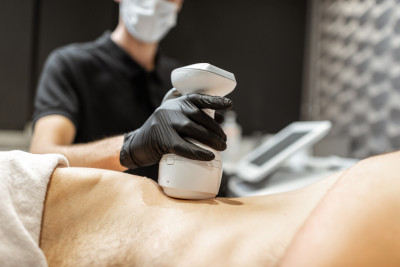
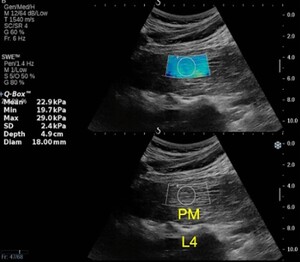
Figure 1. Anatomical adjacencies and ultrasound SWE measurement of PM
During imaging, athletes were positioned side-lying with the spine and upper leg maintained in neutral alignment. Cushions were used to support consistent positioning of the trunk, hips and lumbar spine. A low-frequency curvilinear ultrasound probe was placed above the iliac crest along the mid-axillary line and adjusted to visualise the L4 vertebra beneath the psoas major. Images were acquired along the long axis of the muscle fibres (Figure 1). To minimise the influence of recent training, all assessments were performed approximately 30 hours after the athletes’ last scheduled training session. This method was found to have high test-retest reliability.
PM strength was measured using a handheld dynamometer in a position designed to target the psoas more specifically than general hip flexor testing. Flexibility was assessed using the modified Thomas test, with hip extension range measured by a goniometer. Pain severity was assessed using the Numeric Pain Rating Scale, while sport-related dysfunction was assessed using the Oslo Sports Trauma Research Center (OSTRC) Questionnaire on Health Problems.
Greater stiffness in athletes with low back pain
The results showed a significant association between chronic LBP and increased PM stiffness on the affected side. After adjusting for potential confounding factors including age and body mass index, athletes with pain on the dominant side had 17.2% higher PM stiffness than controls (Figure 2a). This represented a mean difference of 3.21 kPa and exceeded the minimal detectable change reported in previous reliability work, suggesting that the difference was not only statistically significant but also clinically meaningful.
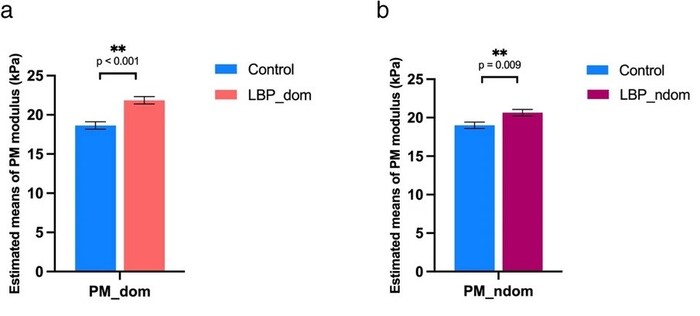
Figure 2. PM stiffness of the (a) dominant side and (b) non-dominant side between LBP and non-LBP control groups
Athletes with pain on the non-dominant side also showed higher PM stiffness than those in the control group, although the difference was smaller. Their affected-side PM stiffness was 8.7% higher, with a mean difference of 1.65 kPa (Figure 2b). This finding was statistically significant, but the magnitude was below the minimal detectable change, indicating that it should be interpreted more cautiously.
The stronger effect on the dominant side is particularly relevant in elite sport. Dominant-side movements often involve greater technical emphasis, repeated loading and higher force production. In sports such as wushu, for example, the dominant leg may be used more frequently for high-speed kicking or leading movements. Over time, this may expose the dominant-side PM muscle to greater mechanical demand, potentially contributing to regional adaptations in stiffness.
Stiffness relates to sport-related dysfunction
One of the most important findings was that PM stiffness was not merely different between groups. It was also related to functional impact among athletes with chronic LBP. In athletes who experienced pain on the dominant side, higher PM stiffness showed a moderate positive correlation with scores on the OSTRC Questionnaire (Figure 3). In practical terms, athletes with stiffer PM muscles tended to report greater problems in sport participation, amount of training, performance and pain.
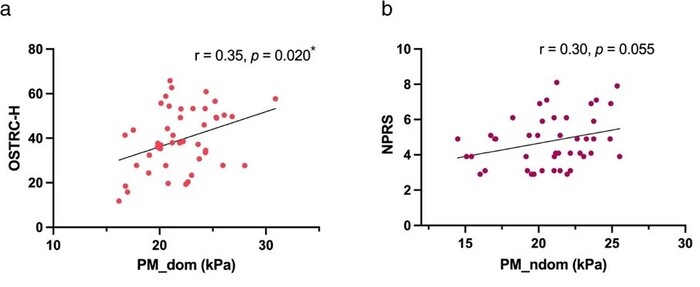
Figure 3. Association between PM stiffness and severity of LBP on the (a) dominant side and (b) non-dominant side
This association is important because athletic LBP should not be evaluated only by pain intensity. In competitive sport, the key concern is often whether an athlete can train fully, perform technical skills and tolerate sport-specific loading. A muscle property that relates to sport-related dysfunction may therefore be highly relevant to performance management and rehabilitation planning.
Interestingly, PM stiffness did not show the same clear relationship with pain intensity. This suggests that stiffness may be more closely linked to movement limitation and performance-related consequences than to perceived pain alone. Increased stiffness might act as a protective strategy to restrict movement around the painful region, but this same response could interfere with the mobility, coordination and dynamic control needed in gymnastics and wushu.
By contrast, PM strength and hip extension range were not significantly associated with chronic LBP, pain intensity or dysfunction. This does not mean strength and flexibility are unimportant in athlete care. Rather, it indicates that conventional measures may not fully capture the relevant changes in a deep stabilising muscle such as the PM muscle.
Towards a stiffness–pain cycle
The findings support a possible two-way relationship between PM stiffness and LBP. Increased psoas tension may raise compressive and shear forces on the lumbar spine, particularly around the lower lumbar segments, potentially contributing to discomfort or dysfunction. At the same time, chronic pain may alter neuromuscular control, leading to protective muscle activation, co-contraction or spasm, which could increase PM stiffness.
In this sense, PM stiffness and LBP may reinforce each other. A stiffer PM muscle may alter spinal loading and reduce dynamic control. Pain may then promote further protective stiffness. For athletes in high-risk sports, this cycle could affect both symptoms and performance.

Overall, this study provides evidence that PM stiffness is associated with chronic LBP and sport-related dysfunction in elite gymnastics and wushu athletes. The association was strongest when pain occurred on the dominant side. In contrast, PM strength and flexibility were not significantly related to LBP. The findings highlight the potential value of assessing regional PM stiffness when managing athletes with LBP. While further longitudinal and interventional studies are needed to clarify cause and effect, PM stiffness may become an important marker for understanding LBP risk, guiding rehabilitation and supporting performance in high-demand sports.
Prof. Fu is a physiotherapist specialising in sports training and rehabilitation. She is the Programme Leader of the Master of Science in Sports Physiotherapy programme at PolyU. Her research focuses on sports injuries, particularly chronic pain and dysfunction associated with tendons and muscles, as well as the early detection, assessment and rehabilitation of musculotendinous problems to optimise athletes’ movement and sports performance. She has developed several wearable devices for knee pain, earning a Silver Medal at the 2023 Geneva International Exhibition of Inventions, a Gold Medal in 2024 and a Bronze Medal at the 4th Asia Exhibition of Innovations and Inventions Hong Kong in the same year. Since 2008, Prof. Fu has been invited by the National and Provincial Sports Bureaux of the Chinese Mainland to serve as a sports rehabilitation expert for major games, including the Paris 2024 Olympic Games. She has led the Departmental Sports Physiotherapy team, serving the Sport Associations under the China HK Olympic Committee, sport teams within PolyU and the Sports Clinic under the PolyU Rehabilitation Clinic.
| References |
|---|
[1] Zhou, E.F.M., Wong, A.Y.L., Lin, G., Huang, J., Fang, J., Liang, W., Cai, X. & Fu, S.N. Differences in Psoas Major Muscle Properties Between Elite Athletes with and Without Chronic Low Back Pain. Sports Med - Open 12, 20 (2026). https://doi.org/10.1186/s40798-026-00983-5
 | Prof. Amy Siu Ngor FU Associate Head (Rehabilitation Sciences) and |