More Than Just a Tight Fit?
Other Articles

A Validated Biomechanical Model Reveals the Secrets Beneath the Fabric
Study conducted by Prof. Joanne Yiu Wan YIP  and her research team
Designed to "stabilise muscles and boost circulation", whether for running, weight training or post-workout recovery, compression leggings are widely used by athletes and fitness enthusiasts. In the past, compression wear was designed based on how "tight" it felt on the outside. In reality, the effectiveness of compression wear depends on how pressure is distributed and how deep muscles handle the load. When a fabric hugs the body, what actually happens to the fat and deep muscles beneath the skin is something that is perhaps not widely considered.
To address this issue, Prof. Joanne Yiu Wan YIP, Associate Dean and Professor of the School of Fashion and Textiles at The Hong Kong Polytechnic University, led her research team to develop a pioneering subject-specific 3D biomechanical model of the female lower body. Their breakthrough study was published in the Journal of Bionic Engineering [1].
Inside the Body: Three Key Discoveries Under Compression
What makes this study unique is the team's use of high-resolution MRI data to precisely reconstruct the skin, bones and nine major muscle groups of the female lower body, including the gluteus maximus, rectus femoris and gastrocnemius (Figure 1). Through in vivo indentation testing, they also simulated the actual stiffness of different tissues.
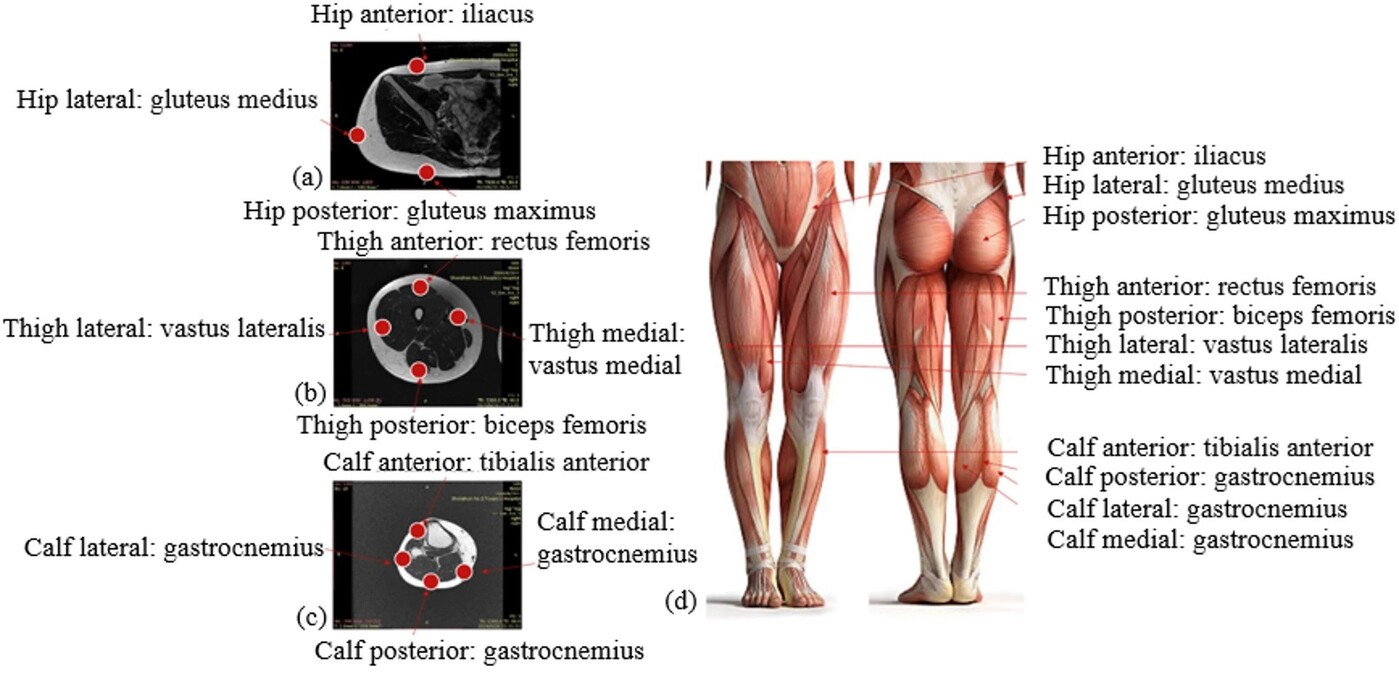
Figure 1. In vivo indentation test points on the anatomical structure of (a) the hip, (b) the thigh, and (c) the calf sections, evaluated at four positions: anterior, posterior, medial and lateral. (d) corresponding plan view
When the 3D model "wore" the specialised compression leggings, three striking discoveries were revealed:
1. Pressure Distribution: Tightest at the Calves, Loosest at the Hips
Contrary to popular expectation, the compression applied to the leg is not uniform across the entire limb. The simulation in Figure 2 shows that the calf experiences the highest surface pressure (approx. 2158 Pa), while the lower hip receives the lowest (approx. 1050 Pa). Because the calf has less fat, stiffer muscle tissue and a smaller circumference, it pushes back against the fabric with the greatest force.
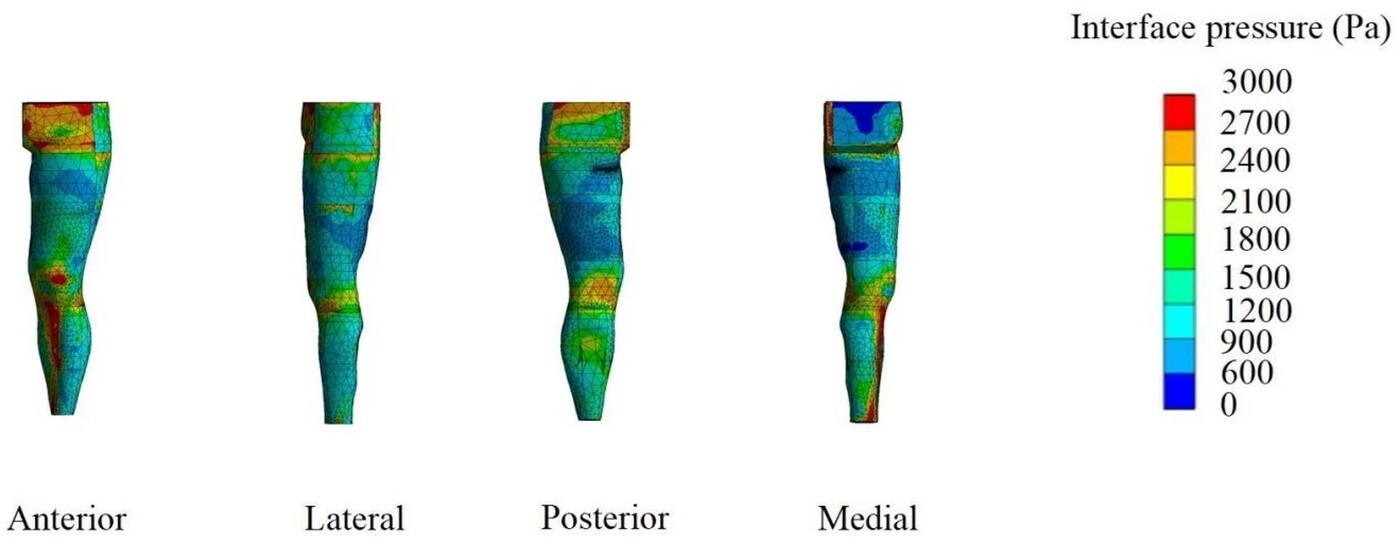
Figure 2. Simulation interface pressure caused by compression leggings
2. Soft Tissue Deformation: High Pressure Does Not Mean High Displacement
Soft tissue deformation followed a different pattern. The greatest simulated deformation occurred in the hip region and progressively decreased towards the ankle (Figure 3). Surprisingly, the greatest shape change occurs in the hip area—deforming by up to 9.43 mm due to its higher volume of compliant soft tissue (fat and muscle). Meanwhile, the calf, which experiences the highest pressure, deforms by a mere 0.76 mm. This indicates that designers must account for the actual "displacement" of fat when tailoring different panels of a garment.
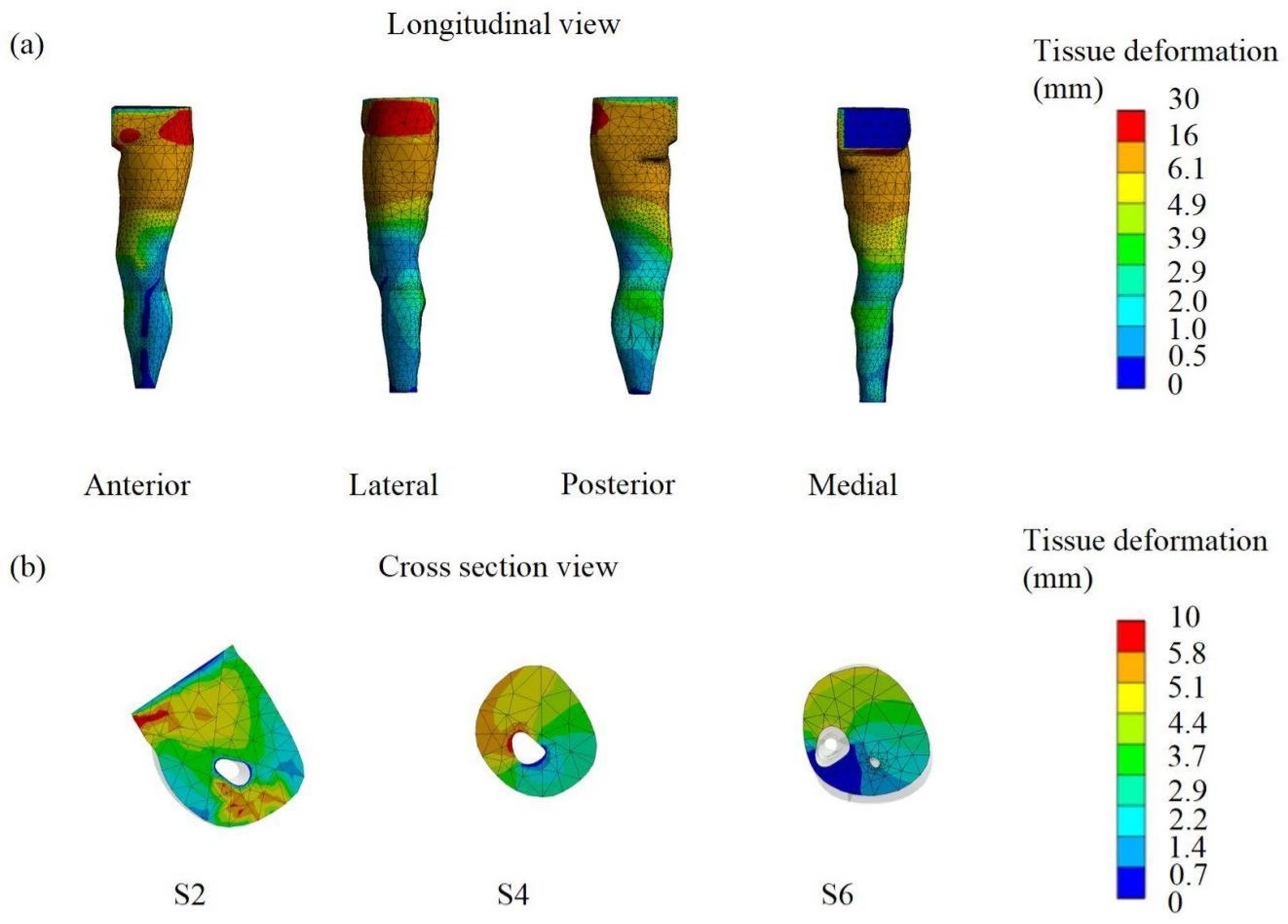
Figure 3. Simulated tissue deformation caused by compression leggings: (a) longitudinal views and (b) cross-sectional views at the low hip, thigh and calf, respectively
3. Deep Muscle Stress: The Tibialis Anterior Experiences the Most Squeeze
External pressure travels deep. The model revealed that the tibialis anterior (front of the calf) experiences the highest internal stress at 3338 Pa, followed closely by the outer thigh muscles. Moderate internal stress is beneficial—it compresses blood vessels to speed up blood flow and aid recovery. However, excessive stress can cause fatigue and discomfort.
The Future of Compression: From "Squeezing Everything" to "Precision Mapping"
Through this research, Prof. Yip suggests that the development of the deformation-aware interactive design system enables us to "communicate" with the body, rather than blindly wrapping fabric around it. With this dynamic 3D model, future compression leggings will move away from generic "one-size-fits-all-tightness" designs. Instead, they will use "precision gradient compression"—utilising fabrics with different elasticities mapped directly to local muscle stiffness and bone locations. This means firm support for the calves to boost circulation, together with comfortable shaping for the hips, achieving a true "second skin" fit.
Building on this biomechanical foundation, the team further developed a deformation-aware interactive design system powered by a physically-constrained PointNet model [2]. Trained on extensive 3D scan data, it delivers real-time predictions of soft-tissue deformation and pressure. Fashion designers can now use an intuitive interface to visualise, tweak and optimise compression leggings in a fast "tweak–predict–see–decide" cycle — transforming scientific insights into practical, precision garment design.
Prof. Yip was recognised by Stanford University as one of the top 2% most-cited scientists worldwide (career-long) in the field of materials for two consecutive years, from 2024 to 2025, and one of the top 2% most-cited scientists worldwide (single-year) for four consecutive years, from 2021 to 2024). As a leading expert in new materials and technology, her inventions have earned her numerous prestigious prizes, including four Gold Medals at the International Exhibition of Inventions of Geneva in 2012, 2015, 2017 and 2023, including the rare Congratulations of the Jury in 2017 and 2023, two Gold Medals (2019 and 2024) and the Special Prize of the Korea Invention Promotion Association (2024) at the Silicon Valley International Invention Festival, the Asia International Innovation Invention Award (Gold Award) from the Hong Kong Federation of Innovative Technologies and Manufacturing Industries in 2023, and the Champion at the 4th Hong Kong Innovation Day in 2020.
| References |
|---|
[1] Li, X., Ye, C., Song, H. et al. Biomechanical Effects of Compression Leggings: 3D Finite Element Analysis of Pressure, Tissue Deformation, and Muscle Stress. Journal of Bionic Engineering (2026). https://doi.org/10.1007/s42235-026-00968-w
[2] Li, X., Yip, J. & Ye, C. 2026. Beyond Rigid Avatars: A Deformation-Aware Interactive System for Garment–Body Design Exploration. In Proceedings of the 2026 Conference on Creativity and Cognition (C&C '26). Association for Computing Machinery, New York, NY, USA, 1713–1717. https://doi.org/10.1145/3803784.3816884
 | Prof. Joanne Yiu Wan YIP Associate Dean and Professor, School of Fashion and Textiles |