A Winning Stride for Marathon Runners
Other Articles

How Coordination and Impact Control Shape Endurance Performance
Study conducted by Ir Prof. Ming ZHANG  and his research team
Running continues to grow in popularity worldwide as an accessible way to improve fitness, health and well-being. Marathon running, in particular, has become increasingly popular among recreational and competitive runners. Yet a marathon is not simply a test of endurance. Over 42 km, the body experiences thousands of repeated impacts, while fatigue gradually challenges movement control, balance and shock absorption.
As runners tire, their gait may change. Some changes may help them maintain stability, while others may increase mechanical load on muscles, joints and soft tissues. Understanding these adaptive strategies is important for coaches and runners who aim to improve their marathon preparation and reduce injury risk.
As published in the Journal of Science and Medicine in Sport [1], Prof. Ming ZHANG, Head and Chair Professor of the Department of Biomedical Engineering at The Hong Kong Polytechnic University, and his research team investigated how runners adapted their lower-limb coordination and impact loading during a full outdoor marathon, with particular attention to the effects of mileage and straight versus curved running paths.
The study aimed to examine two key biomechanical indicators during prolonged running: intersegment coordination variability and impact shock. Intersegment coordination variability describes how consistently body segments, such as the pelvis, thigh, shank and rearfoot, move together from stride to stride. Some variability is normal and may help the body adapt. However, large or poorly controlled variability may indicate fatigue-related changes in motor control and load distribution. Impact shock refers to the acceleration transmitted through the body during landing. In this study, shock was measured at the tibia and pelvis, providing insight into how effectively runners absorbed repeated impacts as the marathon progressed. The team expected both coordination variability and impact shock to increase with mileage and to be affected by curved running.
Outdoor Marathon Monitoring with IMUs
Twenty-three experienced male amateur runners completed a self-paced 42 km run on a circular outdoor track. They were sub-elite marathoners, with an average marathon performance of under 3.5 hours in the previous year.
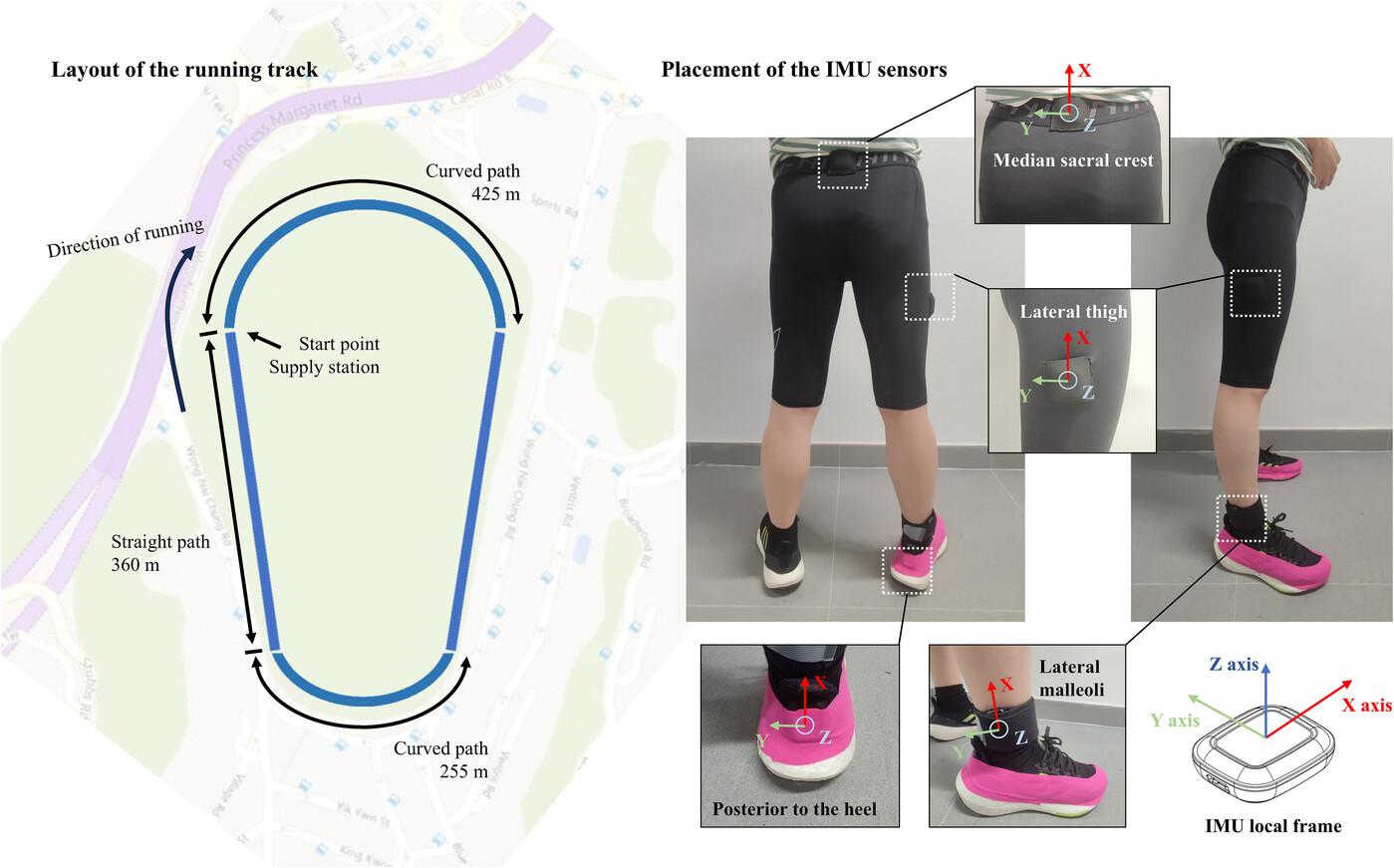
Figure 1. The layout of the running track and placement of IMU sensors on a runner's body
The track was 1.4 km long and included two straight sections and two curved sections (Figure 1). Each runner completed 30 laps. Unlike treadmill-based studies, speed was not controlled, allowing runners to pace themselves naturally.
Four wearable inertial measurement units (IMUs) were attached to the pelvis, right thigh, right shank and right rearfoot respectively (Figure 1). These sensors recorded three-dimensional movement continuously throughout the run. IMUs are valuable in sports science because they allow researchers to monitor athletes in real-world environments without the restrictions of a laboratory.
Data were analysed every 5 km from the 2nd km to the 42nd km. The first 2 km were excluded to avoid early habituation effects. The team compared movement patterns on straight and curved paths and adjusted the analysis for factors including running speed, age, BMI, running experience and the amount of weekly training.
Sagittal-Plane Variability Increased
One major finding was that coordination variability generally increased in the sagittal plane as mileage accumulated (Figure 2). The sagittal plane includes forward-backward movements such as hip, knee and ankle flexion and extension, which are central to running propulsion and landing shock absorption.
The most significant mileage-related change was found in the coordination between the shank and rearfoot in the sagittal plane. Variability in this coupling was significantly higher at the 37th km and 42nd km than at the 2nd km. On average, running for 40 km increased shank–rearfoot sagittal coordination variability by 2.15°. This suggests that, near the end of a marathon, the relationship between lower-leg and foot motion becomes less consistent. Since the shank and rearfoot are important for foot strike, ankle control and impact absorption, this change may reflect fatigue-related disruption to the normal landing strategy.
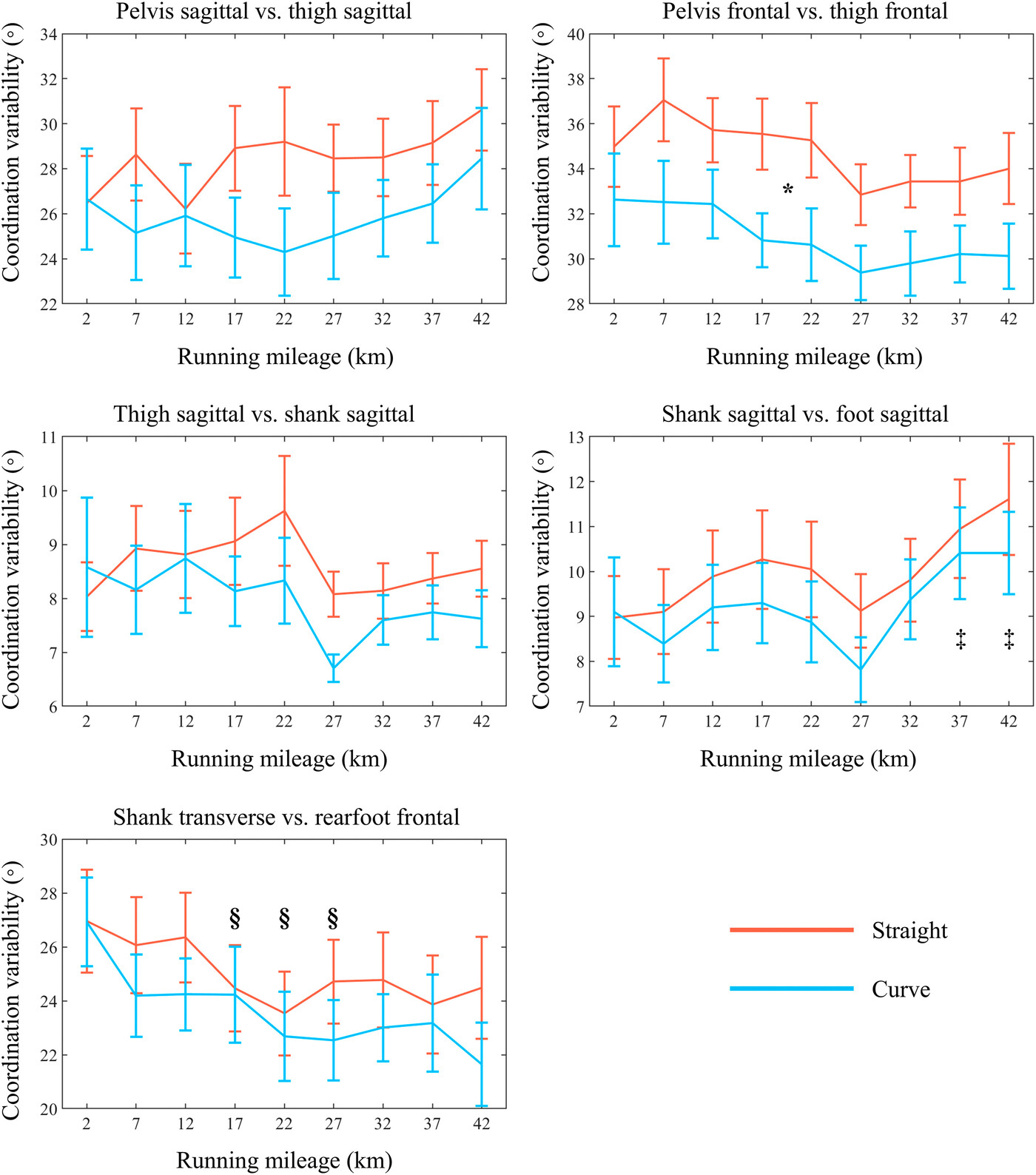
Figure 2. Changes in the coordination variabilities of all coupling pairs during the marathon. The bars represent the standard errors of the mean. ‡ and § indicate significant differences between the 2nd km and other mileage checkpoints when pooling all track types. * indicates significant differences between the straight path and the curved path.
The results show that running form does not remain constant during a marathon. Even experienced runners show measurable changes in lower-limb coordination, especially in the latter stages of a race.
Non-Sagittal Variability Contained
The study also found a contrasting pattern in non-sagittal movements. These include frontal-plane and transverse-plane motions, such as side-to-side control, rotation and foot inversion or eversion.
Variability between shank transverse motion and rearfoot frontal motion significantly decreased by the 22nd km compared with at the 2nd km. This reduction occurred on both straight and curved paths, with decreases of 3.32° and 3.55°, respectively.
This suggests that runners may tighten control of lateral and rotational movements as a race progresses. Such a strategy may help maintain lower-limb alignment and stability when fatigue increases. However, reduced variability may also limit the body’s ability to distribute forces across different tissues. If movement becomes too constrained, certain muscles or joints may experience greater repeated loading.
This finding highlights the importance of training lower-limb control in multiple movement planes, not only in forward-running mechanics.
Curved Paths Demanded More Control
Curved track also had a significant effect. Coordination variability was generally lower on curved paths than on straight paths. The strongest result was observed in the pelvis–thigh coupling in the frontal plane, where curved running reduced coordination variability by 3.56°.
Running on curves requires the body to manage additional balance and directional demands. Runners must control centrifugal forces, adjust limb placement and maintain stability while continuing to move forward. The lower variability observed on curved sections suggests that runners adopt a more controlled and repeatable movement pattern when negotiating bends.
This may help explain why marathon routes with many turns can feel more demanding than straight courses. Curved paths may increase neuromuscular control requirements and alter workload distribution across the lower limbs. For athletes preparing for races with frequent turns, curved-path running should be included in training rather than treated as a minor course feature.
Tibial and Pelvic Shock Increased
Impact shock increased as the marathon progressed. After adjusting for running speed, tibial shock increased consistently with mileage (Figure 3). Every additional 5 km was associated with a 0.23 g increase in tibial shock. Tibial shock was also 0.53 g higher on curved paths than on straight paths.
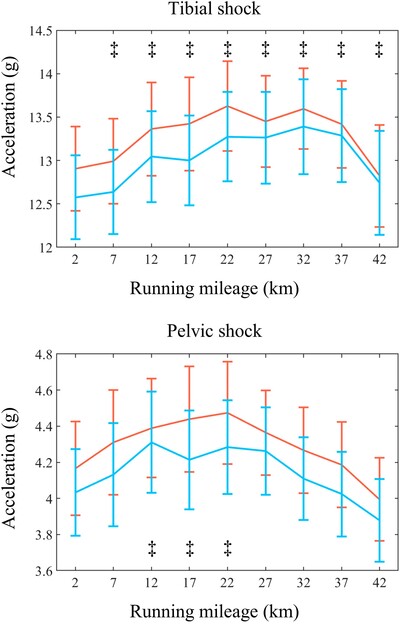
Figure 3. Changes in tibial shock and pelvic shock during the marathon. The bars represent the standard errors of the mean. ‡ indicates significant differences between the 2nd km and other mileages checkpoints, pooling all track types.
Pelvic shock also increased with mileage (Figure 3). Every additional 5 km was associated with an average 0.07 g increase in pelvic shock and pelvic shock significantly higher at the 22nd km than at the 2nd km.
Importantly, runners slowed down during the race. On straight paths, average speed dropped from 13.83 km/h at the 2nd km to 11.97 km/h at the 42nd km. On curved paths, speed decreased from 12.85 km/h to 10.50 km/h. Since slower running would usually reduce impact loading, the finding that shock still increased after adjusting for speed suggests that fatigue may compromise shock absorption.
In practical terms, slowing down may not fully protect runners from increased loading in the later stages of a marathon. Maintaining effective landing mechanics and lower-limb strength endurance remains essential.
Strategies for Runners
These findings suggest several training implications.
First, marathon training should target coordination stability, not only aerobic endurance. Runners need to maintain effective segment coordination over thousands of strides, especially between the shank and rearfoot.
Second, strength training should include multi-plane control. Traditional exercises such as squats, lunges and calf raises are useful, but runners may also benefit from exercises targeting ankle invertors and evertors, hip abductors and hip rotators. Examples include single-leg balance drills, resisted ankle inversion and eversion, lateral band walks and controlled turning drills.
Third, runners should practise under varied course conditions. Since curved paths increase control demands and tibial shock, training on bends, loops and courses with turns may better prepare athletes for real-world races.
Finally, wearable technology such as IMUs may help coaches and sports scientists monitor fatigue-related changes in running mechanics outside the laboratory. This could support more individualised training and injury-prevention strategies.
This study provides field-based evidence that runners actively adapt their movement strategies during a full marathon. As mileage increased, sagittal-plane coordination variability rose, while non-sagittal variability was constrained. Curved paths required more controlled coordination, and both tibial and pelvic shock increased over time, even after accounting for running speed.
Marathon running is not only about endurance and pacing. It is also about maintaining coordination, absorbing impact and adapting to environmental demands. Training programmes that develop multi-plane strength, coordination stability and curve-running ability may help runners sustain performance and better manage mechanical loading during prolonged running.
Prof. Zhang was recognised by Stanford University as one of the top 2% most-cited scientists worldwide (career-long) in the field of biomedical engineering for five consecutive years, from 2021 to 2025, and one of the top 2% most-cited scientists worldwide (single-year) for six consecutive years, from 2020 to 2025. His scientific research has earned him prestigious awards, including the Natural Science Award (First Class) of the 2015 Higher Education Outstanding Scientific Research Output Awards from the Ministry of Education of China, the Huang Jiasi Biomedical Engineering Award (First Class) from the Chinese Society of Biomedical Engineering in 2017 and the Young Scholar Award at the World Congress on Bioengineering from the World Association for Chinese Biomedical Engineers in 2019. He has served as the President of the World Association for Chinese Biomedical Engineers and Chair of the Chinese Society of Rehabilitation Engineering, and currently serves as a Councillor on the World Council of Biomechanics, a Committee Member of the Chinese Society of Biomechanics and Biomedical Division of Hong Kong Institute of Engineers, a Standing Council Member of the Chinese Society of Biomedical Engineering and Vice President of the China Rehabilitation Devices Association.
| References |
|---|
[1] Zhang, G., Fu, Y., Wei, L., Bing, F., Cai, H., Chen, T. L-W., Zhang, M. Continuously monitoring runners' adaptive strategies to prolonged running on an outdoor track with straight and curved paths: Insights from the varying intersegment coordination variability and shock absorption during a full marathon, Journal of Science and Medicine in Sport, 2025; 28, 858-866.
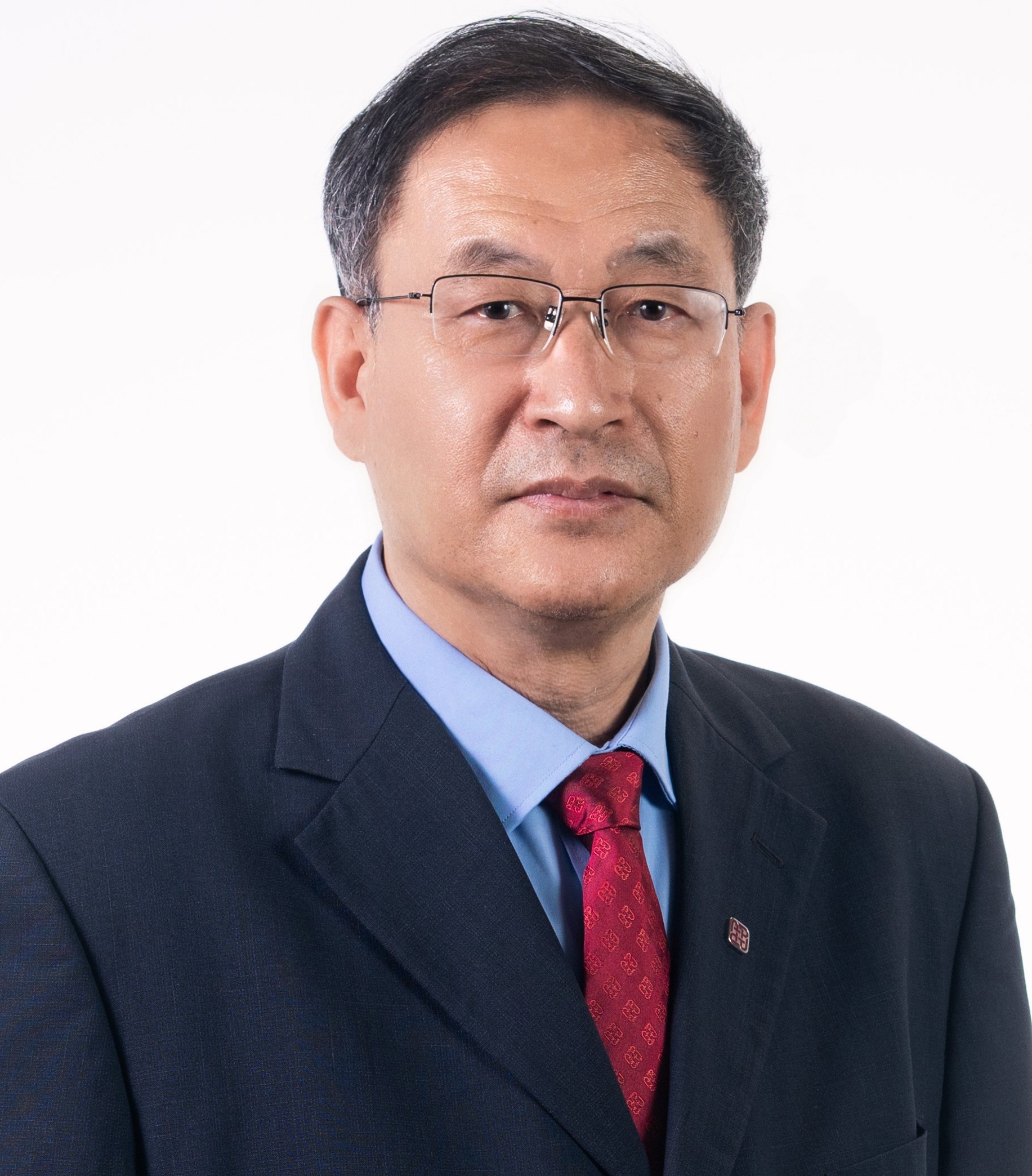 | Ir Prof. Ming ZHANG Head and Chair Professor of Biomechanics, |