Unlocking Spin Coherence in Chiral Perovskite Quantum Wells for Next-Generation Spintronics
Other Articles

How Quantum Well Engineering and Chiral Ligands Achieve Long-Lived Spin States in Metal Halide Perovskites
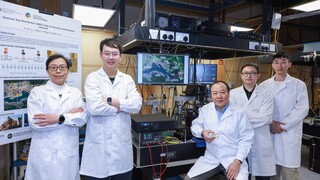
Study conducted by Prof. Mingjie LI  and his research team
Spintronics, the science of harnessing the electron’s spin as well as its charge, is poised to revolutionise information technology. By enabling devices that are faster, more energy-efficient and capable of storing data at higher densities than conventional electronics, spintronics holds the promise of a new era in computing and communications. At the heart of this field is the challenge of controlling and preserving spin coherence, especially at room temperature, which is essential for practical applications in memory, logic and quantum information processing.
Metal halide perovskites, a class of materials celebrated for their outstanding optoelectronic properties and solution-processable fabrication, have recently emerged as promising candidates for spintronic devices. Their unique crystal structures and strong spin–orbit coupling offer exciting opportunities for manipulating spin states. However, a fundamental obstacle remains: the intrinsic spin coherence times in perovskites are typically very short, especially at room temperature, due to rapid spin relaxation caused by strong spin–orbit coupling, phonon scattering and defects. Overcoming this limitation is crucial for unlocking the full potential of perovskite-based spintronic and quantum technologies.
In research published in ACS Energy Letters [1], Prof. Mingjie LI, Associate Professor of the Department of Applied Physics at The Hong Kong Polytechnic University, and his research team address this challenge by exploring how the combination of quantum well engineering and chiral ligand functionalisation can dramatically extend spin coherence in metal halide perovskite nanomaterials. Specifically, the research team investigates spin dynamics in colloidal quantum wells (CQWs) of CsPbBr3, a prototypical perovskite, functionalised with chiral organic ligands.
The central question is whether the interplay between quantum confinement and chirality-induced spin selectivity can be harnessed to suppress spin relaxation and achieve robust, long-lived spin coherence at room temperature. By systematically varying the thickness of the quantum wells and introducing right- and left-handed chiral ligands, the study aims to elucidate the mechanisms that govern spin relaxation and to identify strategies for optimising spintronic performance in perovskite nanostructures.
The research team begins with the synthesis of CsPbBr3 CQWs (the “untreated CQWs”) of varying thickness, ranging from two to five monolayers (n = 2–5), using an antisolvent method. Transmission electron microscopy confirms the two-dimensional morphology and precise control over well thickness, with measured values of 1.2, 1.8, 2.4 and 3.0 nanometres for n = 2, 3, 4 and 5 untreated CQWs, respectively. Optical characterisation reveals sharp excitonic absorption peaks that systematically blue-shift as the well thickness decreases, a hallmark of quantum confinement. The exciton binding energy, extracted from absorption spectra, decreases from 302 meV in the thinnest wells to 150 meV in the thickest, reflecting the reduced Coulomb interaction in wider wells. Photoluminescence quantum yield also increases with well width, rising from approximately 2% in n = 2 CQWs to 20% in n = 5 CQWs, indicating improved radiative efficiency and reduced non-radiative losses in thicker wells.
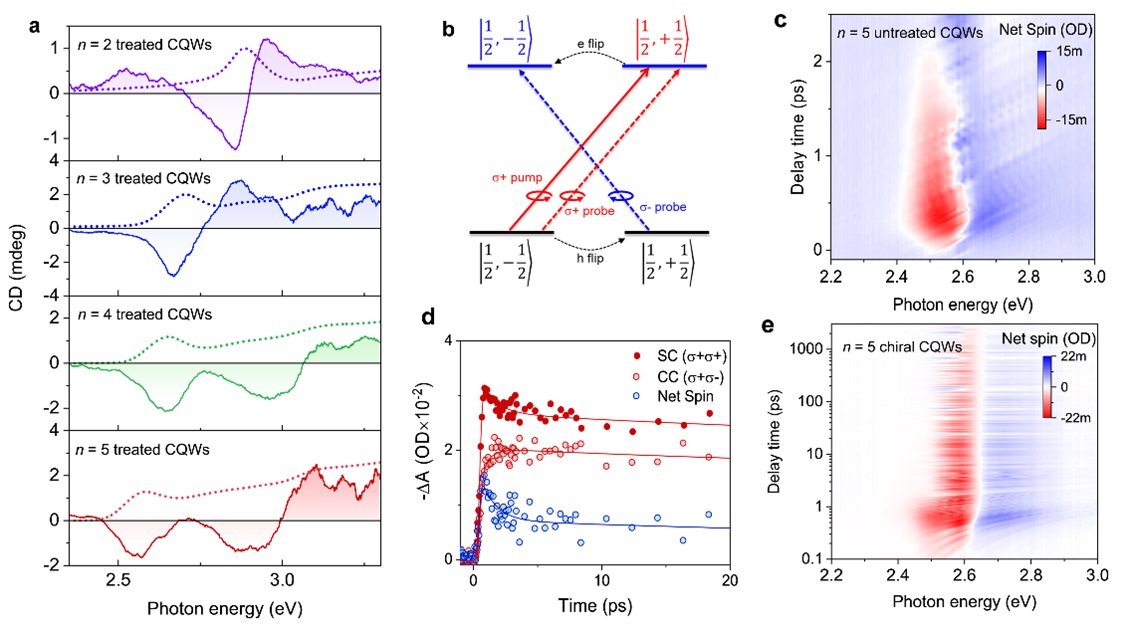
Figure 1. Chiroptical properties and spin dynamics of n = 2–5 R-PEA CsPbBr3 CQWs
(a) Circular dichroism spectra
(b) Schematic illustration of spin relaxation measurements using circularly polarised TA spectroscopy
(c) Their 2D-colour plot of the net spin dynamics of n = 5 untreated CsPbBr3 CQWs
(d) Their pump-probe kinetics of n = 5 R-PEA CsPbBr3 CQWs
(e) Their 2D-colour plot of the net spin dynamics of n = 5 R-PEA CsPbBr3 CQWs
The breakthrough comes with the introduction of chiral ligands, specifically right-handed (R-PEA) and left-handed (S-PEA) α-phenylethylammonium, which are used to functionalise the surface of the CQWs. The chiroptical properties and spin dynamics of R-PEA CsPbBr3 CQWs are shown in Figure 1. Circular dichroism spectroscopy reveals strong bisignate Cotton effects at the excitonic absorption maxima in ligand-treated samples, confirming the successful transfer of chirality from the organic ligands to the inorganic perovskite lattice. To probe spin relaxation dynamics, the team employs circularly polarised transient absorption (CPTA) spectroscopy under carefully controlled conditions to isolate spin-flip processes (Figure 1b). In untreated CQWs, spin relaxation lifetimes are found to be extremely short, ranging from 0.24 ps in n = 2 wells to 1.14 ps in n = 5 wells. These values follow a quadratic dependence on exciton binding energy and are consistent with the strong electron–hole exchange interactions and efficient spin–phonon coupling expected in quantum-confined perovskites. The degree of spin polarisation, calculated as the difference in transient absorption signals under same- and counter-circularly polarised pump–probe configurations, decays rapidly, confirming the challenge of maintaining spin coherence in these materials.
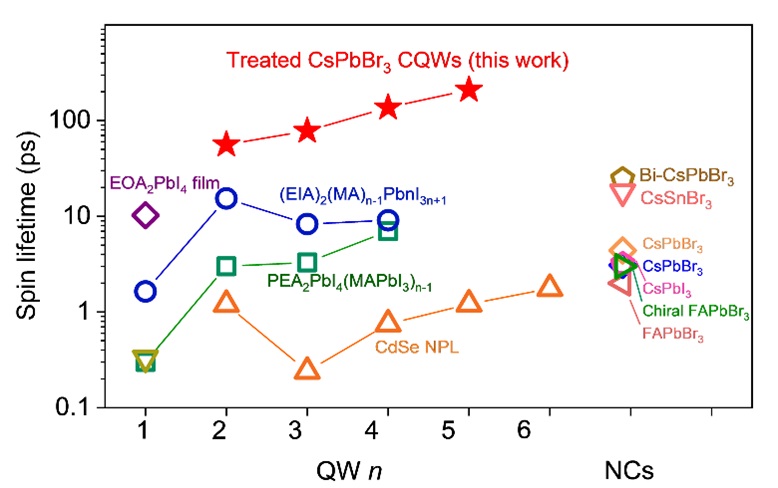
Figure 2. Comparison of extracted spin relaxation times of R-PEA CsPbBr3 CQWs and other materials
The impact of chiral ligand functionalisation on spin coherence is dramatic. In n = 5 R-PEA CQWs, the spin relaxation lifetime extends to 210 ps, nearly two orders of magnitude longer than in untreated samples and three times longer than the best previously reported values for chiral perovskites nanocrystals (NCs) (Figure 2). This extended spin coherence is revealed in the 2D-colour plot of time-resolved net-spin dynamics and is further quantified by biexponential fitting of CPTA spectroscopy data (Figures 1d&1e), which reveals a slow relaxation component (Tspin,2 = 210 ps, accounting for ~60% of the signal) alongside a fast component (Tspin,1 = 1.28 ps, ~40%). The slow component increases systematically with higher ligand coverage, indicating that it is directly modulated by the chiral ligand layer, which effectively suppresses surface-mediated spin-flip processes. Control experiments with S-PEA-treated CQWs yield similar results, proofing that the suppression of spin relaxation is a general effect of chiral ligand passivation rather than a specific property of one enantiomer.
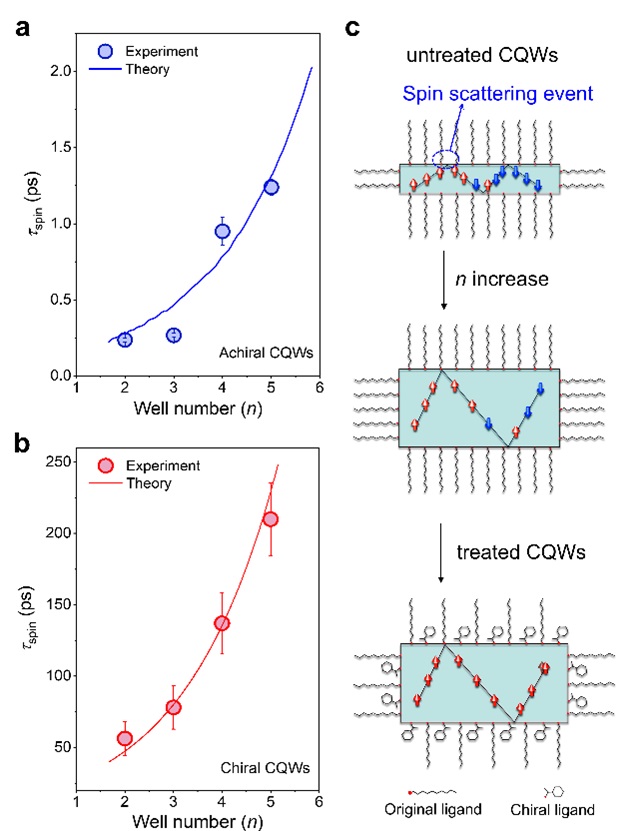
Figure 3. (a&b) Calculated (solid lines) and experimental (circles) spin polarisation lifetimes versus the well number n in CsPbBr3 CQWs without and with chiral ligands (c) Schematic illustration of the Elliott–Yafet model for spin flip in untreated and treated CQWs with increasing well-width n
Theoretical modelling using density functional theory provides insight into the mechanisms underlying this remarkable enhancement of spin coherence. Band structure calculations reveal that chiral CQWs exhibit enhanced Rashba spin splitting compared to their achiral counterparts, resulting in a hybrid regime of Rashba and Dresselhaus spin–orbit coupling. The chiral organic spacers break in-plane symmetry and enhance out-of-plane spin polarisation, which is critical for generating vertically aligned spin-polarised currents. The coexistence of Rashba and Dresselhaus interactions is described by a reduced-symmetry Hamiltonian, while the suppression of spin-flip processes is quantified by a chirality suppression factor (ζ). In chiral CQWs, ζ is found to be as low as 0.0058, indicating a 99.4% reduction in spin-exchange interactions compared to untreated samples (Figures 3a&b). Figure 3c schematically illustrates that, within the Elliott–Yafet model, pristine CsPbBr3 CQWs (ζ ≈ 1) allow frequent spin-flip scattering during electron momentum changes, leading to rapid spin relaxation. In contrast, R-PEA chiral CQWs exhibit a dramatically reduced chirality suppression factor (ζ = 0.0058).
This suppression arises from two synergistic effects: the cancellation of linear spin–orbit coupling contributions due to the global symmetry introduced by the chiral axis and the introduction of asymmetric selection rules that further restrict spin relaxation channels. The result is a dramatic extension of spin lifetime, particularly in thicker CQWs where the surface-to-volume ratio is lower and surface-related spin scattering is diminished.
The practical implications of these findings are significant. The prolonged spin lifetime in chiral CQWs directly enhances the spin diffusion length, a key parameter for spintronic devices. In R-PEA-treated CsPbBr3 CQWs, the spin diffusion length reaches up to 33 nm in n = 5 wells, compared to less than 1 nm in untreated samples.
To demonstrate the generation and transport of spin-polarised currents, the team fabricated a prototype spin-valve device incorporating an R-PEA CsPbBr3 CQW film and a ferromagnetic nickel electrode. In this device, the current is strongly modulated by the magnetisation direction of the nickel electrode, with the degree of spin current polarisation reaching 43% at a bias of –2 V in n = 5 CQWs. This confirms that spin-up charge carriers are preferentially transmitted through the chiral perovskite layer, while spin-down carriers are filtered out, providing direct evidence of chirality-induced spin selectivity and robust spin filtering at room temperature.
In summary, this study demonstrates that the combination of quantum well width engineering and chiral ligand functionalisation enables unprecedented control over spin coherence in metal halide perovskite nanomaterials. By systematically increasing the well width and introducing chiral organic ligands, the research team achieves spin relaxation lifetimes of up to 210 ps, circularly polarised emission of 5% and spin current polarisation of 43% at room temperature. Theoretical analysis attributes these enhancements to the suppression of spin-flip processes via symmetry-protected spin–orbit coupling and reduced surface scattering in wider wells. These findings not only elucidate the fundamental mechanisms governing spin dynamics in low-dimensional perovskites but also establish a clear pathway for the rational design of high-performance, room-temperature spintronic devices.
Prof. Li was recognised by Stanford University as one of the top 2% most-cited scientists worldwide (single year) in the field of nanoscience and nanotechnology in 2025. His research interests include charge/energy/spin dynamics, light-matter interactions, and novel photophysics in quantum optical materials and devices using state-of-the-art ultrafast optical spectroscopies.
| References |
|---|
[1] Wei, Q., Tang, B., Chen, Y., Bian, T., Ren, H., Liu, Q., Yin, J., Rogach, A. L. & Li, M. (2025). Long-Lived Exciton Spin Coherence in Chiral Perovskite Colloidal Quantum Wells, ACS Energy Letters 2025, 10, 12, 6114–6122. https://doi.org/10.1021/acsenergylett.5c02899
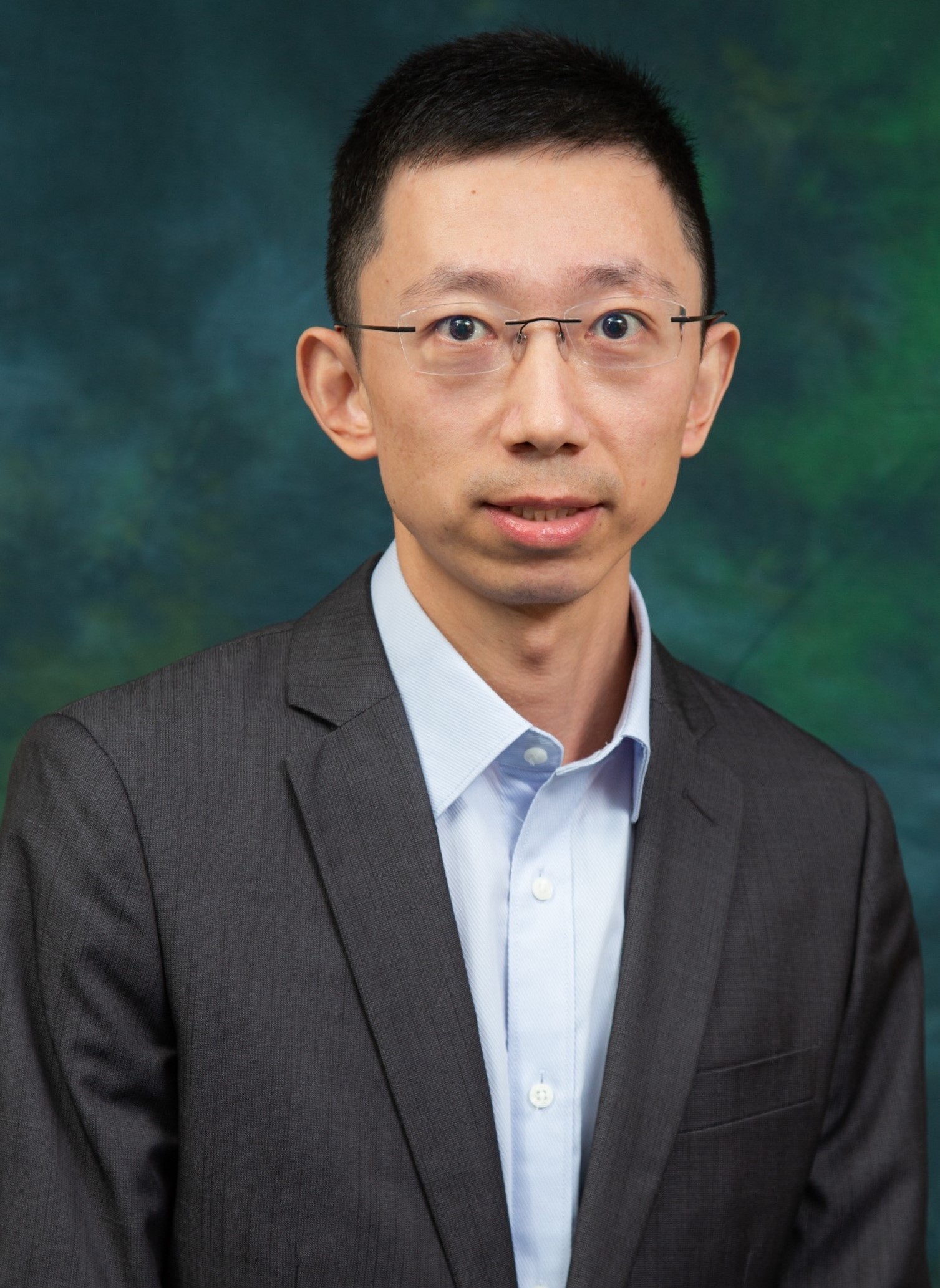 | Prof. Mingjie LI |