
PolyU Successfully Completes Hong Kong’s First Chip-Based Quantum Network and Test
Other Articles

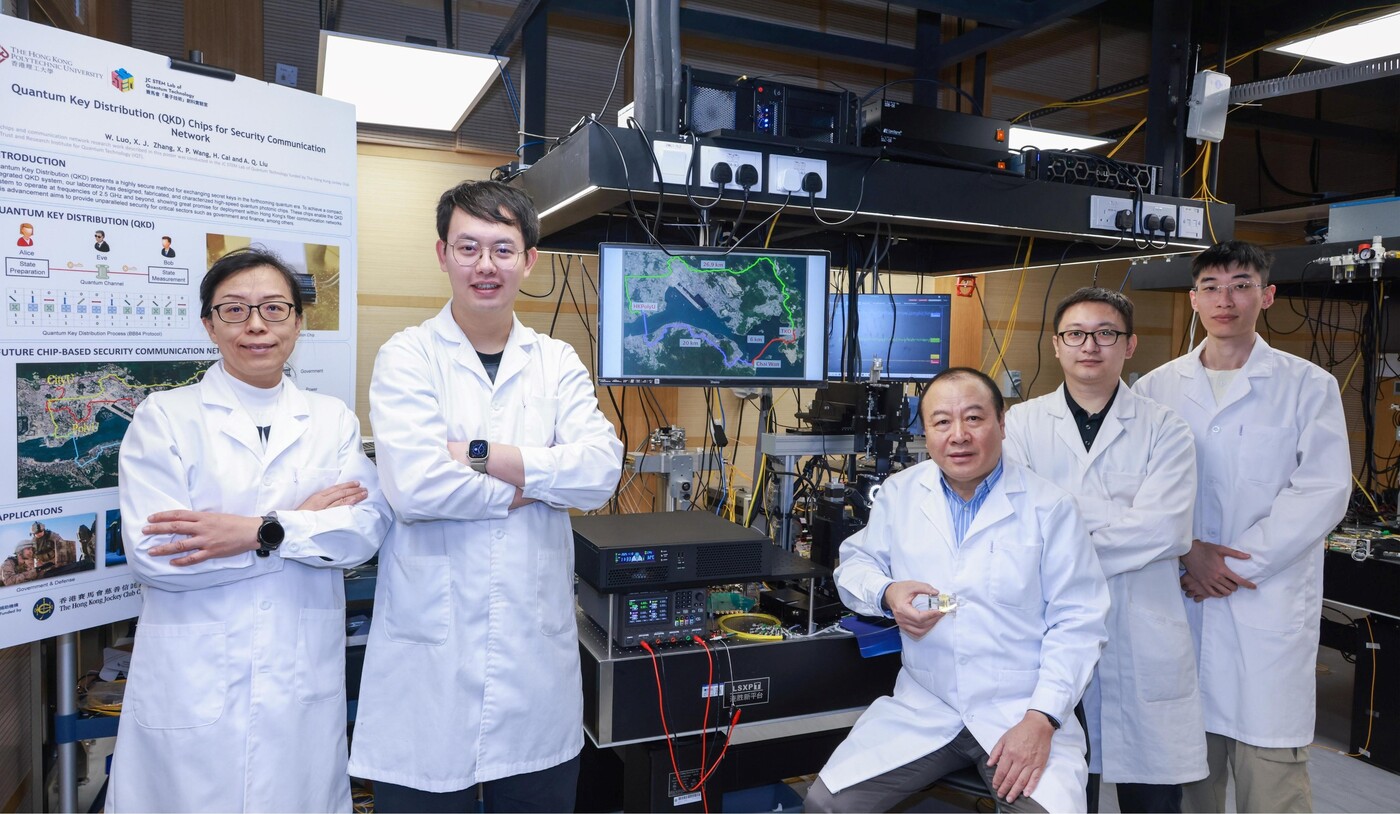
PolyU has achieved a breakthrough by successfully conducting a cybersecurity test on the world’s longest optical fibre quantum network, built utilising a quantum chip platform. This milestone marks a stride forward in the commercialisation of quantum communication and aligns with China’s strategic priorities, as outlined in the Nation’s “15th Five-Year Plan”, where it is identified as one of the top technological areas for industry development.
Led by Prof. Ai-Qun LIU, Director of the Research Institute for Quantum Technology (RIQT), Chair Professor of Quantum Engineering and Science of the Department of Electrical and Electronic Engineering, and Hong Kong Global STEM Scholar, a PolyU research team has successfully developed a quantum communication chip to establish Hong Kong’s first quantum communication network.
Under the leadership of Prof. Liu, the team at RIQT has developed a compact quantum chip, measuring just 12mm × 4mm, utilising semiconductor fabrication techniques. The optical fibre network provided by the HKCOLO.NET data centre as a donation enabled the team to complete a quantum encrypted transmission test on an existing optical fibre link spanning approximately 55 kilometres, connecting four nodes across Hong Kong, Kowloon and the New Territories, including PolyU, another university and two large data centres in Tseung Kwan O and Chai Wan. During the trial, the quantum chip successfully encoded and emitted photons with quantum information, transmitting encrypted messages between points through the network.
The quantum chip operates at a clock rate of 1.25 GHz, generating and transmitting high-quality quantum-encoded signals with remarkable stability. This enables secure key generation at a rate of 45.73 kbps, facilitating reliable encrypted optical fibre communications over distances exceeding 100 kilometres. Moreover, the system dynamically adapts to environmental factors such as temperature fluctuations and vibrations, maintaining stable connections and paving the way for commercial deployment.