


Innovation and Technology


Interdisciplinary Research with Microbes
Prof. Chua Song-lin
Associate Professor, Department of Applied Biology and Chemical Technology
Our research explores how microorganisms live, interact, and influence systems ranging from human health to the surrounding environment. By investigating microbial physiology and the dynamic relationships between microbes, their hosts, and their environments, we aim to uncover fundamental principles of life while developing practical solutions to some of today’s most pressing challenges.
Our current research focuses include:
Microbial communities and biofilms
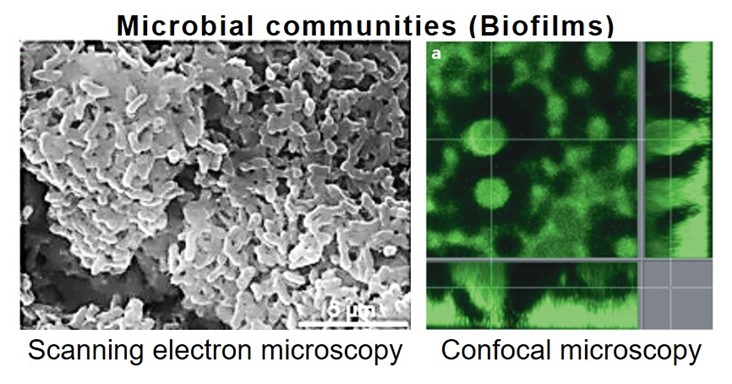
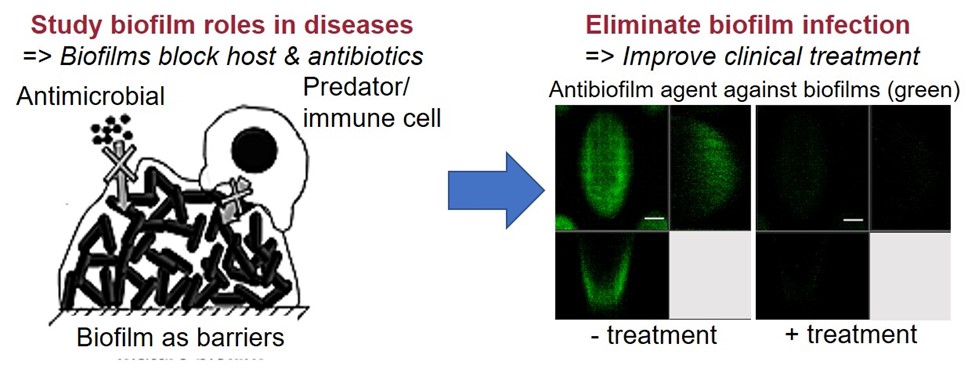
Rather than existing as free-floating cells, many microbes form structured, surface-attached communities known as biofilms. These biofilms can develop on medical devices, within the human body, and in natural environments such as rivers and soil. Far from benign, biofilms are often associated with persistent infections and exhibit strong resistance to antibiotics, posing significant challenges in healthcare. Our research examines how biofilms form, interact with host systems, and evade treatment, with the goal of identifying effective strategies for their control and removal.
Drug discovery and alternative antimicrobial therapy
By advancing our understanding of infection mechanisms and antibiotic resistance, we design innovative approaches to control harmful microbes and improve therapeutic outcomes. In response to the global rise in antibiotic resistance, we explore alternatives to conventional bactericidal drugs. These include antivirulence and antibiofilm strategies, which aim to disarm pathogens by inhibiting toxin production or biofilm formation, thereby reducing the selective pressure that drives resistance.
We also investigate bacteriophages—viruses that specifically infect bacteria—as a promising class of targeted antimicrobials. Phages offer the advantage of selectively eliminating harmful bacteria while preserving beneficial microbiota. By studying their interactions with biofilms and host environments, we aim to harness their potential in next-generation therapies. Ultimately, we seek to develop combination treatments that integrate alternative agents with traditional antibiotics to enhance efficacy and sustainability. Using advanced screening platforms, we identify novel drug candidates and therapeutic strategies.
Novel lab-on-a-chip for microbiological applications
Our research extends beyond conventional laboratory methods by integrating microbiology with cutting-edge technologies such as microfluidics and biosensing. Lab-on-a-chip systems enable precise manipulation of minute fluid volumes, allowing us to recreate controlled, physiologically relevant environments for microbial growth and interaction. When combined with biosensors, these platforms facilitate real-time monitoring of microbial behaviour and responses to stimuli.
These technologies not only advance fundamental research but also hold significant practical potential, including improved diagnostics in healthcare and enhanced quality control in industrial applications.
Microbial engineering for environmental applications
Microorganisms can be engineered to perform valuable functions, such as degrading pollutants or detecting hazardous substances. We apply microbial engineering approaches to areas including pollution control, bioremediation, and sustainable technology development.
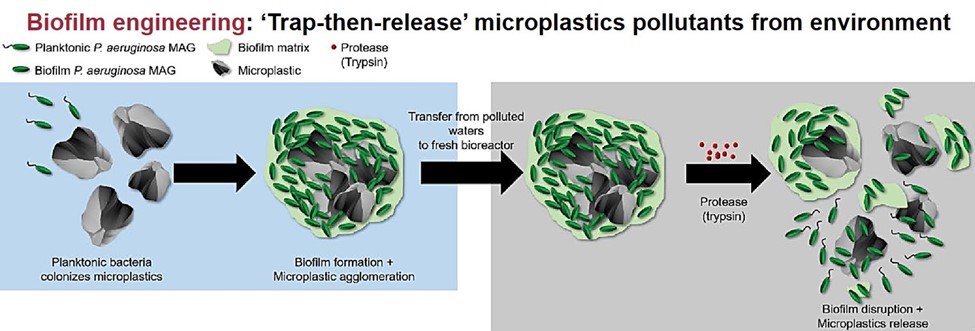
For instance, we are developing strategies to detect and remove micro- and nanoplastics—pervasive contaminants increasingly found in ecosystems and even within the human body. This work highlights the potential of microbial biotechnology to contribute directly to environmental protection and sustainability.
Translation to commercial applications
Importantly, our research extends beyond the laboratory to real-world implementation. We are committed to translating scientific discoveries into tangible impact, exemplified by the establishment of our PolyU start-up, MicroFish. The company focuses on developing microbial technologies for pathogen detection, with applications in food safety, agriculture, and healthcare. This reflects our broader vision of transforming scientific innovation into practical solutions that benefit society.
微生物跨學科研究
蔡松霖教授
應用生物及化學科技學系副教授
我們的研究致力探討微生物如何生存、互動,並影響人體健康甚至周邊環境等不同系統。透過研究微生物的生理特性,以及微生物、宿主與環境之間的動態關係,我們不僅希望揭示生命運作的基本原理,亦為當前不同的重大挑戰尋找實際可行的解決方案。
我們目前的研究重點包括:
微生物群落與生物膜
生物膜是附著在物體表面並聚集生長的微生物群落,常見於醫療器材表面、人體內部,以及河流、土壤等自然環境。由於生物膜容易導致持續性感染,且對抗生素具有較高抗性,對醫療方面構成重大挑戰。我們的研究重點在於了解生物膜的形成機制及其與宿主的互動關係,從而探索更有效的控制與清除方法。
藥物研發與替代抗菌策略
透過深入了解感染機制及抗藥性問題,我們致力開發控制病菌並提升治療效果的創新方法。面對全球日益嚴重的抗藥性問題,我們不再單純依賴傳統以「殺菌」為主的藥物,而是探索其他替代策略,例如抗毒力及抗生物膜方法,透過抑制細菌產生毒素或形成生物膜,削弱其致病能力,同時降低產生抗藥性的壓力。
此外,我們亦著手研究專門感染細菌的噬菌體,作為具潛力的精準抗菌工具。噬菌體可選擇性地消滅有害細菌,同時保留有益菌群。透過研究噬菌體與生物膜及宿主環境的互動機制,我們將發展新一代治療方法,並進一步結合替代療法與傳統抗生素,提升治療效果及可持續性。同時,我們亦利用先進篩選平台,尋找新的藥物及治療策略。
將晶片引入微生物實驗
我們的研究結合創新科技,將微生物感測技術引入微生物學與微流控實驗中。微流控芯片能夠精準控制微量流體,讓我們在可控且接近真實環境的條件下,觀察微生物的生長與互動。這些平台也能搭配生物感測器,即時監測微生物的行為及其對不同刺激的反應。
這些技術不僅有助推動基礎研究,亦具備實際應用價值,例如提升醫療診斷能力,以及改善工業生產應用過程中的品質控制。
微生物工程與環境應用
微生物可透過生物改造工程,賦予特定功能,例如分解污染物或偵測有害物質。為此,我們致力將微生物工程應用於污染控制、生物修復及可持續技術發展等範疇。
例如,我們正研究如何檢測與去除微塑膠及納米塑膠等污染物,這些污染物已廣泛存在於自然環境與人體內。相關研究展示了微生物科技在環境保護方面的實際潛力。
科研成果轉化與應用
我們致力將研究成果轉化為實際應用。團隊在香港理工大學成立了初創公司 MicroFish,專注開發以微生物為基礎的病原檢測技術,應用於食品安全、農業及醫療等範疇。這體現了我們將科研成果轉化為具體產品與服務,為社會帶來實際價值的理念。
