|
Commerce today is no longer confined to boardrooms or shop floors. It flows through algorithms, robots, and decentralised networks — reshaping how businesses create and capture value. The boundaries between the physical and digital worlds are fading fast. A new industrial era is emerging, shaped by the convergence of AI, embodied robotics, and Web3. Each technology is transformative, but their real power emerges when they are woven together into a cohesive, forward-looking business strategy.
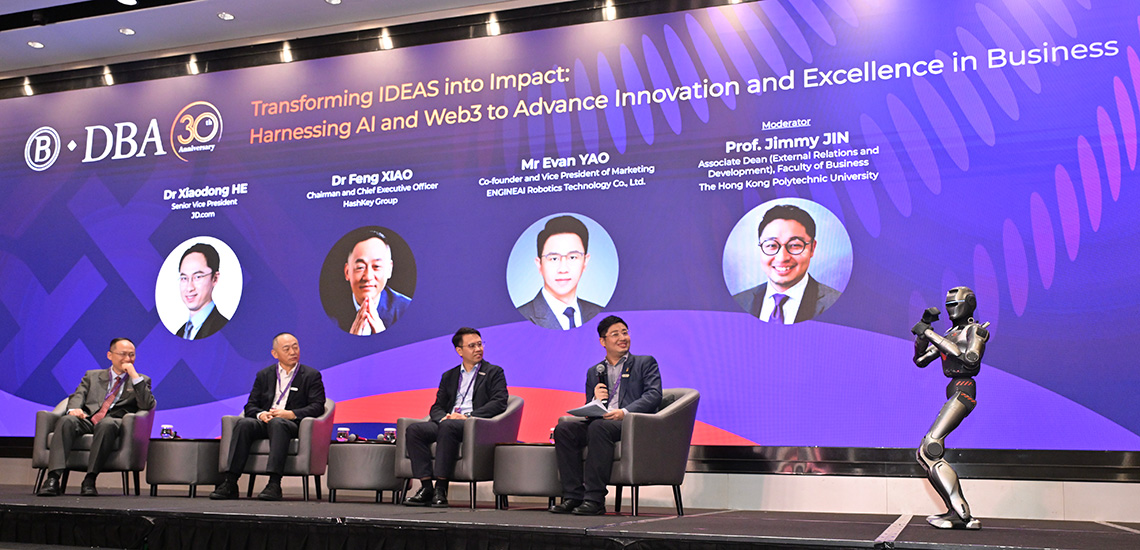
At the recent 30th Anniversary Dinner of the PolyU Doctor of Business Administration (DBA) programme, the theme of technological convergence took centre stage. During a lively panel discussion moderated by Prof. Jimmy Jin, Associate Dean of the Faculty of Business — and briefly co-hosted by a humanoid robot — three leading industry figures shared their insights: Dr Xiao Feng, Chairman and CEO of HashKey Group; Dr He Xiaodong, Senior Vice President of JD.com; and Mr Evan Yao, Co-founder and Vice President of Marketing at Engine AI Robotics.
Their discussion cut through the jargon, laying out how emerging technologies are reshaping how commerce is done, and how PolyU Business School is preparing the next generation of scholar-leaders to navigate this digital frontier.
|
 |
Prof. Shenyang Jiang
Assistant Professor
Department of Logistics and Maritime Studies |
The Dawn of ‘Real-World AGI’ and High-Efficiency Digital Commerce
 The first major shift in business is AI’s evolution from a passive tool into an active, generative force. Dr He Xiaodong showed how JD.com — which runs one of the world’s most complex supply chains — is deploying AI at a remarkable scale. Beyond chatbots serving over 700 million users, JD.com has built digital sales systems so efficient they are redefining customer engagement.
Dr He offered a striking example: JD.com created a digital avatar of its co-founder, Richard Liu. In its first livestream, the avatar drew over 20 million viewers and generated RMB 50 million in sales in just one hour. For JD.com, this was proof that AI is no longer simply fine-tuning existing processes — it is creating substantial new revenue streams and reshaping how companies engage with customers.
But the digital realm is only the beginning. Dr He stressed the coming shift from digital AI to physical AI. “We are expecting ‘Real-World AGI’ within five years,” he noted. As the physical world’s largest operational company, JD.com envisions a future where it uses more than 50 million robots to handle logistics, warehousing, and delivery. This physical manifestation of AI will demand a massive leap in how machines perceive and interact with their surroundings.
Embodied AI and the ‘App Store’ for Humanoid Robots
 Mr Evan Yao brought the vision of physical AI to life, describing Engine AI’s rapid progress towards mass-producing general-purpose humanoid robots. He painted a vivid picture of the near future, within five to ten years, when robots will be as common in homes and workplaces as smartphones are today.
Mr Yao explained Engine AI’s approach to scaling robot utility through an innovative ‘App Store’ model. Just as we add apps to our phones, users will soon be able to download specific skill sets for their open-source robots, enabling a single machine to switch from warehouse picker to security patroller, or even domestic companion.
Yet, the path to mass deployment is not without hurdles. Mr Yao candidly highlighted two critical challenges for robotics: the vast data required to train robots using vision–language–action (VLA) models, and the urgent need for global regulatory standards. As robots enter our daily lives, complying with privacy laws such as the General Data Protection Regulation — a comprehensive European Union law that governs data protection and privacy — and establishing clear safety certifications will be as vital as the hardware and software engineering itself.
Web3: The Trust Layer for an AI-Native Economy
 As AI agents and robots take on autonomous roles in the economy, a pressing question arises: how do we govern their interactions, verify their identities, and settle their transactions? Here, Web3 and blockchain technology become essential.
Dr Xiao Feng, a pioneer in digital assets, explained that Web3 rebuilds trust and value networks across organisations. It provides the infrastructure for verified identities, data rights, and seamless settlement.
One of the evening’s most striking insights came when the panel explored the intersection of AI and Web3. Dr He noted that both ecosystems revolve around the concept of ‘tokens’: in Web3 they represent decentralised trust and assets; in AI they are tied to computational power and energy. The panel envisioned these concepts converging, with tokens becoming the currency of an AI-native economy. Such a system would enable autonomous AI agents and robots to trade data, computation, and services across decentralised networks, creating a self-sustaining digital economy.
The Power of Integrated Systems
If one overarching conclusion can be drawn from the DBA 30th Anniversary panel, it is that the next era of business competition will be defined by integrated systems. Business success now depends on uniting intelligence, trust, and execution, rather than treating them as separate domains.
AI is shifting from analysing data to taking action; robotics is carrying those actions into the physical world; and Web3 is supplying the trusted rules, settlement mechanisms, and auditability needed to scale these operations across organisations. Companies that can align these three forces will hold a decisive competitive advantage.
Cultivating Scholar-Leaders for the Next Era
For the PolyU Business School and our DBA community, these technological shifts affirm our core mission. As Prof. T.C. Edwin Cheng, Dean of the Faculty of Business, remarked at the anniversary celebrations, our goal is to cultivate scholar-leaders — individuals who combine intellectual rigour with practical insight to drive meaningful change.
Our commitment to the IDEAS framework (Innovation-driven Education and Scholarship) keeps our research and our programmes firmly rooted in real-world challenges. Through our established DBA programme and our new Doctor of Business Artificial Intelligence (DBAI), we are preparing executives not only to grasp technologies such as generative AI, embodied robotics, and Web3, but to weave them into forward-looking business strategies.
While technological breakthroughs are ubiquitous. What matters now is leadership — the ability to turn these ideas into impact at scale. As we look towards the next 30 years, PolyU Business School remains committed to empowering leaders who will harness these integrated systems responsibly, drive sustainable growth, and shape a digital landscape that serves society as a whole.