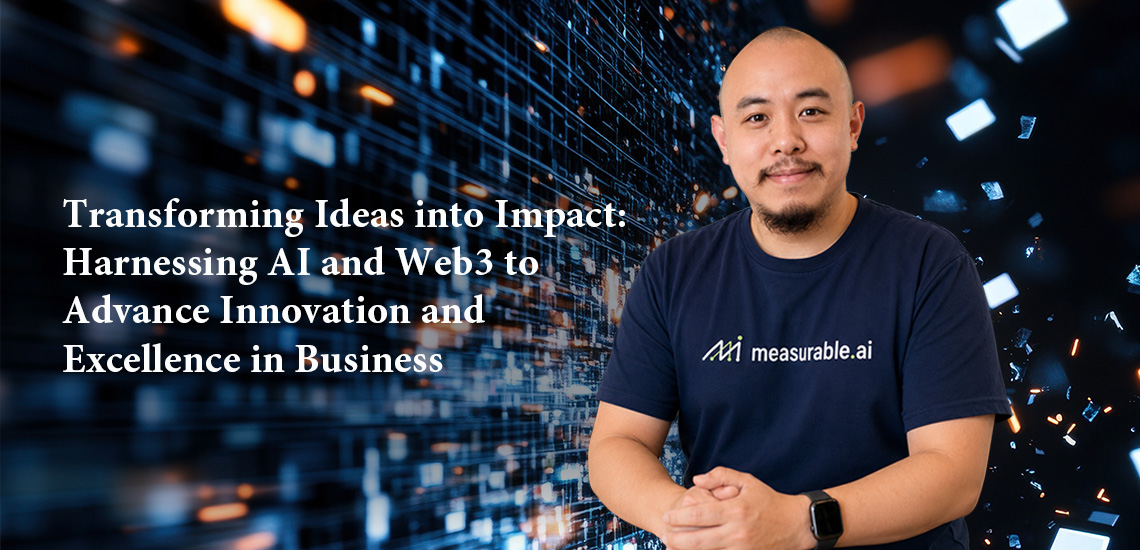
Dr Heatherm Huang, a 2022 graduate of PolyU’s Doctor of FinTech (DFinTech) programme, is a serial entrepreneur and pioneer in decentralised economies, with a career spanning multiple national innovation contest wins in China to building startups in Silicon Valley. He is the founder of the mobile productivity app MailTime and Measurable AI, an alternative data provider for emerging markets. Driven by a passion for user-centric innovation, Dr Huang created the Measurable Data Token (MDT) ecosystem — including RewardMe and Measurable Finance — to reshape how data and value are exchanged in the digital age.
As a DFinTech graduate, you hold a unique position bridging cutting-edge research and market application. What do you consider the greatest strength you gained from the programme that helps businesses translate complex frameworks into business excellence? Could you share an example where you applied this strength to address a business challenge or create measurable impact?
Dr Huang: "The greatest asset I gained was the ability to bridge academic theory with practical application. In the corporate world, hype often distracts people into looking through a narrow window instead of focusing on what really matters. My DFinTech training taught me to look at the bigger picture, to see past temporary trends and focus on what truly drives sustainable business excellence.
A concrete example of this is how we transformed software development in my own company. Traditionally, coding was a heavily manual, time-consuming, and expensive process that created constant operational bottlenecks. By applying advanced AI computing principles, we shifted our entire engineering workflow into an AI-powered system. Instead of spending endless hours typing out lines of basic code, our senior engineers were elevated to system architects and reviewers. This transformation dramatically accelerated our time-to-market and delivered massive, measurable cost savings to the business."
AI and Web3 are transforming business in different ways, but their convergence offers powerful opportunities. How does the synergy between AI’s predictive intelligence and Web3’s decentralised transparency drive business excellence? Can you share an example where this integration has created real impact?
Dr Huang: "I see AI and Web3 as the ultimate 'dream team' for the digital age. When you combine them, AI accelerates processes at scale, while Web3 ensures the data generated is secure, transparent, and trustworthy
We’re building this synergy directly into the Measurable Data Token (MDT) ecosystem. Our platform uses AI to turn raw, anonymised user data into valuable insights, while Web3 secure tracking manages the process securely. By combining these, we can automatically reward users fairly for their data — a level of transparency and precision that simply wasn’t previously possible."
Based on your research and observations, which traditional industries are most ripe for a 'Web3 + AI' overhaul? What will that disruption look like?
Dr Huang: "Industries that operate 100% in the digital sphere — such as software, digital media, online banking, and digital intellectual property management — are most ripe for disruption. Because these assets exist entirely as digital data, they can be seamlessly embedded with blockchain signatures and enhanced by AI.
This shift could reshape corporate structures, moving towards more decentralised models where decisions are made collaboratively and executed automatically by AI systems. While traditional hierarchies may not disappear overnight, the potential for more transparent, peer-to-peer ecosystems is significant. Imagine a company where proposals are voted on by stakeholders through secure digital tokens, and once approved, AI systems execute the workflows automatically. It’s a glimpse of how decentralised autonomous organisations (DAOs) could evolve — not replacing leadership entirely, but offering new ways to democratise decision-making and reduce bureaucracy."
Translating a flawless technological concept into actual market impact often hits real-world roadblocks. What are the biggest hurdles enterprises face when deploying AI and Web3, and how should they overcome them?
Dr Huang: "Three hurdles stand out. First, the speed of technological change — AI evolves so quickly that today’s technology setup may be outdated within a year. Second, lingering scepticism among executives who dismiss AI based on early limitations. Third, regulatory and geopolitical constraints that complicate access to leading models.
Take Hong Kong as an example. Access to certain Western AI models is restricted, creating compliance risks for enterprises. At the same time, some companies hesitate to adopt Mainland Chinese solutions. This creates an impasse that slows innovation. The solution is to start small. Use AI to automate low-risk, repetitive tasks like meeting summaries or expense claims. This builds trust and demonstrates ROI without exposing sensitive data. I often tell leaders: don’t wait for flawless conditions. Technology will never stand still. The safest way forward is to experiment in controlled areas, learn from those pilots, and gradually expand."
Technology evolves at an astonishing speed. Looking ahead to the next three to five years, what do you foresee as the next major milestone at the intersection of AI, Web3, and FinTech? Are there specific concepts that businesses should anchor down on right now?
Dr Huang: "Artificial General Intelligence (AGI) represents the next transformative milestone. Unlike today’s reactive AI, AGI will be capable of independent learning and self-improvement. Once achieved, it could enter an exponential loop of continuous self-evolution, reshaping industries at unprecedented speed. This is both exciting and daunting. Businesses will need to think carefully about governance, ethics, and risk management. Preparing now, by building flexible strategies and ethical frameworks, will be essential.
Alongside this, AI will integrate with advanced robotics, moving beyond screens into real-world environments. These robots will not just repeat pre-programmed motions but will be able to evaluate complex situations and make smart, real-time decisions. Imagine robots with humanlike hand dexterity and intelligent vision navigating unpredictable environments, much like self-driving cars handle sudden traffic hazards. For businesses, the priority now is to focus on AI-driven execution and coding. Summarising emails and fixing grammar are trivial; the real value lies in building systems that autonomously manage operations. Companies that anchor their strategies on this will be best positioned for the future."
What is your advice to traditional corporate leaders or decision-makers who want to innovate but are hesitant due to the perceived risks of AI and Web3? What should be their first step to avoid being left behind?
Dr Huang: "Don’t wait for perfect conditions. Start small by automating one repetitive pain point with AI. I come from a designer background, meaning I’m not a traditional software engineer who manually writes code. Yet, in the past two-to-three months alone, I’ve personally built and shipped 20 products purely by using natural language to coordinate AI tools like Claude Code and Codex.
Even without coding skills, you can describe a workflow in plain language and let AI build a tool. Once leaders see tangible results, resistance fades and innovation accelerates. What matters most today is not technical skill, but the clarity of ideas. If you can articulate a problem well, AI can help you build a solution. That mindset lowers barriers to innovation and empowers leaders to act.
Professional roles are also evolving. AI can already review contracts, analyse ledgers, and optimise software faster than junior employees. Humans remain essential for accountability and oversight, but even this final barrier is beginning to crack. The framework of professional accountability is shifting. New laws governing autonomous vehicles, for example, are beginning to assign liability to the manufacturer’s AI system in the event of an unsupervised crash. Leaders should prepare for this change by experimenting with AI tools now, rather than waiting until the shift is complete."
How has your ongoing engagement with PolyU and the Faculty of Business enriched your personal growth and professional development?
Dr Huang: "PolyU keeps me grounded, offering perspectives beyond the insular world of technology. Engaging with faculty and students exposes me to diverse perspectives, from business to sociology, which sharpens my thinking.
Mentorship programmes have been especially rewarding. Young PolyU interns bring creativity and fresh ideas that challenge stagnant corporate thinking. Their academic work largely revolves around AI integration, and their ingenuity pushes us to rethink assumptions and adapt more quickly. Attending cross-disciplinary symposiums has also been eye-opening. Hearing business professors debate with experts in sociology, anthropology, and geography helps me see how human society, culture, and technology will coexist in the future. These exchanges keep my mindset adaptable and future-proof. Ultimately, staying connected with PolyU is not just about giving back — it’s about staying sharp. The dialogue between academia and industry is vital for innovation."
This interview has been edited for clarity and brevity.