Smart FRP Composite Structures: Enabling Self-Sensing and Health-Aware Functionality from the Ground Up
Seminar

-
Date
14 Sep 2026
-
Organiser
Department of Aeronautical and Aviation Engineering
-
Time
10:30 - 11:30
-
Venue
PQ305 Map
Summary
Abstract
Fibre-reinforced polymer composites are widely valued for their high strength-to-weight ratio, corrosion resistance and tailorable properties. Beyond their conventional use as load-bearing materials, FRP composites can be designed as multifunctional structural systems with integrated sensing and structural health monitoring capabilities.
This seminar presents research on advanced FRP composite structures, covering three connected areas: structural mechanics, innovative self-sensing materials, and field-deployed health monitoring. The first part highlights hybrid FRP-concrete-steel composite systems, supported by experimental studies, finite element modelling and design-oriented theoretical models. The second part focuses on smart FRP composites, including self-sensing FRP products and sensor integration during manufacturing. The third part presents structural health monitoring applications in marine and geotechnical infrastructure and potential applications of smart FRP composites in aerospace engineering. The seminar concludes by discussing how these mechanics-based and sensing-enabled FRP technologies can be extended towards smart aerospace structures.
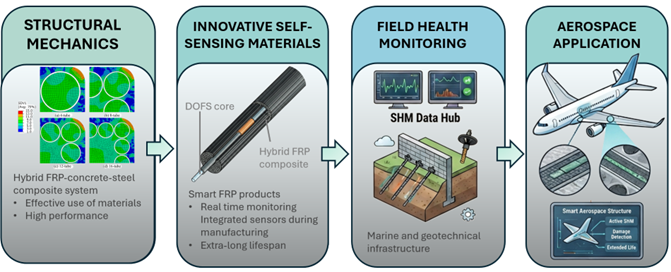
(AI-assisted figure, modified by the speaker.)
Speaker
Dr Michael C.W. Chan specialises in emerging structural materials and systems, with particular expertise in fibre-reinforced polymer (FRP) composites for high-performance structural applications. His research focuses on the development, modelling and implementation of innovative FRP structural components, including hybrid FRP-concrete-steel systems, FRP reinforcement solutions, and smart FRP composites for structural health monitoring.
He has also invented several novel FRP-based structural systems, which have attracted research interest from groups in China and Australia. In addition to his research contributions, he has played a leading role in the development of local design guidelines in Hong Kong through the government-funded project “Development of Design Guidelines for Glass Fibre-Reinforced Polymer for Marine Structures.”