Speed Dating with Flames: How to Understand A Flame’s Response Quickly and Accurately
Seminar

-
Date
25 Aug 2026
-
Organiser
Department of Aeronautical and Aviation Engineering
-
Time
11:00 - 12:00
-
Venue
TU103 Map
Summary
Abstract
Gas turbine engines are an integral part of the global energy production and infrastructure. The ability to rapidly scale their power output makes them an attractive partner to intermittent renewable energy sources, meaning they are likely to retain their importance throughout the energy transition. They are also widely used for propulsion, with their high power to weight ratio, and their fuels’ energy to weight ratio making them difficult to replace for long distance transportation. There has long been a focus to reduce the emission of pollutants such as nitrous oxides (NOx) from gas turbines, but the impending climate crisis means there is a growing need to also eliminate the emission of carbon dioxide (CO2). One promising method of achieving this is to switch from hydrocarbon-based fuels such as natural gas (mainly composed of methane – CH4), to fuel blends composed of increasing proportions of carbon-free fuels such as hydrogen (H2) and ammonia (NH3). However, switching to these fuels is challenging due to substantially different fuel properties. Designing future gas turbine systems that can operate in a fuel-flexible manner, accepting a wide variety of alternative carbon-free fuels is not straightforward, and hindered by our incomplete understanding of these fuels and some important phenomena which occur during their use, including flame stabilisation, thermoacoustic instabilities, and harmful emissions.
In this talk, recent experimental work on thermoacoustic instabilities in single flames will be presented, with an emphasis on the interference effects from different sources, which can be exploited to control the overall flame response and the stability of the system. Recent work will also be presented detailing methods to quickly characterise the flame response, using non-conventional acoustic excitation such as dual frequency, broadband, and chirp forcing.
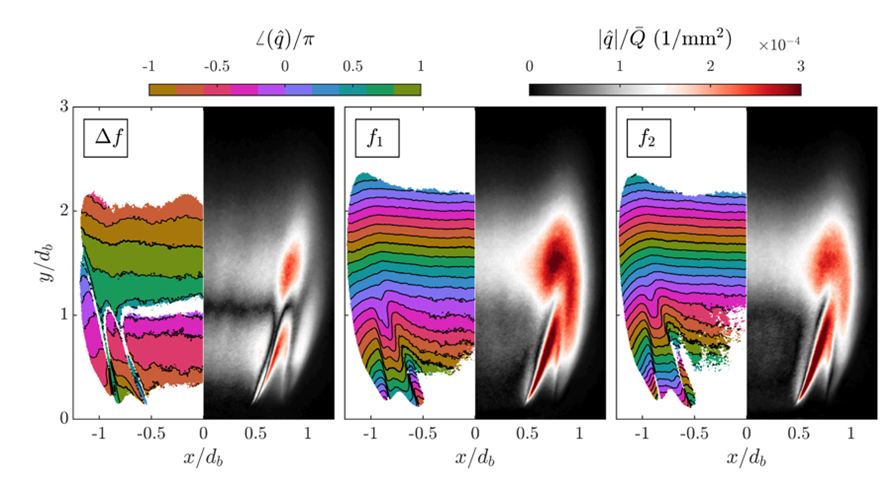
This figure illustrates the effect of frequency interactions during dual-frequency forcing in a single bluff-body stabilised flame. At higher frequencies more oscillations are present on the flame simultaneously, resulting in local cancellation. Therefore, combinational harmonic modes at lower frequencies may dominate the response, resulting in poor transfer function prediction accuracy.
Speaker
Prof. Nicholas Worth is a Professor at the Southern University of Science and Technology (SUSTech) in Shenzhen. He previously worked as a Professor and Head of the Thermo-fluids research group in the Department of Energy and Process Engineering at the Norwegian University of Science and Technology (NTNU).
He received his doctorate from the University of Cambridge in 2010, through an EPSRC doctoral training scholarship, and has held positions as a Postdoctoral Researcher and a Senior Research Fellow at Cambridge University, and worked as a Research Engineer at Rolls-Royce. He is the previous recipient of an ERC Starting Grant (2016–2021), the Gaydon Prize (2013), and distinguished paper awards from ASME (2021) and the Combustion Institute (2023). His main research areas are in turbulent combustion and thermoacoustics, the structure of turbulent flows, and the development of advanced experimental methods.