

Education 4.0: Leading the shift to AI-empowered, personalised learning

With the rapid advancement of artificial intelligence (AI), education is experiencing a profound transformation. At the forefront of this revolution is PolyU, pioneering the Education 4.0 (E4.0) initiative – an AI-empowered, student-centred learning and teaching model that envisions a future where technology supports interactive, flexible, and personalised learning.
E4.0 marks a significant shift from traditional, teacher-centred methods to a model that empowers students to take ownership of their learning. Supported by AI, big data analytics, and smart technologies, students are able to design their own learning pathways. Leading this change is Professor Cao Jiannong, PolyU’s Vice President (Education), who assumed the role this September. “Education 4.0 is revolutionary—it puts the student at the core,” Professor Cao explains. “By embracing AI and digital transformation, we are not replacing the human element of teaching—we are enhancing it. We are giving both teachers and students new power to learn, to create, and to thrive.”
Rather than attending lectures simply to absorb information, students will engage in active learning through discussion, exploration, and application. The Digital Education Data Hub, a comprehensive digital platform that consolidates teaching data across departments, is being developed to support intelligent decision-making. “A teacher cannot individually design courses for 30,000 students, but AI can help us do exactly that,” Professor Cao notes. E4.0 also redefines teachers’ roles. By helping educators leverage new technologies, teaching can be enhanced. “Instead of feeding knowledge, teachers will evolve into advisors and facilitators, guiding students in their independent learning journeys,” he says.
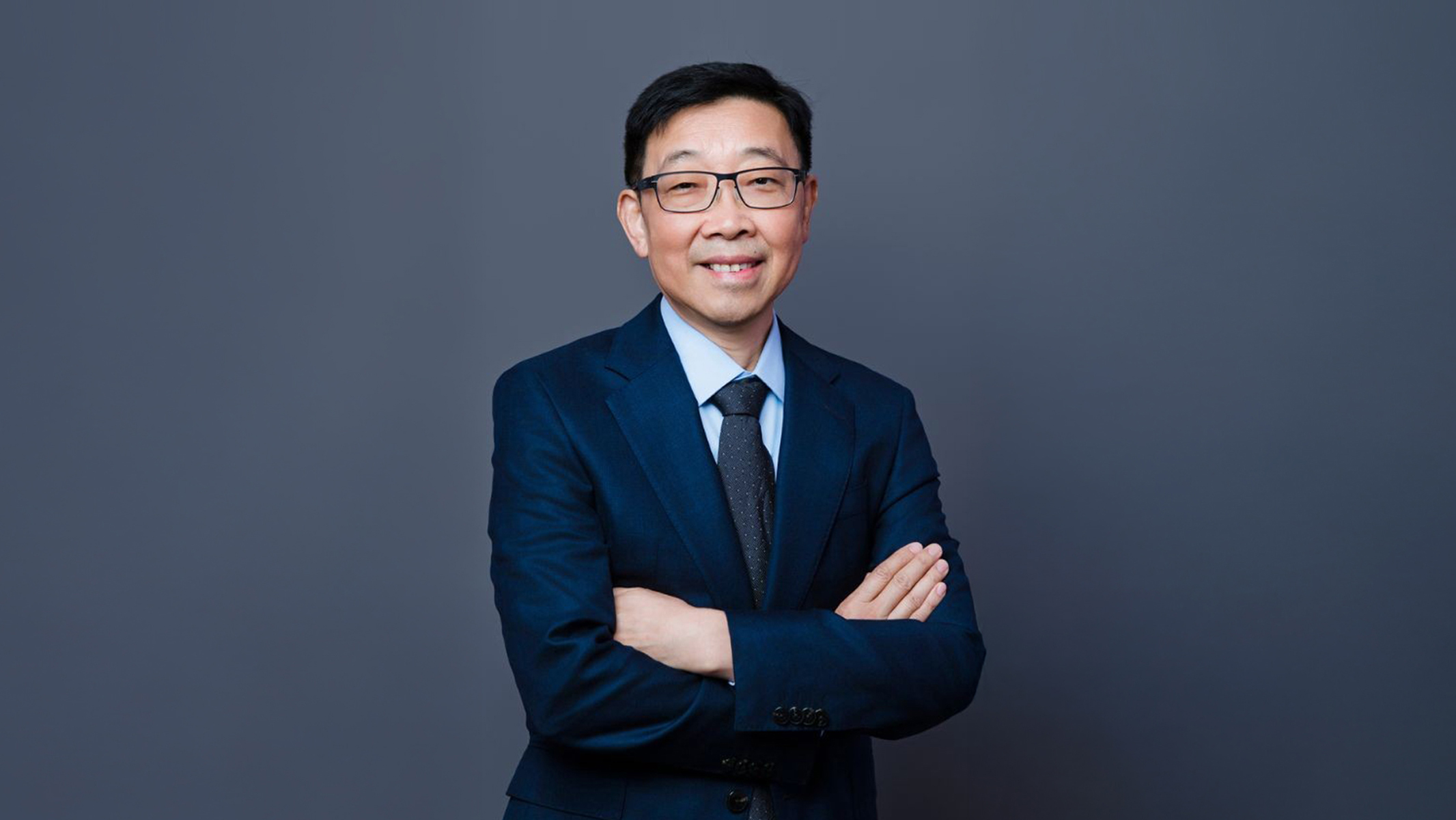
Prof. Cao, a renowned AI expert, applies his expertise to transform PolyU’s educational offerings in his position as Vice President (Education).
To support this transformative journey, Professor Cao leads the Education Innovation Committee (EIC), which brings together experts in education research and digital technologies to oversee projects aligned with E4.0 goals. PolyU’s Institute for Higher Education Research and Development (IHERD) plays a pivotal role, comprising three units: the Digital Transformation Division, which promotes digital adoption across the campus and develops unified data systems; the Education Research Centre, which leads research in new teaching technologies and AI applications; and the Education Development Centre, dedicated to teacher training and pedagogy innovation.
As a trailblazer, language education will undergo a comprehensive reform. Starting from the 2026/27 academic year, the new compulsory subject “AI-as-a-Tool for Language Learning (AITLL)” will be introduced to first-year, first-degree students, with an aim to enhance their language proficiency and manage workplace communications through scenario-based, project-driven, student-centred, and flipped learning. Current students are encouraged to join the pilot AITLL subject available in Semester Two of 2025/26. Additionally, the Division of Artificial Intelligence and the Humanities will be launched in January 2026 under the Faculty of Humanities to further bridge AI expertise with humanities disciplines.
These initiatives, among others, mark PolyU’s commitment to leading the way in integrating AI into education, supporting the University’s goal to nurture future-ready students equipped with creativity, problem-solving, and collaboration skills to thrive in a rapidly changing world.