
Interdisciplinary excellence in leading research initiatives secures substantial funding
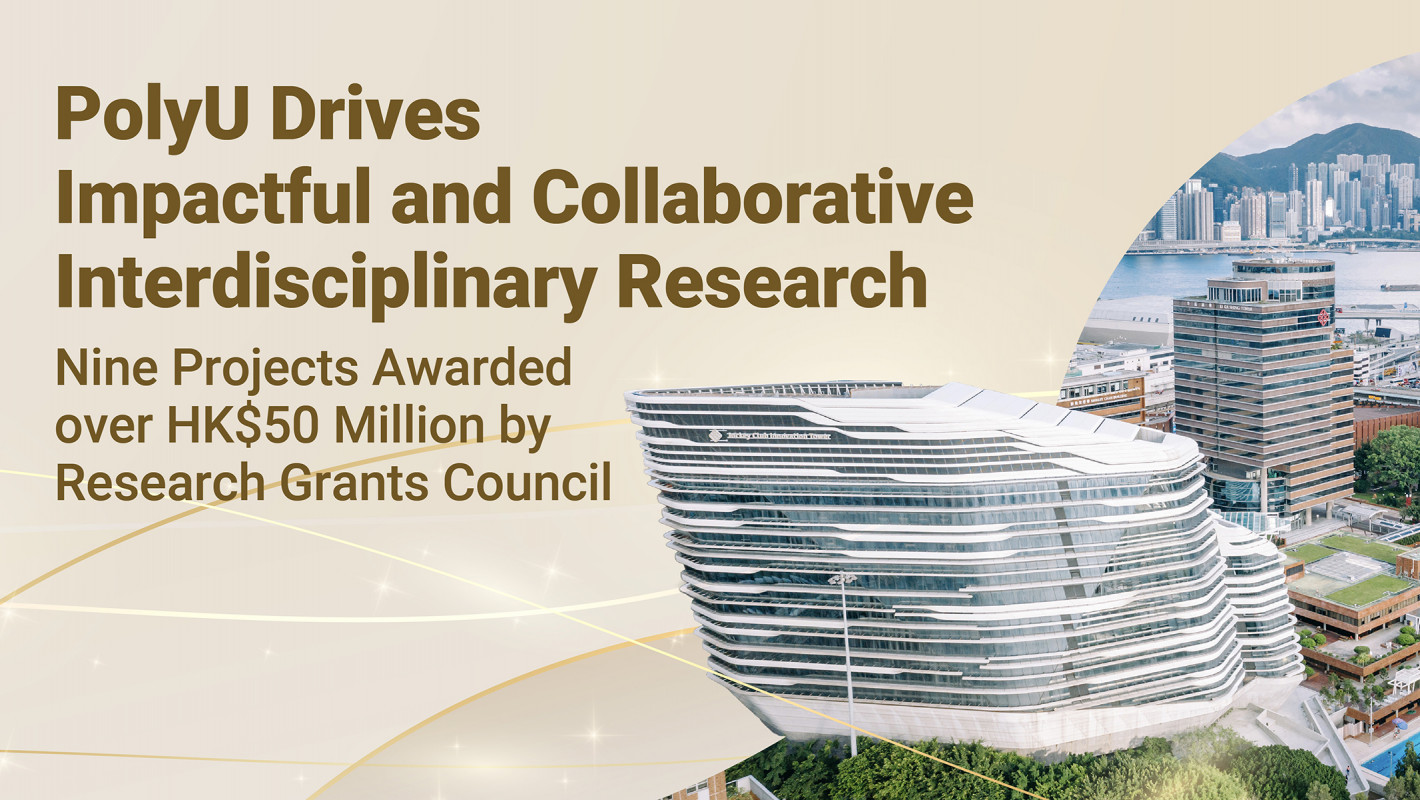
In the pursuit of world-leading research and innovation, PolyU is making significant strides by fostering interdisciplinary collaboration. In the latest funding cycle from the Research Grants Council (RGC) for the 2025/26 academic year, the University secured approximately HK$50.92 million for nine diverse research projects through the Research Impact Fund and Collaborative Research Fund. These initiatives span fields such as health and biomedical sciences, engineering technology, Artificial Intelligence of Things (AloT), Web3, and environmental sustainability.
In particular, the University has secured approximately HK$13.2 million for two groundbreaking research projects under the Research Impact Fund, targeting advancements in cancer immunotherapy and railway safety.
One of these projects is the “Spatial and High-throughput Immunopeptidomics Enabled by Integrated Microfluidics and Proteogenomics (MAP)”, led by Professor Zhao Qian, Associate Professor of the Department of Applied Biology and Chemical Technology, which aims to transform tumour peptide profiling through the integration of proteomics, genomics, and microfluidics. By enabling ultra-sensitive analysis of minimal samples, the technology will facilitate spatial mapping of immune peptides and high-throughput profiling of glioblastoma neoantigens. This innovative approach will enhance our understanding of tumour-immune interactions and identify novel targets for advancing cancer immunotherapy.
Another project titled “Towards Life-Cycle Intelligent Predictive Maintenance for Railway Tracks: Advancing with Deep Learning Algorithms and Digital Twin Technology”, led by Professor Dong You, Associate Professor of the Department of Civil and Environmental Engineering, focuses on enhancing railway maintenance through a collaborative health-monitoring and robotic system. By integrating ultrasonic guided waves, vision systems, VLA (vision-language-action) models, and artificial intelligence (AI), the project aims to establish a performance-oriented life-cycle management framework. A dynamic digital twin utilises real-time data and AI models for predictive maintenance, minimising disruptions and extending service life, thus delivering transformative impacts for modern rail systems and global transportation.
Meanwhile, around HK$37.72 million was received for seven additional research projects through the Collaborative Research Fund. This includes three projects funded by the Collaborative Research Project Grant, two that received the Collaborative Research Equipment Grant, and two supported by the Young Collaborative Research Grant. Click here to learn more about the projects.
Professor Christopher Chao, Senior Vice President for Research and Innovation, praised the efforts of the research teams, stating, “We sincerely thank the RGC for its support and recognition of PolyU’s interdisciplinary research efforts. As an innovative world-class university, PolyU is dedicated to pursuing excellence in scientific research and remains steadfast in its commitment. The University will continue to drive impactful research, striving for excellence in education, research and knowledge transfer, and contributing to Hong Kong, the Nation and the world.”
The RGC Research Impact Fund is designed to promote impactful and translational research among local universities, encouraging collaboration beyond academia. In contrast, the Collaborative Research Fund supports multi-investigator, interdisciplinary projects to foster high-quality cross-disciplinary and cross-institutional research.