



摘要
There has never been more attention to freight network resilience than since 2020. Due to several unexpected disruptions such as Covid-19, major infrastructure and traffic failures on European corridors, the Suez Canal blockage, and the Hormuz Strait threats of today, it has become clear that the robustness and flexibility of service networks are important for global supply chains. At a time of unprecedented threats due to infrastructure maintenance backlogs and climate adaptation needs, research is needed to help improve resilience design practices. This seminar focuses on the mechanisms that create resilience in freight networks and on necessary pre-conditions for design. Several approaches for evaluating and designing network resilience are presented, including conceptual models and management approaches, analytical evaluation methods, simulation and optimization models, and serious games. These approaches are illustrated by practical examples from several research projects carried out at and with the Delft University of Technology.
講者

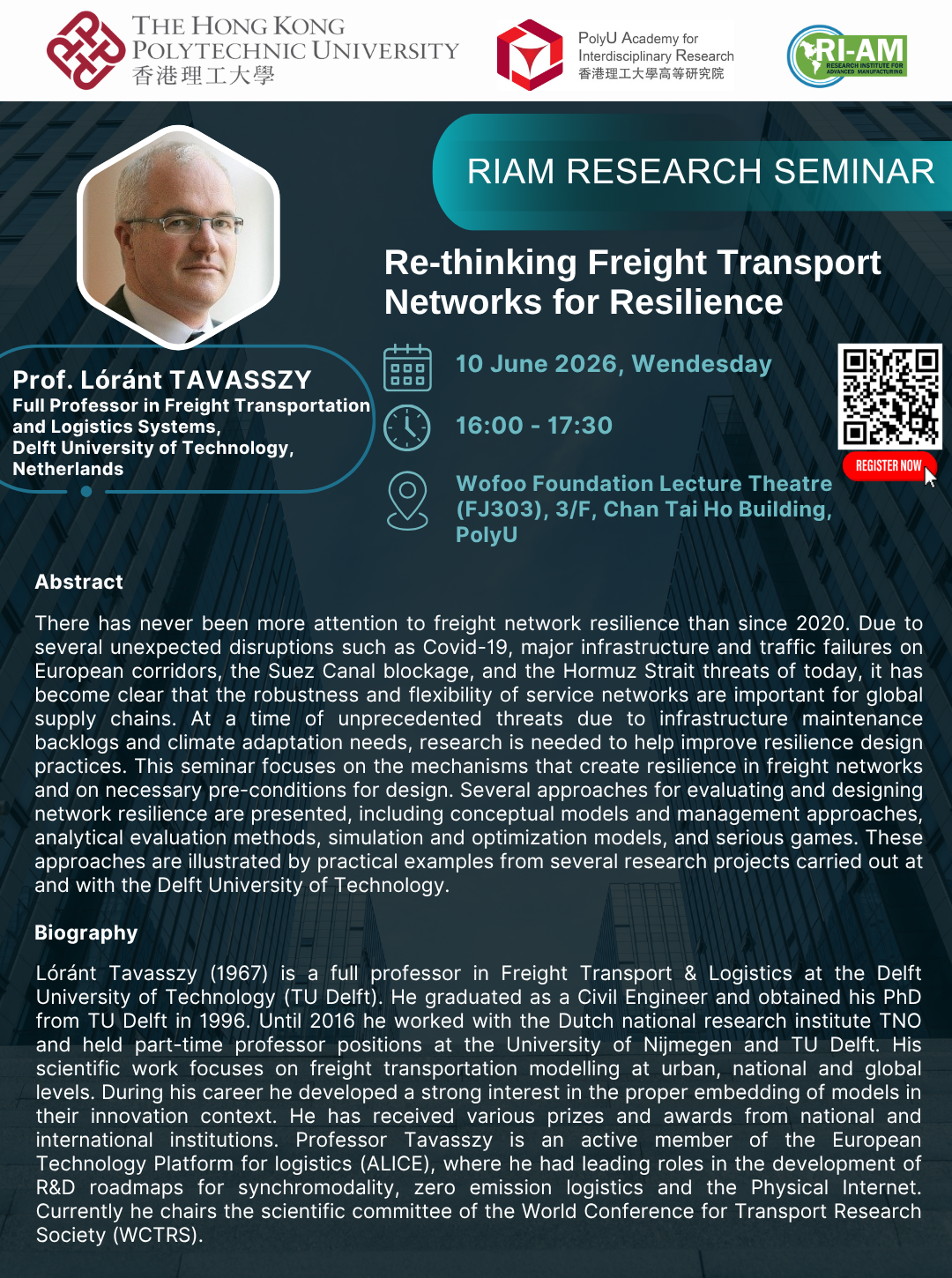
Prof. Lóránt TAVASSZY
Full Professor in Freight Transportation and Logistics Systems,
Delft University of Technology, Netherlands
Lóránt Tavasszy (1967) is a full professor in Freight Transport & Logistics at the Delft University of Technology (TU Delft). He graduated as a Civil Engineer and obtained his PhD from TU Delft in 1996. Until 2016 he worked with the Dutch national research institute TNO and held part-time professor positions at the University of Nijmegen and TU Delft. His scientific work focuses on freight transportation modelling at urban, national and global levels. During his career he developed a strong interest in the proper embedding of models in their innovation context. He has received various prizes and awards from national and international institutions. Professor Tavasszy is an active member of the European Technology Platform for logistics (ALICE), where he had leading roles in the development of R&D roadmaps for synchromodality, zero emission logistics and the Physical Internet. Currently he chairs the scientific committee of the World Conference for Transport Research Society (WCTRS).
