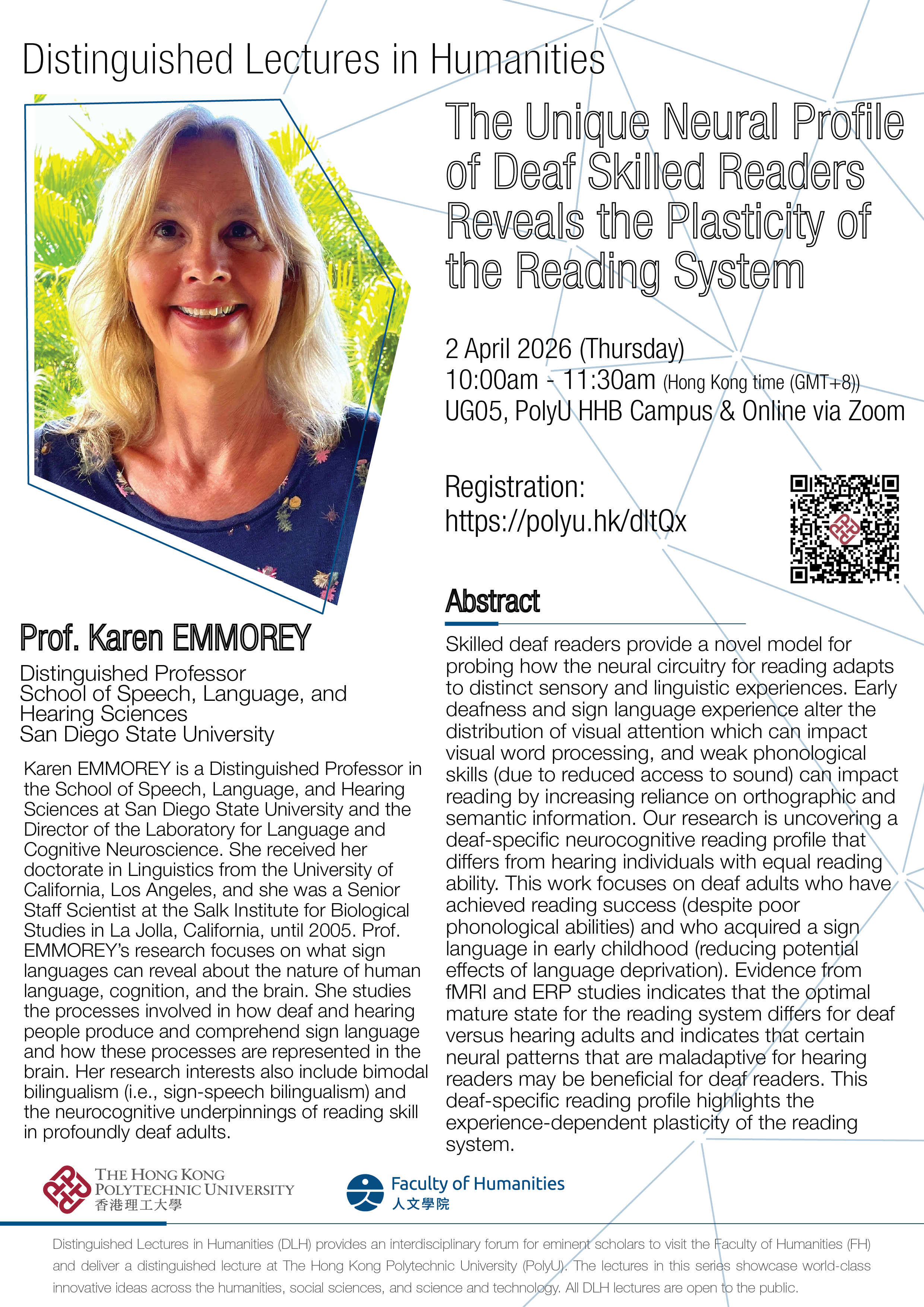
Distinguished Lectures in Humanities: The Unique Neural Profile of Deaf Skilled Readers Reveals the Plasticity of the Reading System
Distinguished Lectures in Humanities

-
Date
02 Apr 2026
-
Organiser
Faculty of Humanities
-
Time
10:00 - 11:30
-
Venue
UG05, PolyU HHB Campus & Zoom
Remarks
The talk will be conducted in English.
Summary
Abstract
Skilled deaf readers provide a novel model for probing how the neural circuitry for reading adapts to distinct sensory and linguistic experiences. Early deafness and sign language experience alter the distribution of visual attention which can impact visual word processing, and weak phonological skills (due to reduced access to sound) can impact reading by increasing reliance on orthographic and semantic information. Our research is uncovering a deaf-specific neurocognitive reading profile that differs from hearing individuals with equal reading ability. This work focuses on deaf adults who have achieved reading success (despite poor phonological abilities) and who acquired a sign language in early childhood (reducing potential effects of language deprivation). Evidence from fMRI and ERP studies indicates that the optimal mature state for the reading system differs for deaf versus hearing adults and indicates that certain neural patterns that are maladaptive for hearing readers may be beneficial for deaf readers. This deaf-specific reading profile highlights the experience-dependent plasticity of the reading system.
About the speaker
Karen EMMOREY is a Distinguished Professor in the School of Speech, Language, and Hearing Sciences at San Diego State University and the Director of the Laboratory for Language and Cognitive Neuroscience. She received her doctorate in Linguistics from the University of California, Los Angeles, and she was a Senior Staff Scientist at the Salk Institute for Biological Studies in La Jolla, California, until 2005. Prof. EMMOREY’s research focuses on what sign languages can reveal about the nature of human language, cognition, and the brain. She studies the processes involved in how deaf and hearing people produce and comprehend sign language and how these processes are represented in the brain. Her research interests also include bimodal bilingualism (i.e., sign-speech bilingualism) and the neurocognitive underpinnings of reading skill in profoundly deaf adults.