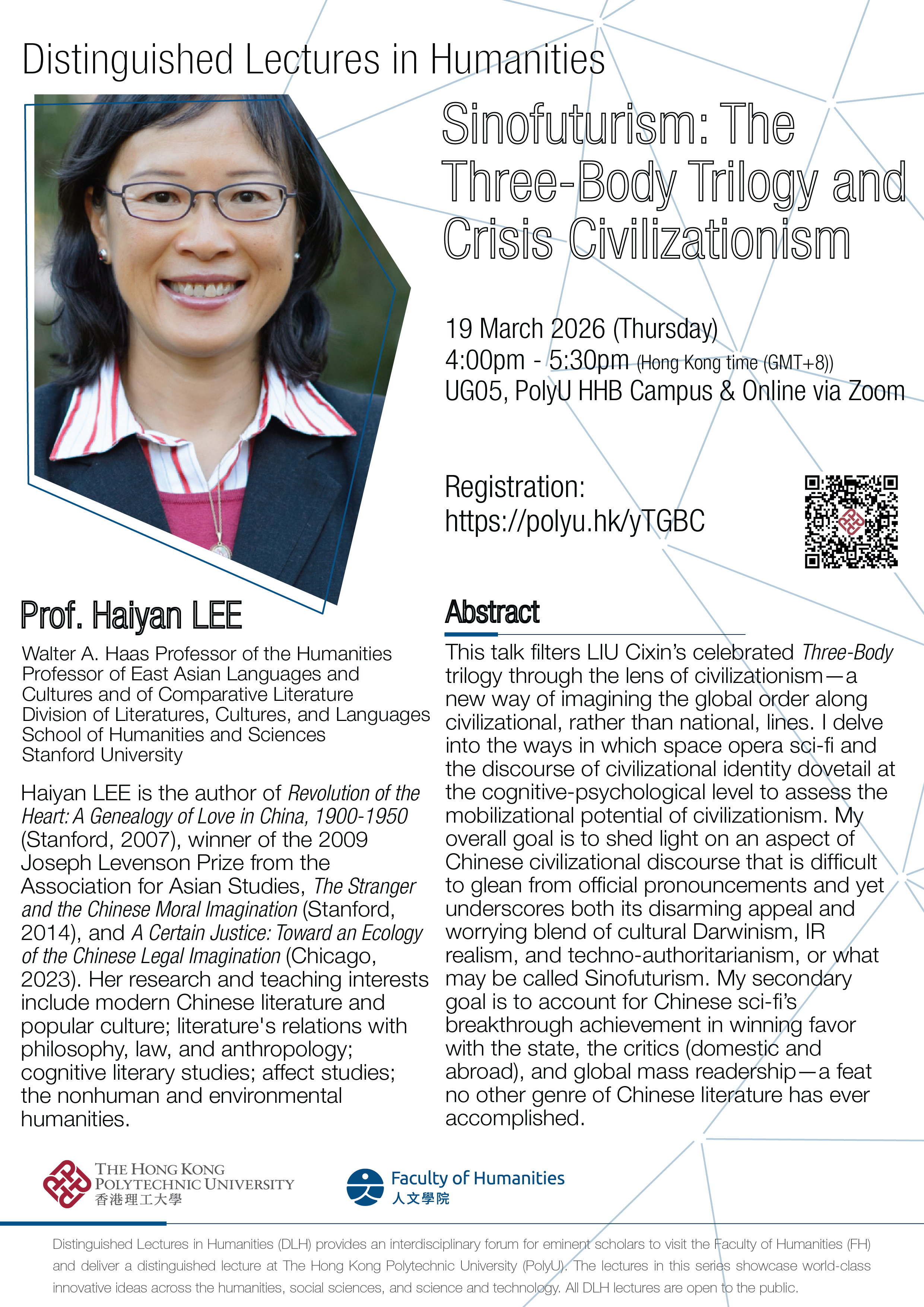
Distinguished Lectures in Humanities: Sinofuturism: The Three-Body Trilogy and Crisis Civilizationism
Distinguished Lectures in Humanities

-
Date
19 Mar 2026
-
Organiser
Faculty of Humanities
-
Time
16:00 - 17:30
-
Venue
UG05, PolyU HHB Campus & Zoom
Remarks
The talk will be conducted in English.
Summary
Abstract
This talk filters LIU Cixin’s celebrated Three-Body trilogy through the lens of civilizationism—a new way of imagining the global order along civilizational, rather than national, lines. I delve into the ways in which space opera sci-fi and the discourse of civilizational identity dovetail at the cognitive-psychological level to assess the mobilizational potential of civilizationism. My overall goal is to shed light on an aspect of Chinese civilizational discourse that is difficult to glean from official pronouncements and yet underscores both its disarming appeal and worrying blend of cultural Darwinism, IR realism, and techno-authoritarianism, or what may be called Sinofuturism. My secondary goal is to account for Chinese sci-fi’s breakthrough achievement in winning favor with the state, the critics (domestic and abroad), and global mass readership—a feat no other genre of Chinese literature has ever accomplished.
About the speaker
Haiyan LEE is the Walter A. Haas Professor of Chinese and comparative literature at Stanford University. She is the author of Revolution of the Heart: A Genealogy of Love in China, 1900-1950 (Stanford, 2007), winner of the 2009 Joseph Levenson Prize from the Association for Asian Studies, The Stranger and the Chinese Moral Imagination (Stanford, 2014), and A Certain Justice: Toward an Ecology of the Chinese Legal Imagination (Chicago, 2023). Her research and teaching interests include modern Chinese literature and popular culture; literature's relations with philosophy, law, and anthropology; cognitive literary studies; affect studies; the nonhuman and environmental humanities.