Instabilities and Receptivities of Turbulent Aerospace Flows
Seminar

-
Date
22 Sep 2026
-
Organiser
Department of Aeronautical and Aviation Engineering
-
Time
11:00 - 12:00
-
Venue
PQ305 Map
Summary
Abstract
Turbulent flows in aerospace applications often exhibit unsteady dynamics that can be adequately studied using a global stability analysis based on a set of URANS equations. One of the objectives of this work is to develop a unified framework for solving linear stability problems for turbulent flows using both time-stepping and matrix-forming methods. Following a validation phase using canonical tests, two configurations of engineering interest are examined. Firstly, the transonic flow through a diffuser (Sajben model G) is investigated in both a strong shock (with flow separation) and a weak shock (without separation) configurations. The 2D global stability analysis reveals that the unsteadiness observed experimentally is not driven by a global instability. Through the resolvent analysis, a peak is observed at the same frequency, indicating that this is a receptivity mechanism. Extending the study to the spanwise direction by superimposing a 3D perturbation onto the 2D base flow reveals the emergence of a zero-frequency unstable mode for the strong-shock case; this is a centrifugal instability which, however, does not emerge in the weak-shock case.
The second configuration presented in this seminar is an over-expanded, axisymmetric nozzle with a Truncated Ideal Contour (TIC). The flow regime is primarily governed by the nozzle pressure ratio (NPR); within a certain range, the flow is highly unsteady and exhibits self-sustained low-frequency oscillations. The objective of this work is to apply the methods used for the Sajben diffuser to this nozzle.
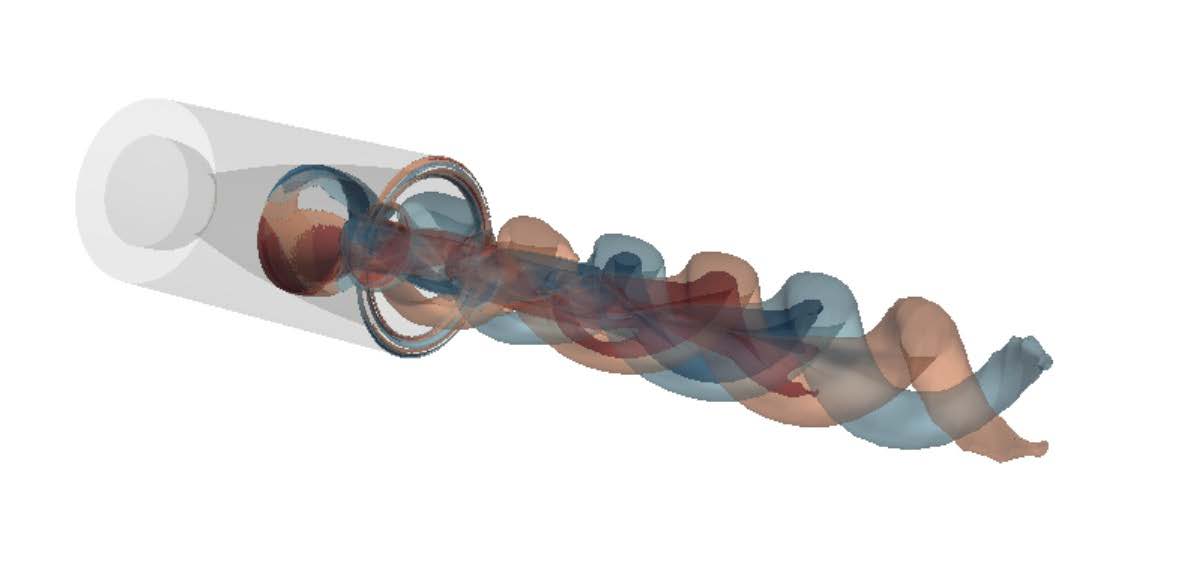
Figure: Helicoidal (m=1) global mode, for over-expanded TIC nozzle and for NPR=9.
Iso-surface of axial velocity perturbations Re(u’).
Speaker
Prof. Jean-Christophe Robinet is a Professor and the Director of the DynFluid Laboratory (Laboratoire de Dynamique des Fluides) at Arts et Métiers Institute of Technology (ENSAM) in Paris. After completing a postdoctoral position at Aix-Marseille University, he became an Associate Professor at Arts et Métiers Paris in 2001 within the SINUMEF laboratory directed by Professor Alain Lerat, where he worked on the modelling and numerical simulation of temporally self-sustaining instabilities, with applications to shock-wave/boundary-layer interactions, separated flows, and flows past obstacles such as roughness elements and cavities. In 2011, he became a Professor within the DynFluid laboratory. His research centres on hydrodynamic instability theory, receptivity and sensitivity analysis, and transition to turbulence, using large-scale eigenvalue problems and optimal-perturbation methods, with applications spanning shock-wave/boundary-layer interactions and separated flows.
He has been cited over 3,800 times across a substantial body of published work, reflecting sustained international recognition in the fluid stability and transition community. He has supervised numerous PhD students and postdoctoral researchers, and maintains close scientific collaborations with peers at ONERA and other academic institutions in France and abroad. He continues to lead research at the intersection of compressible flow stability, aeroacoustics, and global/resolvent analysis, applying these methods to nozzle flows, jets, and boundary layers relevant to aerospace applications.