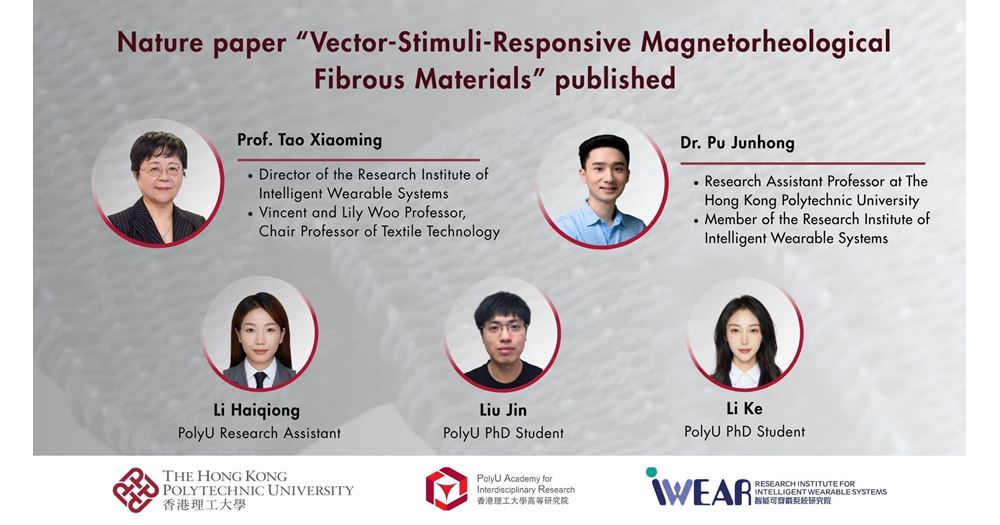
A team of SFT researchers, led by Prof. Tao Xiaoming, Vincent and Lily Woo Professor in Textile Technology, Chair Professor of Textile Technology, and Director of the Research Institute for Intelligent Wearable Systems; Dr Pu Junhong, Research Assistant Professor; Dr Li Haiqiong, Research Assistant; Dr Liu Jin, PhD graduate and Ms Li Ke, PhD student, has reported soft fibres and fibre assemblies that can quickly and reversibly change their form and mechanical characteristics in response to a safe and low magnetic field. These programmable textiles have potential applications in soft robotics, electromagnetic devices and wearable technologies.
Magnetorheological (MR) materials like fluids or polymer composites can change shape or mechanical properties quickly when exposed to a magnetic field. Typically, magnetic particles suspended in a fluid or polymer medium form fibre-like structures under a magnetic field, which change their properties. However, issues such as sedimentation and aggregation in fluid-based MR materials lead to instability and inconsistent performance. While MR polymer composites solve some stability problems, they often inhibit responsiveness due to the restrictive polymer matrix and ineffective magnetic micro-particles.
To address these issues, the research team designed fibrous MR materials. They created soft-magnetic polymer composite fibres that are 57 microns in diameter, and can be manipulated with low-strength, human-safe magnetic fields. This was achieved by uniformly distributing carbonyl-iron particles within a low-density polyethylene matrix, which allows for magnetic alignment and prevents sedimentation. Using these MR fibres, the team constructed various fibrous architectures, including yarns and multi-layer fabrics, without relying on magnetically inactive bonding matrices. This innovative system enables a scalable approach from fibres to large-area fabrics with directional deformation control. Unlike traditional responsive materials that react to scalar stimuli, these MR textiles respond to 'vectorial' magnetic fields.
This breakthrough extends MR technology into fibrous forms by combining tuneable stiffness with versatile deformation while incorporating lightweight, flexible, and breathable textile properties—capabilities not present in traditional MR systems.
The strategies employed can also apply to hard-magnetic fibrous materials, thus transforming standard rigid magnetic devices into soft, flexible alternatives. Such advancements could pave the way for a new generation of soft robotics, electro-mechanical devices, and wearable systems.
The team's low-magnetic-field control technology will be crucial for human-centred applications, with plans for both remote magnetic manipulation and the integration of textile-based electromagnets within fabrics.
The progress of the smart MR fibrous assemblies is the result of over 30 years of research led by Prof. Tao. This extensive study has explored a wide array of applications, from sensors to actuators and systems. The programmable MR fibre assemblies were developed through collaborative efforts from various disciplines aimed at creating future wearable devices that mimic human sensory capabilities, as a part of the Theme-based Research Scheme funded by the Research Grants Council of Hong Kong.
The full article can be accessed here.