
Mapping the route to a “wireless energy internet”
Wireless charging has quietly become part of everyday life. Phones, smartwatches, and electric vehicles are starting to charge without a plug. Most conventional wireless power transfer systems send electricity to a battery, which stores it until it is turned into light, heat or motion. What if that middle step could be skipped altogether?
That question drives a study by PolyU researchers that sets out a technical roadmap for a “wireless energy internet”. This would be a network that delivers energy as flexibly and efficiently as the internet delivers data. Published in Nature Reviews Electrical Engineering, the work charts a shift from wireless power transfer towards direct wireless energy conversion.
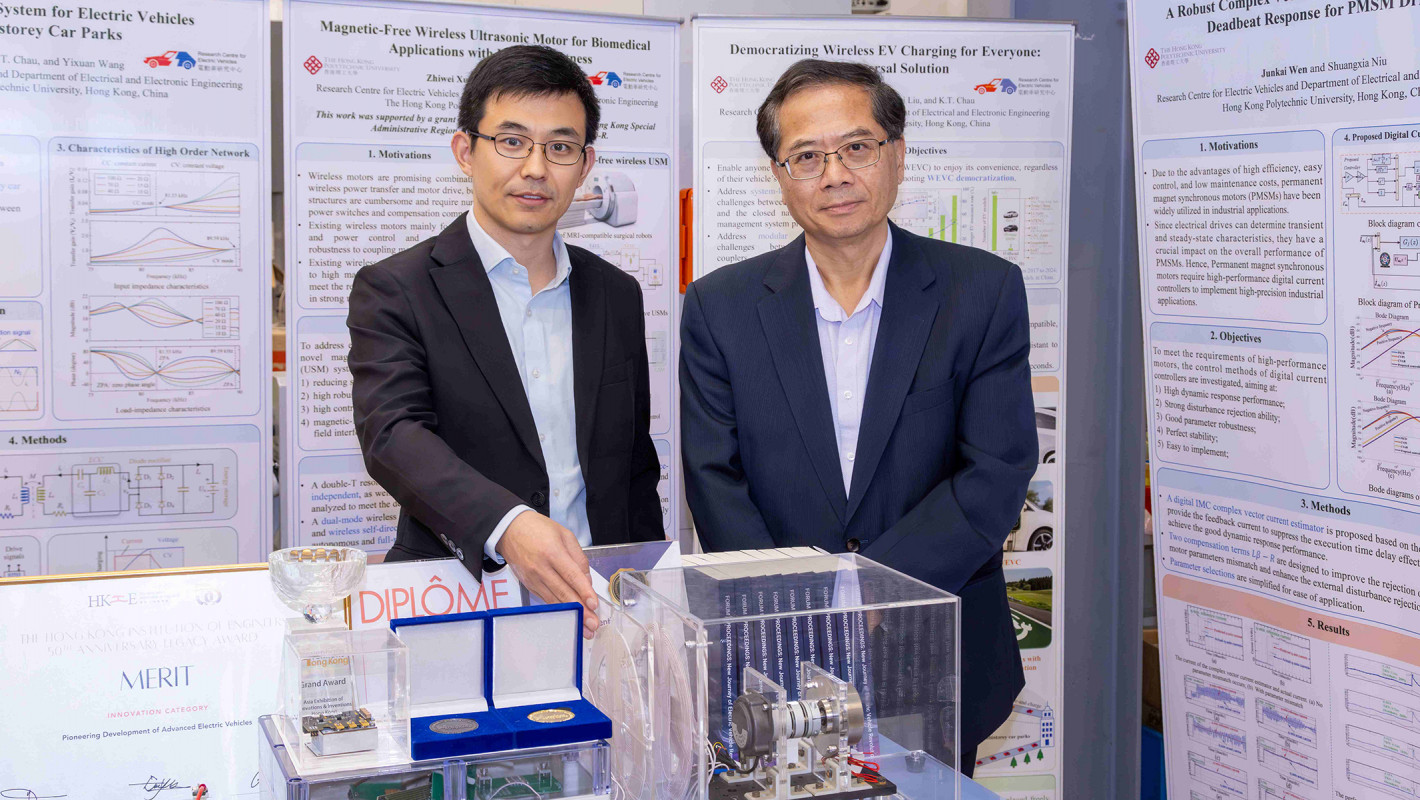
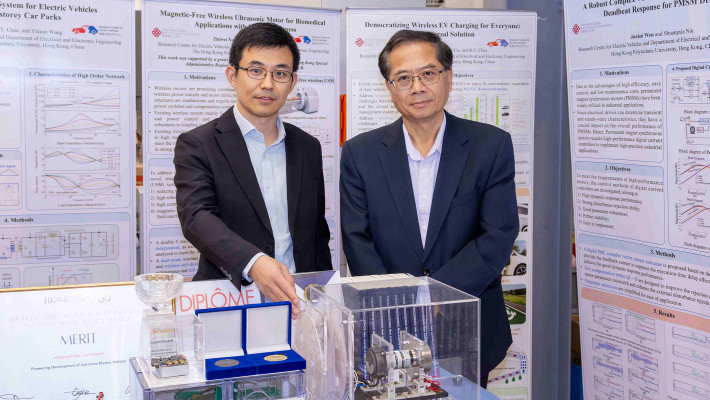
The research was led by Professor Chau Kwok Tong, Chair Professor of Electrical Energy Engineering of the Department of Electrical and Electronic Engineering, and Professor Liu Wei, Assistant Professor of the same department. The study won a Gold Medal with Congratulations of the Jury at the 50th International Exhibition of Inventions Geneva and took a Grand Prize and a Gold Medal at the 4th Asia Exhibition of Innovations and Inventions Hong Kong.
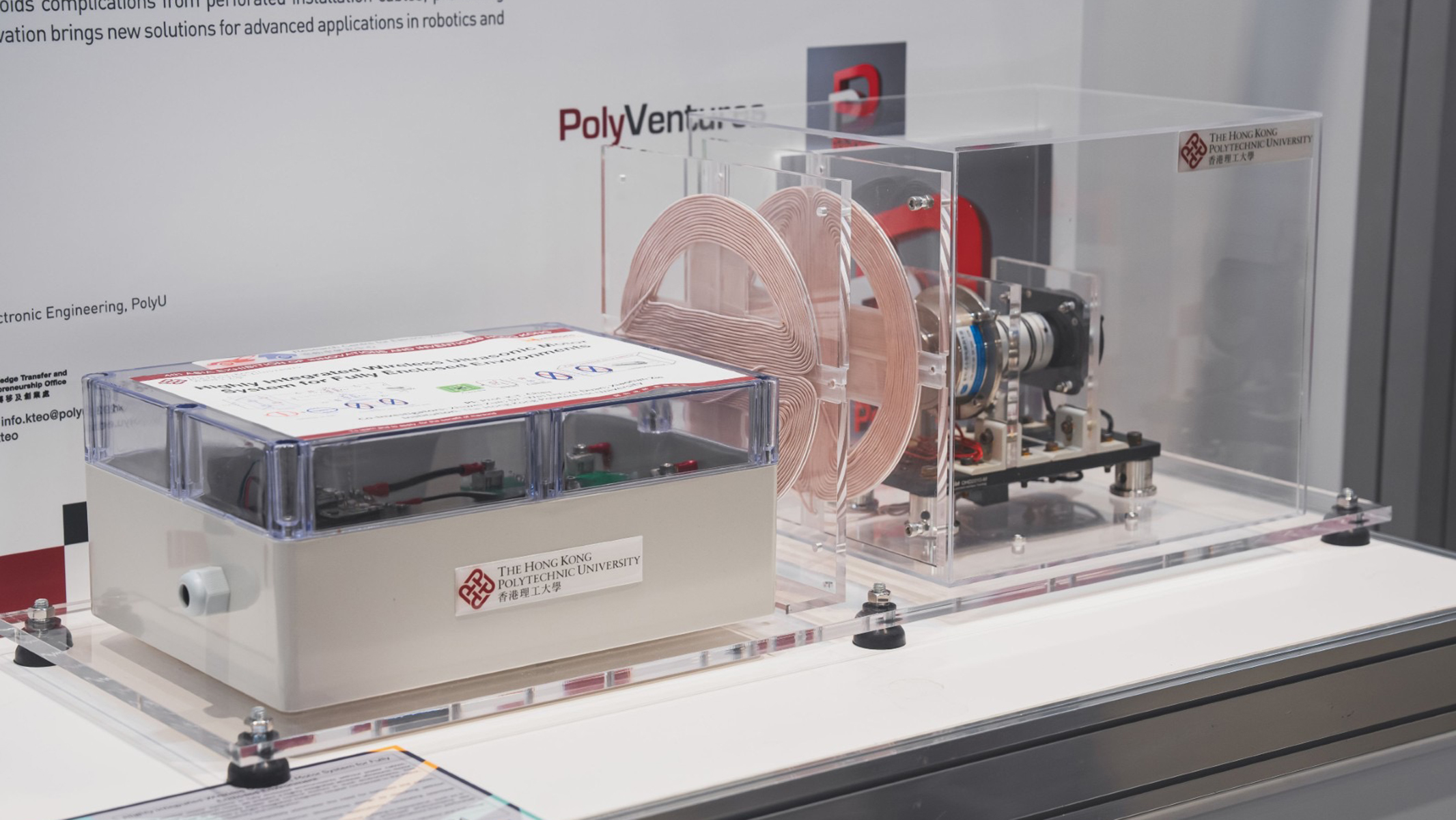
A wireless energy internet, in which energy flows wirelessly among sources, storage and consumers, promises flexible and contactless energy delivery. The image shows the prototype developed by the PolyU research team.
With direct conversion, energy sent from a transmitter arrives as light for illumination, heat for warming or force for motion, with no battery charged along the way. Removing these intermediate stages cuts energy losses, improves efficiency and simplifies the hardware on the receiving end. The team sorts the field into four categories: chemical for charging, optical for lighting, thermal for heating and mechanical for motoring. Together, these cover homes, industry and biomedicine, as well as extreme settings such as deep-sea and deep-space exploration.
Charging batteries remains the most mature approach. However, wireless lighting, heating and motoring are especially useful where cables or batteries are hard to maintain or undesirable. For consumers, wireless energy conversion could offer greater convenience, flexibility and efficiency, while reducing energy-storage risks associated with large battery packs.
Professor Chau explained that team's review of wireless power transfer technologies makes impact on two levels. First, it sets out practical design routes for core technologies such as primary-side control, multi-frequency compensation networks, secure transmission and field-directed transmission. Second, it offers strategic guidance on future standards, security and application priorities. This, Professor Chau noted, will help industry choose viable product architectures and help policymakers and investors see what infrastructure is needed for mass adoption.
Challenges remain, with the safety of energy transmission being a primary concern. The potential effects of prolonged human exposure to electromagnetic fields, as well as electromagnetic interference with nearby electronic devices, are particularly important considerations in public spaces and medical facilities. The study also identifies four major engineering challenges: safety, scalability, complexity and performance.
Professor Liu pointed out that most existing standards cover only specific applications, particularly wireless electric-vehicle charging. Broader frameworks for safety, emissions and interoperability across wireless energy conversion technologies remain incomplete. He therefore advocated designing wireless energy systems in a systematic and holistic manner, rather than optimising individual energy conversion stages in isolation.
Looking ahead, the researchers outline several priorities for advancing the field. These include developing standard interfaces that allow devices to negotiate power, identify receivers and exchange data; strengthening energy encryption through integrated physical-layer security; creating lightweight, sealed and radiation-tolerant systems for aerospace applications; and improving electromagnetic energy harvesting through more sensitive receivers and ultra-low-power technologies.
In time, a wireless energy network could automatically recognise the specific energy needs of different devices, whether chemical, optical, thermal or mechanical, and dynamically adjust transmission frequency, field distribution and power level accordingly. Such a system would move wireless technology beyond simply charging batteries and towards delivering the exact form of energy required, when and where it is needed.