
PolyU and TaxChina forge new frontier in AI-powered taxation
As the world enters an era of “digital tax administration”, the way businesses manage compliance is undergoing a profound shift from reactive response to proactive prevention. Seizing this moment of transformation, PolyU and TaxChina Intelligent Technology (TaxChina) have joined forces to establish the Joint Research Centre for AI Taxation, a bold step towards reshaping the future of the global fiscal and taxation services industry.
Signed on 3 August, the Memorandum of Understanding (MoU) unites PolyU’s outstanding research strengths in artificial intelligence (AI), federated learning and data science with TaxChina’s extensive industry experience and rich application scenarios. Together, the two parties aim to drive innovative applications of AI across the fiscal and taxation fields and accelerate the intelligent transformation of tax services.
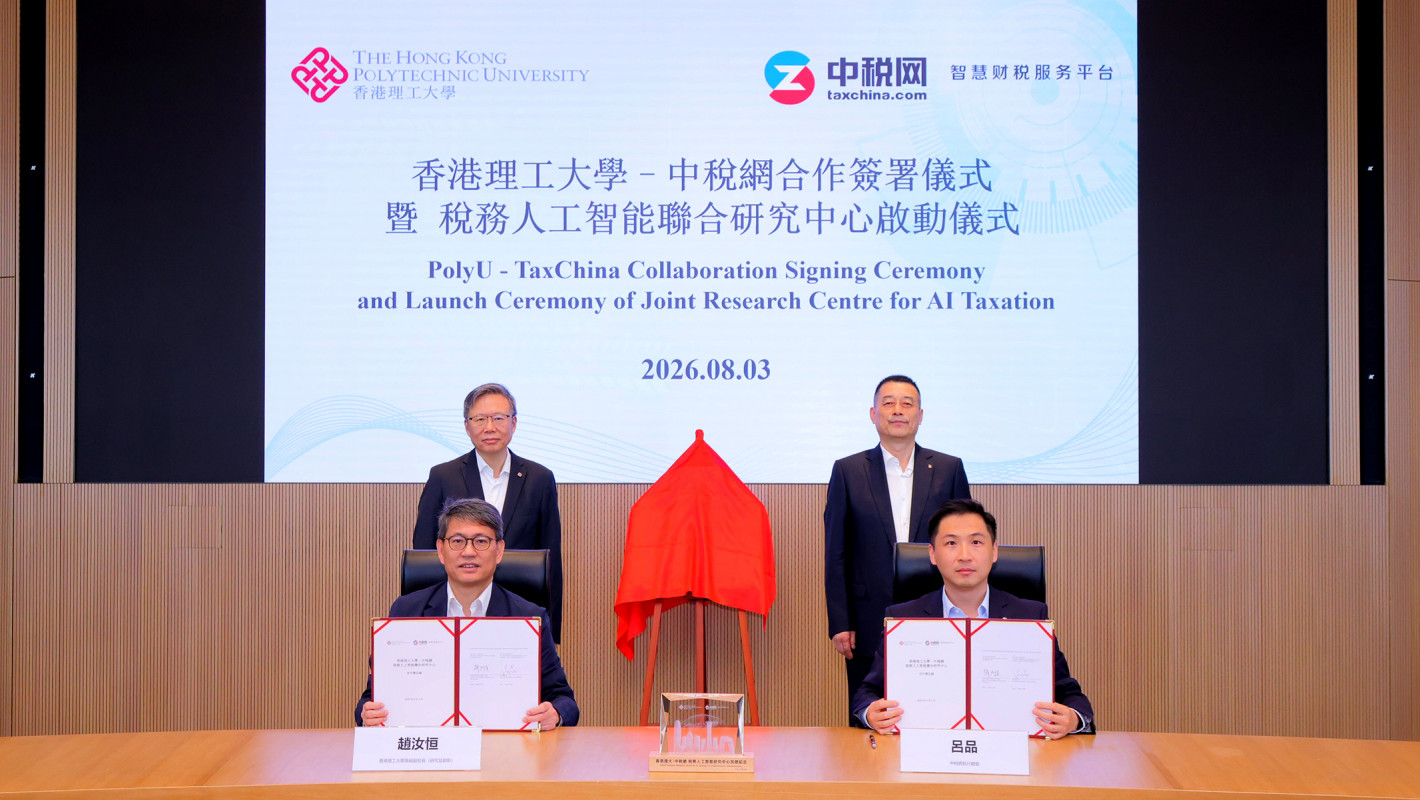
The signing ceremony, held on the PolyU campus, was witnessed by PolyU President Prof. Jin-Guang Teng and TaxChina Founder and Chairman Mr Xu Zhaohong. The MoU was signed by Prof. Christopher Chao, PolyU Senior Vice President (Research and Innovation), and Mr Lyu Pin, Chief Executive Officer of TaxChina (Beijing) AI Technology. A plaque unveiling ceremony followed, marking the official launch of a dedicated AI taxation research and development platform between a leading Asia-Pacific higher education institution and a top-tier tax services enterprise. This milestone opens a new chapter in industry-academia-research integration and intelligent transformation for the global tax sector.
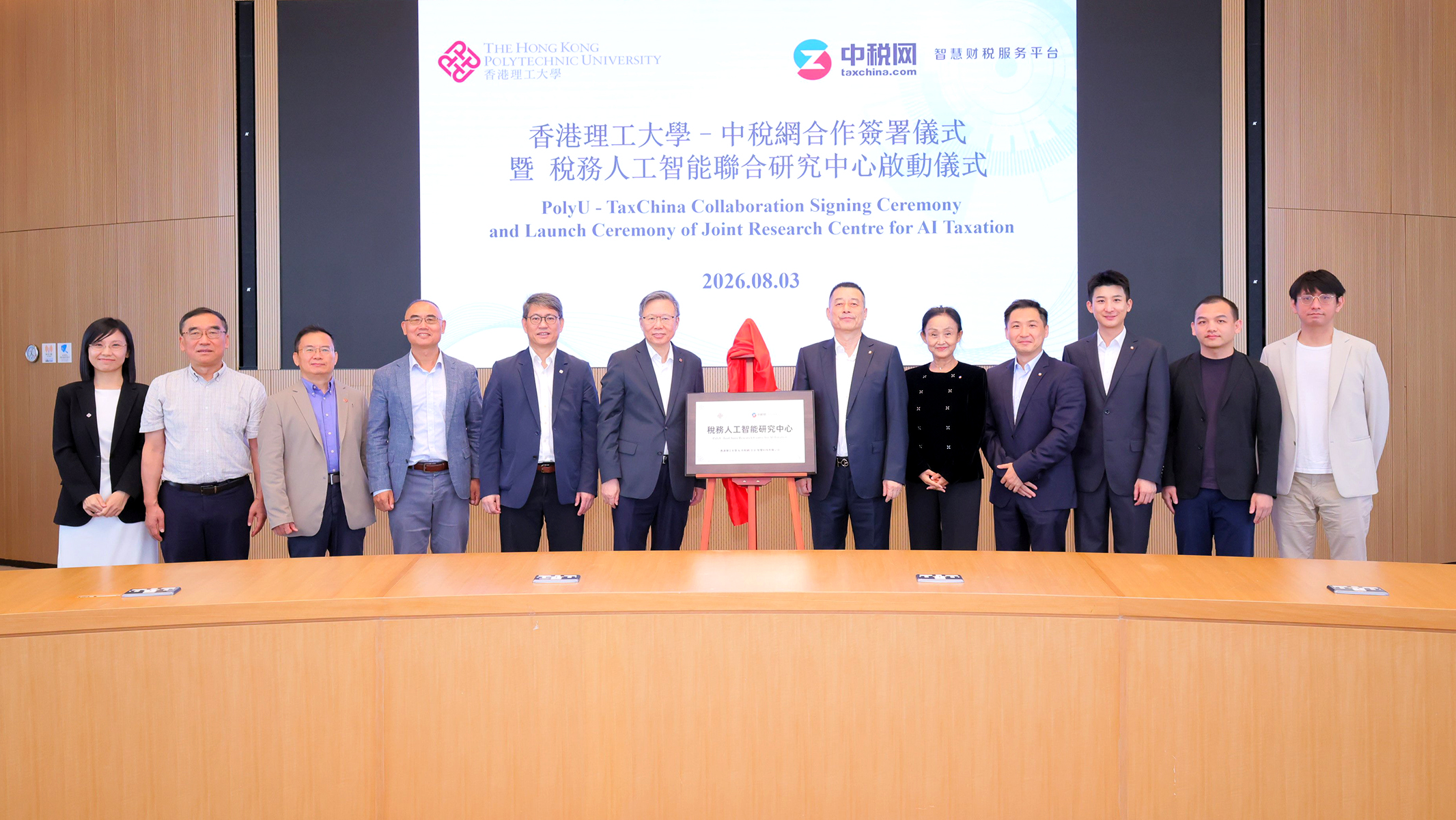
The two parties held a plaque unveiling ceremony for the Research Centre, marking the official launch of a dedicated AI taxation research and development platform.
The Research Centre will pursue three core directions. First, it will build a collaborative framework that “combines vertical large models with industry-specific professional models” to sharpen intelligent decision-making in taxation scenarios. Second, it will harness PolyU’s research strengths in federated learning to advance privacy protection and collaborative training technologies, ensuring that “data never leaves the premises”. Third, it will deepen cross-sector innovation to nurture a sustainable ecosystem for AI-assisted taxation.
Prof. Jin-Guang Teng expressed confidence in the partnership’s potential, noting that the collaboration deeply integrates TaxChina’s vast volume of high-quality data and insightful industry practices with PolyU’s world-leading research strengths in AI and federated learning. He hoped that the Research Centre would become a model for collaborative innovation across industry, academia and research.
Echoing this vision, Mr Xu Zhaohong pointed to the growing market demand for intelligent tax solutions capable of adapting to global tax regimes. He anticipated that the partnership would narrow the gap between technology and application scenarios, developing the Research Centre into an internationally leading hub for AI taxation innovation while cultivating interdisciplinary talent skilled in both AI and taxation.
The timing could not be more apt. As the intelligent economy accelerates, AI is fast becoming a key driver in modernising tax governance, reducing cross-border compliance costs and enhancing enterprise decision-making. The collaboration builds on PolyU’s solid foundation in AI, reflected in its Department of Data Science and Artificial Intelligence (DSAI), the PolyU Academy for Artificial Intelligence (PAAI), and the recently established Research Institute for Federated Learning.
By adopting a closed-loop model in which “needs come from industry and results return to industry”, PolyU and TaxChina are poised to propel the tax profession from “digitalisation” to “intelligentisation”—delivering fresh solutions for global tax governance and corporate compliance alike.