
Charting AI’s next frontier: The journey of a Forbes 30 Under 30 Asia honouree
Being named in the Forbes 30 Under 30 Asia list represents more than a moment of recognition for an emerging researcher. It serves as an important endorsement of bold ideas, original thinking and the ability to translate research into measurable impact. The prestigious list provides a stage to celebrate early-career innovators who are already reshaping industries.
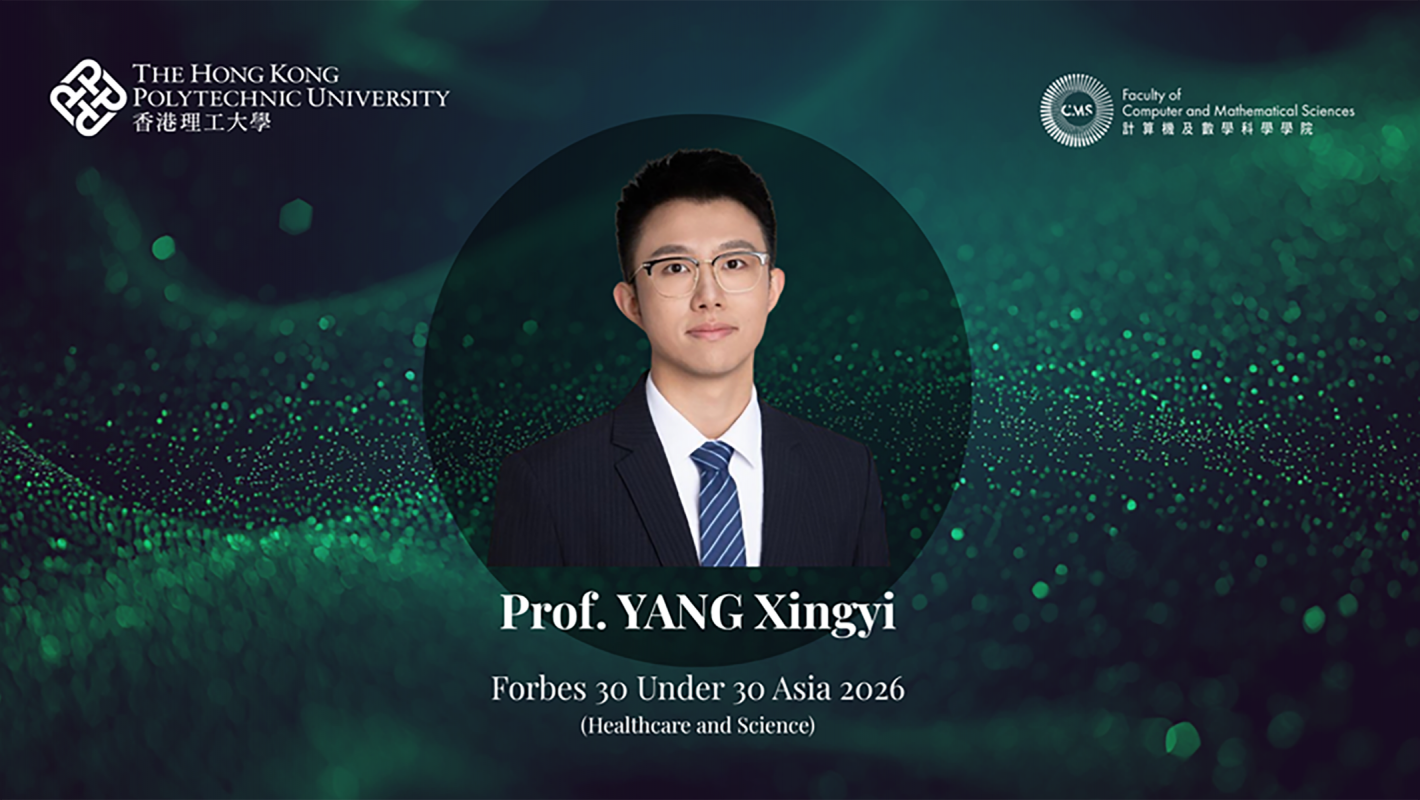
For one young academic at PolyU, the official notification arriving in the early morning hours was an unexpected surprise. “I saw the email very early in the morning at around 6 a.m., and I had just woken up. For a moment, I wasn’t even sure if I was reading it correctly,” he recalls. Yet, his inclusion in the Healthcare & Science category of the Forbes 30 Under 30 Asia 2026 serves as a fitting testament to a journey defined by foresight, impact, and an unwavering commitment to societal needs.
As an Assistant Professor in PolyU’s Department of Data Science and Artificial Intelligence (DSAI), Professor Yang Xingyi’s work is positioned at the forefront of future technological developments. At a time when much of the public attention is focused on the capabilities of Large Language Models, his research is firmly set on a more profound challenge: connecting artificial intelligence (AI) with the complexity of the physical world.
His breakthrough moment began during the acute uncertainty of the 2020 pandemic. Faced with a persistent challenge in the field of healthcare AI – the difficulty of building reliable models with limited, noisy and costly medical data – he pioneered transfer learning methodologies to enable base models for real-world healthcare applications. His work on AI-assisted COVID-19 diagnosis using Computed Tomography (CT) imaging received over 1,000 citations, serving as an important technical reference for healthcare systems worldwide.
Looking back, he sees that intense period as formative in shaping his research philosophy. “Impactful research is not only about finding a good solution,” he reflects. “It is also about recognising the right problem at the right moment.” The experience also changed the way he thinks about academic risk. “Sometimes the most important problems are also the most difficult and uncertain ones. But if the problem is truly important, that uncertainty can also be an opportunity.”
Since then, his research has continued to advance in step with the rapid development of generative AI. His focus has increasingly turned to what is needed for AI to move beyond a passive tool on a screen and become an active, dependable agent in high-stakes real-world settings. Central to this challenge, he says, are controllability and reliability.
For generative AI to be truly controllable, models must be guided by sophisticated algorithmic constraints that shape how they sample from complex learned distributions. Reliability, meanwhile, depends just as much on the quality of the data behind the system. “Reliability also depends on how we select, clean, filter, and evaluate data,” he notes. This is especially important when AI systems are expected to perform robustly despite the imperfect and unpredictable nature of real-world data.
This direction has led to his current focus on spatial intelligence and world models. By combining the ability to understand 3D structures, simulate possible scenarios through generative AI and predict how situations may unfold over time, his laboratory is helping AI develop an internal model of the real world.
“Today’s AI is already very powerful, but it still lives inside the digital world,” he explains. “To build AI that can reason about the real world, we need three essential abilities: understanding space, imagining possibilities, and predicting what may happen next.” For him, this combination forms the foundation for the next generation of autonomous household robots and advanced healthcare assistants.
For the next generation of student innovators at PolyU and beyond, his advice is clear: look beyond short-lived trends and develop independent, long-term judgment. “AI is advancing at an incredible pace, and it is easy to follow whatever is currently popular,” he warns. “Develop your own judgment. Learn broadly, understand the fundamentals, and think carefully about where the field may be heading next. Do not simply ask what is important today; ask what will become important five or ten years from now.”
Driven by this ethos, the Forbes recognition is not a destination, but a powerful catalyst for further impact and broader collaboration across the global research community. “I believe the next frontier is enabling AI to understand and interact with the physical world,” he concludes. With growing international visibility and a clear sense of purpose, he is well positioned to help shape a future in which AI can safely and meaningfully benefit humankind, while contributing to the development of AI research at PolyU.