When Connectivity Shapes the Flight Path
Other Articles

A Foundational Step Towards Reliable Network-Connected Aerial Operations
Study conducted by Prof. Shuowen ZHANG and her research team
Imagine an unmanned aerial vehicle (UAV) carrying out tasks such as cargo delivery, aerial surveillance, video streaming or infrastructure inspection. In conventional systems, it communicates directly with a nearby pilot or ground control station, which can limit its range, reliability and data capacity.
Cellular-enabled UAV communication offers an alternative: the UAV functions as an aerial user of an existing cellular network and is served by ground base stations (GBSs) as it flies (Figure 1). This allows its control signals and mission data to use the network’s broader coverage and higher-capacity connections. However, it also raises a new question: if the UAV must fly from point A to point B while maintaining connectivity, along what path should it fly?
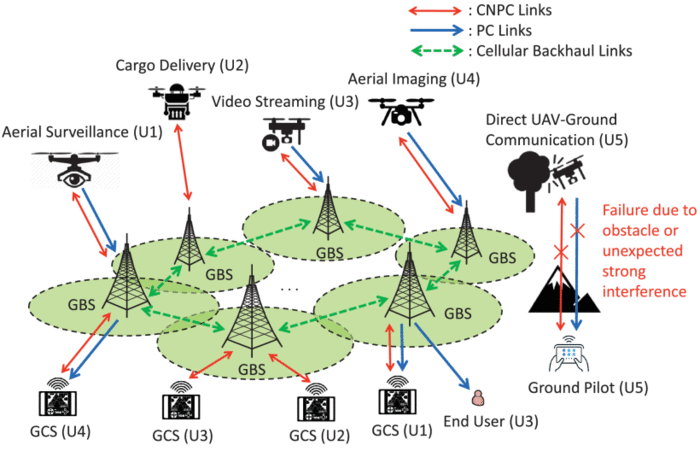
Figure 1. Schematic diagram for cellular-enabled UAV communication and the relationship between the UAV, ground base stations and its ground control station
The shortest route may pass through a coverage gap. A route with the strongest signal may require a lengthy detour. For beyond-visual-line-of-sight operations, losing the communication link is not simply an inconvenience: it may prevent the UAV from receiving commands, reporting its status, or transmitting mission data.
In a paper published in IEEE Transactions on Communications [1], Prof. Shuowen ZHANG, Assistant Professor of the Department of Electrical and Electronic Engineering at The Hong Kong Polytechnic University, and her collaborators addressed this problem. The work presented a clear and extensible framework for planning the movement of a cellular-connected UAV while preserving the quality of its communication link, which helped establish communication-aware trajectory design as a distinct and important problem in UAV research. Its contribution was later recognised with the IEEE Communications Society Young Author Best Paper Award in 2022, as one of the only two awarded papers worldwide.
From a flight route to a mathematical problem
This paper considered a focused but widely relevant setting. A UAV must travel from a given initial location to a specified final location in the shortest possible time. During the mission, it must remain connected to the cellular network, with the received signal quality never falling below a prescribed threshold.
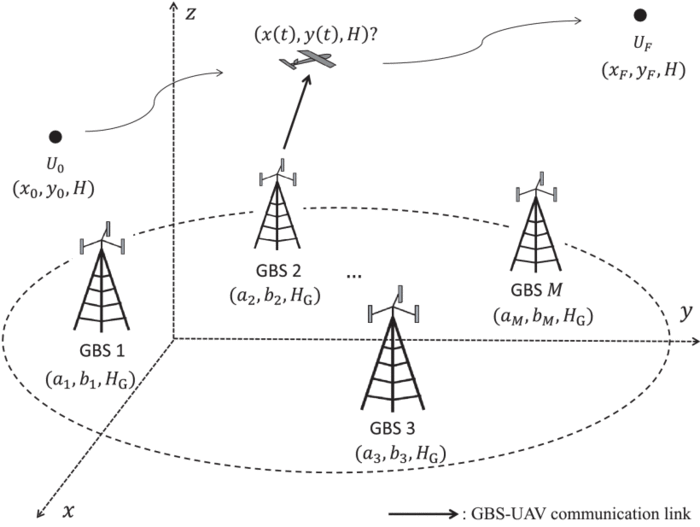
Figure 2. System model for a UAV travelling from an initial location to a final location while maintaining a required communication quality with the cellular network. U0 denotes the initial location and UF is the final location
The system model in Figure 2 shows the basic arrangement: a UAV travels at a fixed altitude between two locations while several GBSs are distributed across the ground. As the UAV moves, it associates with the GBS offering the strongest channel and may hand over to another station when necessary.
This formulation captures an important requirement of network-connected aerial operations. A UAV may need to maintain a reliable command-and-control link while also transmitting images, videos or other mission data. The route must therefore satisfy a communication constraint at every point, not merely at the beginning and end of the flight.
That makes the problem difficult. The trajectory is a continuous function of time, and the connectivity requirement must hold continuously as well. The UAV must also decide where to fly, which GBS to use and when to hand over. Conventional route planning, which often optimises distance or time first and evaluates communication performance afterwards, cannot easily handle these decisions together.
The beauty of this paper’s approach is that they did not treat this complexity as an obstacle requiring a purely numerical search. They looked for the mathematical structure hidden within the physical problem. By doing so, they transformed an apparently infinite-dimensional trajectory-design problem into a finite sequence of geometric and graph-based decisions.
The hidden structure of the optimal route
The first major insight was that the optimal trajectory is not an arbitrary curved path. Under the assumptions of the model, it consists of connected straight-line segments flown at the UAV’s maximum speed.
During each segment, the UAV remains associated with one GBS. It hands over to another GBS at a point where their required coverage regions overlap (Figure 3). This result is both mathematically useful and physically intuitive: once feasible handover points have been chosen, slowing down or following a curved path would only increase the flight time.
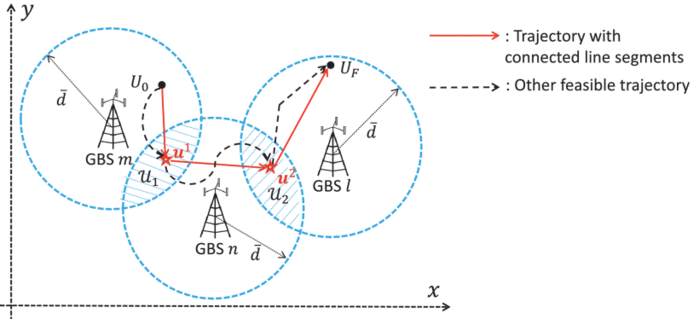
Figure 3. The optimal trajectory (red arrows) formed by connected straight-line segments, compared with longer feasible paths that include unnecessary curvature or detours (dotted arrows)
This finding substantially simplifies the original problem. Instead of designing an entire continuous trajectory point by point, the only remaining task is to determine:
1. the sequence of GBSs with which the UAV will associate; and
2. the locations at which handovers will occur.
The handover locations can further be restricted to the boundaries of overlapping coverage regions. These boundaries are the transition areas where the UAV can remain within the required communication range of both its current and next serving GBS.
The result illustrates the value of mathematical modelling in practical engineering. The original question “Where should the UAV fly?” is replaced by a more structured set of questions: “Which coverage regions should it pass through?” and “Where should it move from one region to the next?” A continuous flight path becomes a finite geometric object that can be analysed and optimised.
Turning coverage into a graph
This paper then used graph theory to represent the possible movement between coverage regions. Each GBS becomes a vertex in a graph (Figure 4). Two GBSs are connected by an edge when their coverage areas overlap sufficiently for the UAV to move between them without losing the required signal quality. The initial and final UAV locations are connected to the GBSs that can serve them.
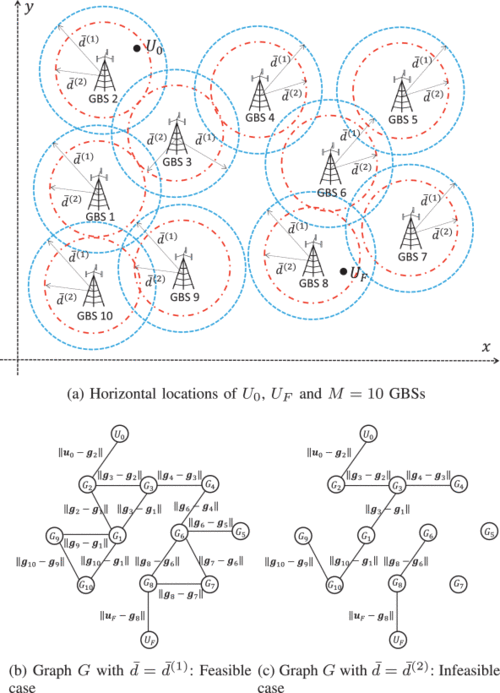
Figure 4. Relationship between overlapping GBS coverage regions and the corresponding graph. A connected path from the initial to the final location represents a feasible sequence of cellular associations
This graph provides an efficient answer to a fundamental question: is the mission feasible at all? If the initial and final locations are connected through a sequence of overlapping coverage regions, the UAV has at least one possible route that preserves connectivity. If no such path exists, the required signal-quality threshold cannot be met, regardless of how the UAV attempts to fly.
The graph can also guide the optimisation itself. A path through the graph represents a possible sequence of GBS associations. The distance associated with that path provides a route cost, while convex optimisation is used to refine the precise handover locations.
In this way, this paper converted a difficult engineering problem into a mathematically well-structured combination of graph connectivity, shortest-path search, and geometric optimisation. It revealed why feasible routes exist, what their structure should be and how solution quality can be balanced against computational complexity. Particularly, by judiciously exploiting the problem structure and proposing a novel quantization-based graph construction approach, this paper developed a polynomial-time algorithm that is analytically proved to arbitrarily approach the optimal solution of this challenging non-convex continuous optimization problem. This paves the way for fast yet performance-guaranteed UAV deployment in practical missions.
A milestone in UAV communication
The lasting value of the study lies in the way it framed a problem that would become increasingly relevant as UAVs moved towards large-scale networked operation.
The study made a clear conceptual contribution: cellular connectivity should be incorporated into UAV trajectory design from the beginning, rather than assessed after a route has already been chosen. It also demonstrated how mathematical abstraction can make a practical problem easier to understand and solve. Physical coverage regions became geometric constraints; handovers became graph transitions; and flight planning became an optimisation problem with a clear structure.
The framework is also extensible. Subsequent studies have considered more complex settings involving interference, multiple UAVs, energy consumption, three-dimensional movement, non-line-of-sight channels, coordinated transmission and dynamic resource allocation. These extensions introduce new challenges, but they build on the same central insight: a UAV’s movement and communication environment cannot be designed independently.
In moving cellular-connected UAVs from an attractive concept towards practical deployment, this study provided an important early theoretical foundation. It showed that a connected UAV does not simply follow a route through physical space. It follows a route through the communication network as well.
Prof. Zhang was recognised by Stanford University as one of the top 2% most-cited scientists worldwide (single-year) in the field of networking and telecommunications for six consecutive years, from 2021 to 2026. She is a rising young scholar in communications technology. Her research frequently receives international recognition. She is the sole recipient of the 2021 Marconi Society Paul Baran Young Scholar Award and the 2025 IEEE Communications Society Communication Theory Technical Committee (CTTC) Early Achievement Award. She is a recipient of the 2024 IEEE Communications Society Asia-Pacific Outstanding Young Research Award, the 2023 PolyU Young Innovative Researcher Award, the 2023 IEEE Communications Society Best Tutorial Paper Award, and the 2022 IEEE Communications Society Young Author Best Paper Award. She is recognised by N2Women (Networking Networking Women) as one of the ten “N2Women 2024 Rising Stars in Computer Networking and Communications” and one of the Rising Stars in EECS, Class of 2019. Prof. Zhang is currently serving as an Editor for IEEE Transactions on Wireless Communications and an Associate Editor for IEEE Transactions on Mobile Computing. She is the Project Coordinator (PC) of a 2025/2026 Hong Kong Research Grants Council Collaborative Research Fund (CRF) Young Collaborative Research Grant.
| References |
|---|
[1] S. Zhang, Y. Zeng and R. Zhang, Cellular-Enabled UAV Communication: A Connectivity-Constrained Trajectory Optimization Perspective, IEEE Transactions on Communications, vol. 67, no. 3, pp. 2580-2604, March 2019, doi: 10.1109/TCOMM.2018.2880468.
 | Prof. Shuowen ZHANG |