AI-Controlled Green Lights for Better-Spaced Buses
Other Articles

A Cooperative AI Signal-Control System Reduces Bus Bunching and Passenger Waiting Times while Keeping Traffic Moving
Study conducted by Prof. Edward Chin-shin CHUNG and his research team
More than 90% of mechanised passenger trips in Hong Kong are made by public transport. Yet the city also has among the world’s highest road and vehicle densities, leaving little room to absorb delays. In such an environment, a late bus is rarely an isolated inconvenience. Once gaps between buses become uneven, crowded buses fall further behind while lightly loaded buses catch up, which is a familiar phenomenon known as bus bunching.
To address the problem, Prof. Edward Chin-shin CHUNG, Professor of the Department of Electrical and Electronic Engineering at The Hong Kong Polytechnic University, and his research team developed a Cooperative Transit signal priority strategy with Variable phase for Headway adherence (CTVH)—a system for smart traffic signals that cooperate to keep buses evenly spaced without creating additional congestion for other road users. The study is published in IEEE Transactions on Intelligent Transportation Systems [1].
Why uneven bus arrivals become a self-reinforcing problem
Bus reliability is not simply about whether a vehicle follows its timetable. On frequent services, what often matters more is headway adherence, which means how consistently buses maintain the planned interval between consecutive services.
Suppose buses are scheduled to arrive every five minutes. If one bus is delayed, more passengers accumulate at the stop. It then takes longer time for them to board, delaying the bus further. Meanwhile, the following bus encounters fewer passengers, spends less time at stops and begins to catch up. Eventually, two buses may arrive almost together, followed by a long wait for the next one. This wastes capacity and worsens passengers’ experience. The first bus becomes crowded, the second is underused and average waiting times rise.
Prof. Chung’s central idea is more selective: use traffic signals to help a late bus close the gap ahead, while allowing an early bus to wait slightly longer when appropriate.
AI agents make signal decisions every second
CTVH uses multi-agent reinforcement learning (RL), a form of AI in which several decision-making “agents” learn to work together. Each signalised intersection is controlled by one agent. Rather than following a preset cycle, the agent observes current traffic conditions and selects the signal for the next second. Its decision considers both public transport and general traffic.
The system does not merely detect whether a bus is approaching. For each relevant bus, it considers how far the bus is from the stop line, whether it is running early or late, the gap to the bus ahead and the bus behind, passenger occupancy, whether the bus is currently at a stop, and traffic speeds and queues on the surrounding approaches.
This allows CTVH to distinguish between buses requiring different treatment. A bus with an unusually large gap ahead may benefit from priority, while giving the same priority to a bus already too close to its leader could make bunching worse.
The agents also cooperate across intersections. During training, the system evaluates how the signals collectively affect the road network, rather than optimising each junction in isolation. Once trained, each intersection can make its own decisions using local information while contributing to the network-wide objective.
Importantly, practical signal-control constraints are incorporated in the system. CTVH accounts for minimum and maximum green times, phase-skipping rules, and the yellow and all-red periods needed for safe phase changes. Treating these transition periods as separate actions enables the agents to remain synchronised and make second-by-second decisions.
The reward used to train the system balances two goals: reducing bus headway deviations and limiting queues for ordinary traffic. This prevents it from improving bus service at an unacceptable cost to cars and other road users.
Bus regularity improved by 6.1% as queues fell by 15.3%
The team first tested CTVH in a simulated arterial corridor with three signalised intersections, standard four-phase signals and six two-way bus routes (Figure 1). Traffic demand changed across five periods, including a peak period, while buses entered the network with varying initial delays.
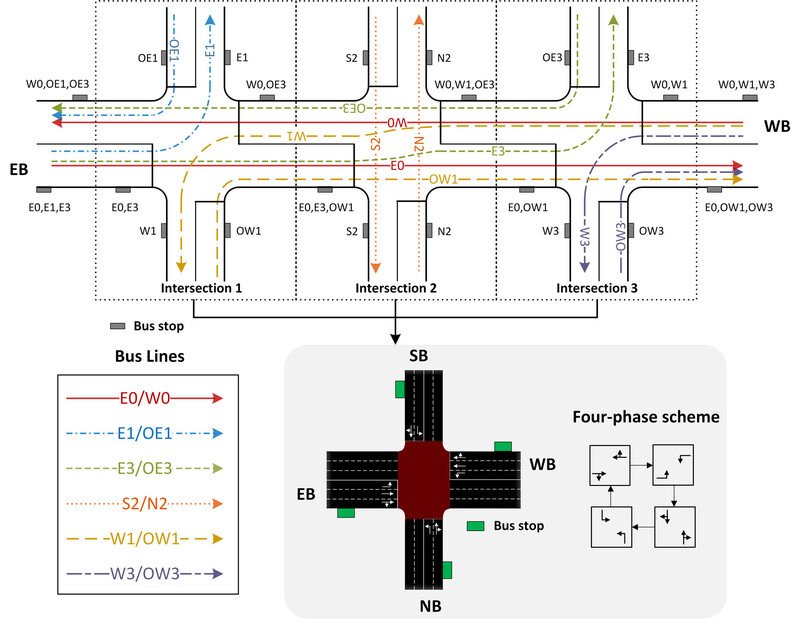
Figure 1. The simulated multi-intersection, multi-route setting used to train and test the system
The results were compared with coordinated fixed-time signals, a bus-holding strategy and two other reinforcement-learning approaches.
Against coordinated fixed-time control, CTVH reduced average bus headway deviation by 6.1% and the difference between forward and backward headways by 5.3%. At the same time, average person delay fell by 3.2%, queues by 15.3% and total passenger delay for bus users by 4.0%. Passenger waiting time at stops decreased by 1.7%.
Bus holding produced larger improvements in regularity within this small test network: average headway deviation dropped by 18.4% and waiting time by 16.5%. However, those gains came with substantial costs. Average person delay increased by 10.7%, queues by 9.4% and the delay experienced by passengers already on buses by 49.8%. Overall passenger delay for bus users rose by 16.7%.
The simulations revealed why. When one bus was held in a short bus bay, following buses could be forced to queue behind it. If several routes used the same stop, this bottleneck could spread to surrounding traffic. CTVH avoids this problem entirely: it never holds buses at stops. Instead, it uses selective signal timing, giving priority to late buses while gently delaying early ones, and is trained with a reward that explicitly balances headway regularity against general-traffic queues. As a result, it improves bus spacing without the delay and queue penalties of holding.
Figure 2 illustrates this process over several stops. By providing transit signal priority (TSP), CTVH helps a late bus move closer to its scheduled trajectory and reduce the excessive gap ahead. Conversely, an early bus can be gently delayed at intersections, preventing it from catching the preceding service and forming a bunch.
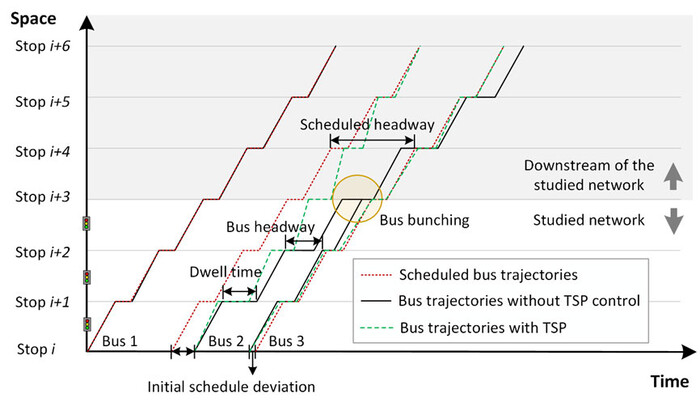
Figure 2. Bus trajectories showing how TSP brings a late bus closer to schedule and gently delays an early bus, reducing bunching. Orange dotted lines: scheduled; black lines: without TSP; green dotted lines: with TSP
A full-route test cut passenger waiting by 6.3%
The relatively modest 1.7% reduction in waiting time in the first experiment reflected the short length of the three-intersection corridor. Bus bunching develops cumulatively: a small headway disturbance near the beginning of a route can grow as buses pass more stops and intersections.
To examine this longer-term effect, the team tested CTVH on a model of Bus Line 2 in Xi’an, China. The complete route included 34 stops and 22 signalised intersections, with buses departing every five minutes and traffic volumes changing between simulation runs (Figure 3).
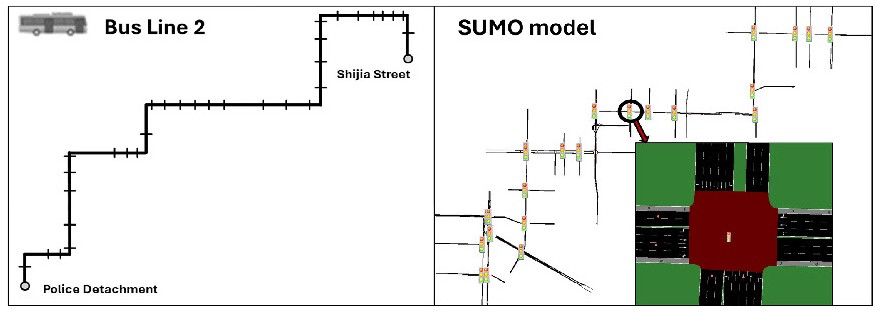
Figure 3. The complete Xi’an bus-line model used to assess whether CTVH could scale beyond a short arterial corridor
Across 60 simulated episodes, CTVH reduced average headway deviation by 19.4% and the difference between forward and backward headways by 22.9%, compared with coordinated fixed-time control. Passenger waiting time fell by 6.3% on average.
These improvements did not come at the expense of general traffic. Average person delay decreased by 4.4%, while queues fell by 7.4%.
The full-route results are important because the benefits of regularity become more visible over distance. By correcting small gaps repeatedly at successive intersections, cooperative signal control can prevent them from growing into severe bunching further downstream.
Second-by-second cooperation brings the system closer to reality
CTVH combines several practical advances. It makes decisions every second, handles several conflicting bus requests, observes the gaps both ahead of and behind each bus, and coordinates multiple intersections. Invalid or unsafe actions are automatically excluded, while the learning objective balances public-transport reliability with the movement of other vehicles.
The study also demonstrates the value of cooperation. Tests in which intersection agents learned independently converged more slowly and yielded smaller improvements in bus regularity and passenger waiting time. The cooperative architecture helped each intersection understand how its local decisions contributed to performance across the network.
Just as importantly, the method was evaluated at two scales: a complex three-intersection arterial and a complete urban bus route. This progression provides useful evidence that the approach could be extended to larger networks.
Towards more reliable urban mobility
In a dense, public-transport-dependent city like Hong Kong, keeping buses evenly spaced is not a minor operational concern. It directly affects waiting times, crowding, fleet utilisation and the capacity of the wider transport system.
CTVH offers a potentially cost-effective way to improve reliability using existing road infrastructure. The study shows how smart transport can move beyond simply accelerating vehicles: the more valuable goal may be to keep the entire service running regularly and efficiently.
Prof. Chung is an internationally recognised expert in connected vehicles and Intelligent Transport Systems (ITS). A Fellow of the Institution of Engineers Australia, he previously served as the Director of the Smart Transport Research Centre at Queensland University of Technology (QUT), where he secured over A$6 million in research funding in the first six years, the Head of the ITS Group at EPFL in Switzerland and a visiting professor at the University of Tokyo’s ITS Centre. He was also QUT’s co-leader in the A$55 million iMOVE CRC, a major Australian national collaborative research centre on connected mobility. He has led industry-partnered projects on cooperative ITS, traffic signal control and real-time traffic management, and served as Editor-in-Chief of the International Journal of ITS Research. Prof. Chung is currently leading multiple projects funded by the Smart Traffic Fund, including a HK$4 million project on an intelligent signal control system for temporary traffic arrangements and a HK$2.2 million project on an automated monitoring system for traffic detector status and non-recurrent events.
| References |
|---|
[1] M. Long and E. Chung, Multi-Agent Reinforcement Learning for Cooperative Transit Signal Priority to Promote Headway Adherence, IEEE Transactions on Intelligent Transportation Systems, vol. 26, no. 3, pp. 3588-3602, March 2025, doi: 10.1109/TITS.2025.3533603.
 | Prof. Edward Chin-shin CHUNG Professor, Department of Electrical and Electronic Engineering |