AI and Blockchain Put Circular Cities in Motion
Other Articles

Digital Tools Offer Targeted Solutions to Urban Transport Challenges
Study conducted by Prof. Kee-hung LAI and his research team
In a dense metropolis like Hong Kong, mobility is both an everyday necessity and a complex systems challenge. Roads, railways, buses, taxis and emerging mobility services must accommodate large numbers of journeys within limited space. When one part of the network underperforms, the effects can spread quickly: congestion increases journey times and emissions, fragmented services make transfers less convenient and infrastructure constraints inhibit modal shifts.
As AI and blockchain technologies become increasingly advanced and widely adopted, Prof. Kee-hung LAI, Chair Professor of Shipping and Logistics and Head of the Department of Logistics and Maritime Studies at The Hong Kong Polytechnic University, examined their potential as digital solutions to persistent urban mobility problems. His research, published in Transport Policy [1], identified six interconnected challenges that hinder the transition towards circular transport systems: traffic congestion, air pollution from transport emissions, inefficient public transport, limited integration between transport modes, insufficient infrastructure and dependence on fossil fuels. The study then assessed which specific capabilities of AI and blockchain are most effective in addressing each challenge.
The circular city model offers a different way to approach these problems. Rather than following a linear pattern of consuming resources and replacing assets, circular cities seek to regenerate resources, extend asset life, reduce waste and emissions, and strengthen system resilience. In transport, this could mean maintaining infrastructure more effectively, using vehicles and capacity more efficiently, coordinating different modes and supporting low-carbon travel.
Digital technologies may help cities make this transition, but only when applied strategically. The key question is:
How can AI and blockchain address specific mobility challenges and advance circular city goals?
The study matches digital tools with specific problems
AI and blockchain have different strengths. AI can analyse large volumes of data, anticipate demand and optimise transport operations. Blockchain can create transparent, verifiable records and automate agreements between organisations.
The study investigated which of these capabilities are most relevant to each of the six mobility challenges. The research team first validated and ranked the challenges through expert surveys. They then used a two-round Delphi process to stabilise expert judgements and the Bayesian Best–Worst Method to produce probabilistic importance weights.
The expert panel included participants from academia, industry and the public sector, with 70 completing the Delphi process and 65 contributing complete and consistent judgements to the final prioritisation.
AI takes the lead on day-to-day operations
The clearest finding is that AI is particularly well suited to operational challenges that require rapid analysis and adaptive decision-making.
For traffic congestion, predictive analysis received the highest importance weight, followed by real-time monitoring. These capabilities can help transport authorities anticipate traffic flows, identify disruptions and adjust signals, routes or services before problems intensify.
For poor integration between transport modes, multimodal optimisation was the leading property. It can support better coordination among buses, trains, shared mobility and other services by aligning schedules, routes and capacity.

AI also performed strongly in public transport and infrastructure management. Demand prediction ranked first for inefficient public transport, reflecting its potential to match service frequency and capacity with changing passenger needs. Predictive maintenance was the top priority for insufficient infrastructure. By detecting emerging faults before failures occur, it can reduce downtime and extend the useful life of transport assets—a direct contribution to circular economy principles.
Blockchain leads where trust and accountability matter
Blockchain was prioritised for systemic and environmental challenges where verification, trust and accountability are essential.
For air pollution, emissions tracking ranked first, followed by carbon-credit systems. The same two capabilities led the rankings for reducing fossil fuel dependence, although carbon-credit systems took first place in that case.
Blockchain could provide reliable records of transport emissions and verified reductions, making environmental claims easier to audit across agencies and operators. It could also support carbon markets or incentive schemes that reward lower-carbon choices, such as cycling, public transport or electric mobility.
Smart contracts were identified as valuable for infrastructure governance. For example, they could automatically trigger payments when agreed maintenance or service conditions have been fulfilled and independently recorded. This could strengthen accountability in procurement and performance-based contracts.
Shared data and live monitoring form the digital backbone
Two capabilities were consistently important across several challenges: transparent data sharing, associated with blockchain, and real-time monitoring, associated with AI.
Together, they provide a common digital foundation. AI requires timely, accurate and interoperable data to generate reliable predictions. Blockchain can help multiple organisations share and verify information with greater confidence.
This relationship also shows why the technologies should not always be treated separately. Their value may be greatest when trusted data-sharing arrangements feed real-time AI analysis, while blockchain-based records make resulting decisions and outcomes more transparent.
The right technology depends on the problem
To translate the findings into action, the team proposes a framework connecting drivers, challenges, blockchain–AI digitalisation, impacts and outcomes (Figure 1).
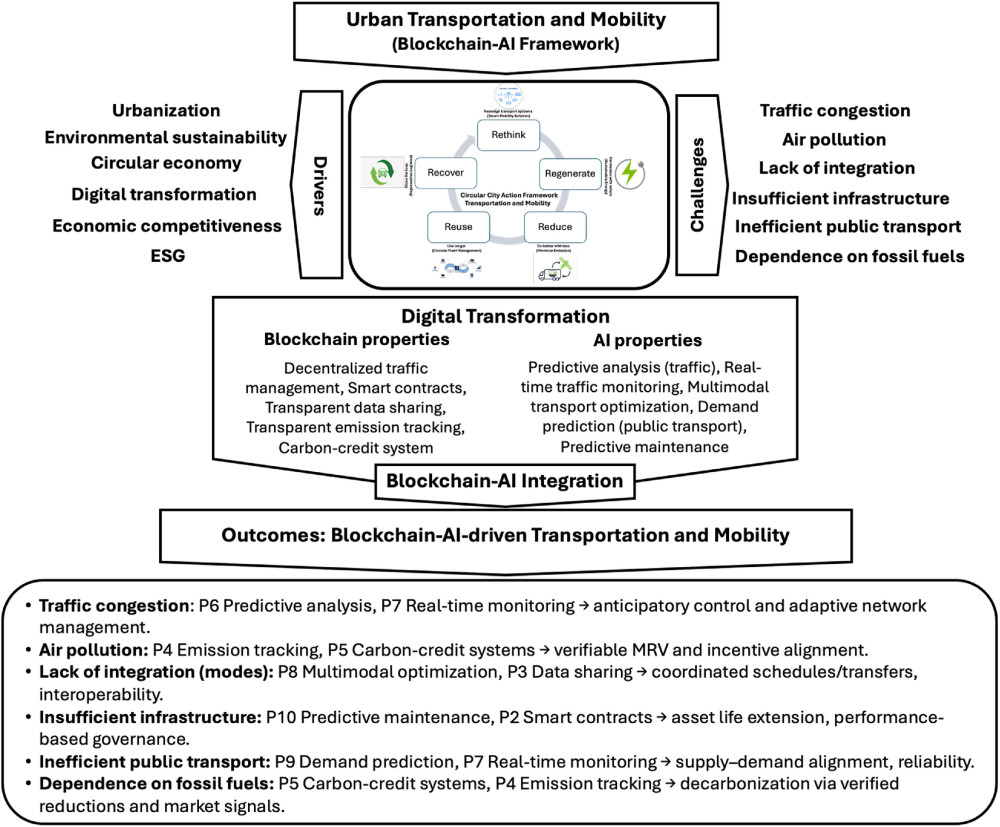
Figure 1. Blockchain–AI managerial framework for circular urban mobility
When congestion, modal integration or public transport performance is the main concern, managers should prioritise AI-led interventions. Predictive analytics can anticipate traffic conditions, demand forecasting can inform service frequency, and multimodal optimisation can improve transfers and network operations.
When the challenge involves air pollution, decarbonisation or institutional accountability, blockchain becomes more relevant. Emissions tracking can create auditable environmental records, carbon-credit systems can support incentives for lower-carbon behaviour, and smart contracts can strengthen accountability in service delivery.
Hybrid systems can tackle high-stakes challenges
Complex situations may require AI and blockchain to be deployed together. An infrastructure operator could combine AI-based predictive maintenance with blockchain-enabled smart contracts. AI would identify when maintenance is needed, while the smart contract could record completion and trigger payment against agreed performance standards.
Similarly, AI demand forecasts could be linked to blockchain-based incentives that reward passengers for choosing lower-carbon modes or travelling outside peak periods.

Successful implementation, however, depends on more than software. Cities need interoperable data standards so that agencies and operators can exchange information securely. They also require clear arrangements for privacy, data stewardship and organisational responsibility.
Procurement should focus on measurable outcomes, such as minutes of delay avoided, reductions in downtime or verified emissions saved, rather than technology adoption alone. Incentives must also be aligned across transport authorities, private operators and technology providers. Without institutional cooperation and reliable data, sophisticated systems may remain isolated pilots rather than city-wide solutions.
Technology works best when paired with good governance
Digital technology is not a silver bullet for urban mobility. AI alone cannot resolve governance failures while blockchain cannot compensate for inadequate infrastructure, incomplete data or weak transport planning. The central lesson is the importance of matching the right tool to the right problem.
AI’s predictive and optimisation capabilities can make transport networks more responsive. Blockchain’s transparency and verification mechanisms can strengthen trust, environmental accountability and coordination. Used together, they could help cities develop mobility systems that are more efficient, resilient and circular.
Prof. Lai was recognised by Stanford University as one of the top 2% most-cited scientists worldwide (career-long) in the field of operations research for eight consecutive years, from 2019 to 2026. He has also been recognised by Clarivate Analytics as a Highly Cited Researcher in 2019, with over 45,500 citations and an h-index of 102 on Google Scholar. He has published more than 300 journal articles (nearly 90% in Q1 journals), including papers in Financial Times Top 50 journals, and has authored or co-authored eight books. Prof. Lai serves as Editor-in-Chief of the International Journal of Shipping and Transport Logistics and the Journal of Shipping and Trade. He is a Fellow of the Chartered Institute of Logistics and Transport and a member of the Hong Kong Logistics Development Council. He has also received the Research.com Business and Management in China Leader Award for four consecutive years, from 2023 to 2026.
| References |
|---|
[1] Javed Aslam, Abroon Qazi, Kee-hung Lai, Aqeela Saleem, Urban mobility and transportation in circular cities: Integrating blockchain–AI digital solutions, Transport Policy, Volume 183, 2026, 104139, ISSN 0967-070X, https://doi.org/10.1016/j.tranpol.2026.104139.
 | Prof. Kee-hung LAI Chair Professor of Shipping and Logistics and Head, |