Research paper titled “CFTR mediates Cl- transport in osteocytes to sustain cell viability and skeletal homeostasis”, with Professor Sharon Y. C. RUAN as the corresponding author, was recently published in Nature Communications. Prof. RUAN’s work has demonstrated for the first time that chloride channel CFTR keeps osteocytes alive and limits bone loss, revealing a new mechanism for maintaining long lived bone cells and suggesting a potential strategy to protect bone health.
“CFTR mediates Cl- transport in osteocytes to sustain cell viability and skeletal homeostasis“
Peijie Hu, Wanting Du, Muyan Chu, Junjiang Chen, Xiaotian Zhang, Ziyi Chen, Jun Hu, Lei Qin, Wayne Yuk-Wai Lee, Jinghui Guo, Hui Chen, Ruiyao Xu, Xiaojun Cai, Xiaohua Jiang, Hsiao Chang Chan, Ling Qin*, Jiankun Xu* & Ye Chun Ruan*
Nature Communications (2026). doi: 10.1038/s41467-026-72349-0
Abstract
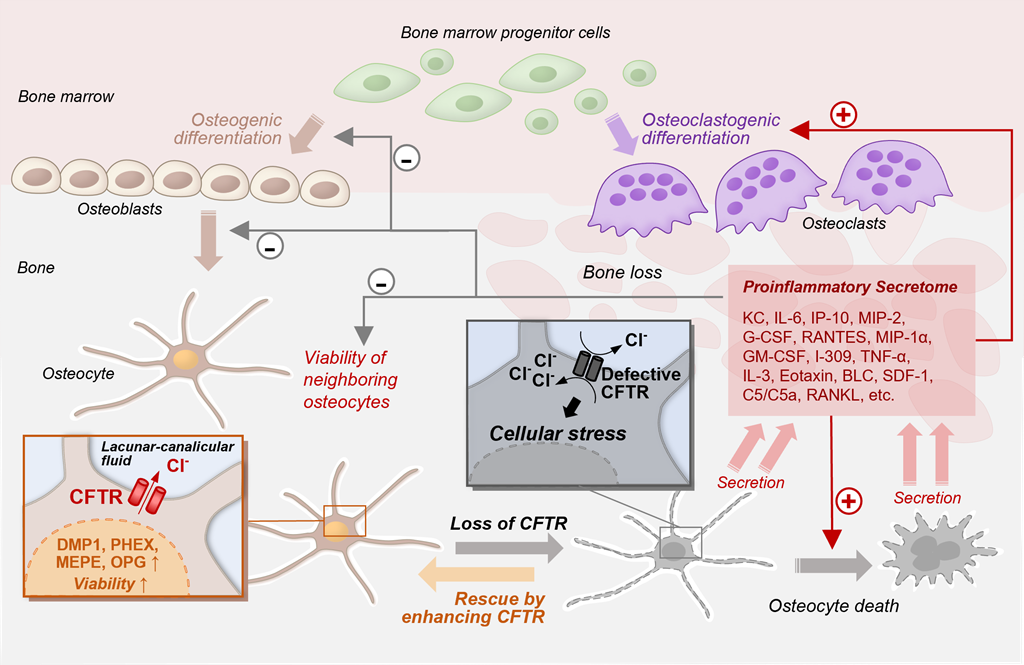
Osteocytes are long-lived with underlying mechanisms largely unknown. Here, we report that osteocyte-specific knockout of cystic fibrosis transmembrane conductance regulator (CFTR) results in excessive osteocyte death, proinflammatory cytokine surge, osteoclast overactivation and bone formation impairment leading to bone loss in adult mice. Consistently in MLO‑Y4 osteocyte‑line, CFTR-knockout causes progressive cell death, which is reversed by CFTR overexpression or medium replenishment. A massive proinflammatory osteocyte secretome is evoked by CFTR-knockout, which deteriorates wild-type osteocytes, inhibits osteogenic differentiation, while robustly stimulates osteoclastogenic differentiation in vitro. Patch-clamp/Cl--imaging verifies CFTR to mediate Cl- transport in osteocytes, while Cl--deprivation mimics CFTR-knockout to trigger transcriptomic/proteomic changes, cell stress and death. Additionally, osteocyte CFTR is downregulated in aged human bones; local delivery of CFTR via adenovirus or a CFTR modulator increases viable osteocytes and bone mass in aged mice. Together, the present study reveals a direct role of CFTR-mediated Cl- transport in sustaining osteocyte viability and skeletal homeostasis.
About Nature Communications
Nature Communications is an open access, multidisciplinary journal dedicated to publishing high-quality research in all areas of the biological, health, physical, chemical, Earth, social, mathematical, applied, and engineering sciences.