Research paper titled “Physics-Guided Dataset Homogeneity Unlocks Universal Deep Learning Generalization in Scattering Media Imaging”, with Professor Puxiang LAI as the co-correspondence author, was recently published in Advanced Photonics (IF=19.5; ranked 7th out of 129 journals in Optics). This work introduces a physics-guided dataset homogeneity strategy and demonstrates that enforcing spatial uniformity — ensuring all spatial modes in the region of interest are equally and sufficiently sampled — effectively aligns the learned weights with the physical transmission matrix. This approach ensures the network simulates the underlying physical laws rather than merely memorizing dataset-specific statistical biases.
Xuyu Zhang, Haofan Huang, Dawei Zhang, Songlin Zhuang, Shensheng Han, Puxiang Lai*, and Honglin Liu*, "Physics-Guided Dataset Homogeneity Unlocks Universal Deep Learning Generalization in Scattering Media Imaging", Advanced Photonics 8 (3): 036015 (2026). doi: 10.1117/1.AP.8.3.036015
Abstract
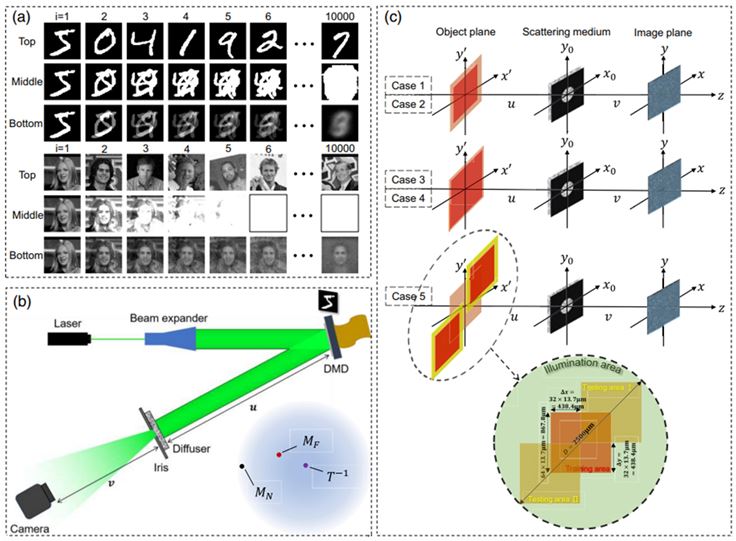
Deep learning (DL) has revolutionized imaging through scattering media, yet its widespread adoption is hindered by limited generalization, where models trained on specific datasets fail to perform reliably in unseen scenarios. Conventional wisdom attributes this limitation to feature-prior mismatches, but we identify a more root cause: a fundamental mismatch between the learned neural mapping and the system’s true physical inverse operator (T -1), driven principally by inhomogeneous spatial-intensity distributions in conventional training data. To overcome this, we introduce a physics-guided dataset homogeneity strategy. We demonstrate that enforcing spatial uniformity — ensuring all spatial modes in the region of interest are equally and sufficiently sampled — effectively aligns the learned weights with the physical transmission matrix. This approach ensures the network simulates the underlying physical laws rather than merely memorizing dataset-specific statistical biases. Specifically, by optimizing training datasets, we achieve unprecedented cross-dataset generalization: networks trained on simple digits successfully reconstruct complex face images. This physics-guided framework not only overcomes generalization barriers in scattering imaging but also establishes a universal principle for designing robust DL architectures. The conceptual repositioning of DL, from pure data-fitting to physics-simulating, is a big step forward for its reliable deployments in real-world imaging applications.
About Advanced Photonics
Advanced Photonics is a highly selective, open-access, international journal that publishes innovative research in all areas of optics and photonics, including fundamental and applied research. The journal publishes top-quality original papers, letters, and review articles, reflecting significant advances and breakthroughs in theoretical and experimental research and novel applications with considerable potential.