Research paper titled “Quantum-inspired computational wavefront shaping enables turbulence-resilient distributed aperture synthesis imaging”, with Professor Puxiang LAI as one of the corresponding authors, was recently published in Science Advances, an open access, multidisciplinary journal from the Science family dedicated to publishing impactful research across the natural sciences.
“Quantum-inspired computational wavefront shaping enables turbulence-resilient distributed aperture synthesis imaging“
Shuai Sun, Zhen-Wu Nie, Yao-Kun Xu, Chen Chang, Ping-Xing Chen, Pu-Xiang Lai* & Wei-Tao Liu*
Science Advances 11, eaea4152 (2025). doi: 10.1126/sciadv.aea4152
Abstract
Wavefront shaping is essential for optical imaging through aberrations, but conventional methods rely on physical modulators that hinder real-time operation in dynamic environments such as turbulence. Inspired by quantum nonlocal aberration cancellation, we propose a modulator-free, computational wavefront shaping technique termed quantum-inspired computational wavefront shaping (QICWS). By leveraging classical correlated illumination and single-pixel detection, QICWS corrects aberrations via virtual phase modulation in the computational domain, eliminating the need for physical spatial light modulators or array sensors. We validate this approach in distributed optical aperture synthesis imaging, where a phase-randomized laser array illuminates objects through turbulence. Despite unknown phase mismatches and turbulent distortions, we reconstruct diffraction-limited images of a 3-meter standoff object at the theoretical resolution limit of the synthetic aperture (0.157 mm experimentally, 97% of the 0.152-mm limit). This work transforms traditionally intractable hardware challenges into computationally solvable problems, enabling turbulence-resilient standoff imaging without adaptive optics.
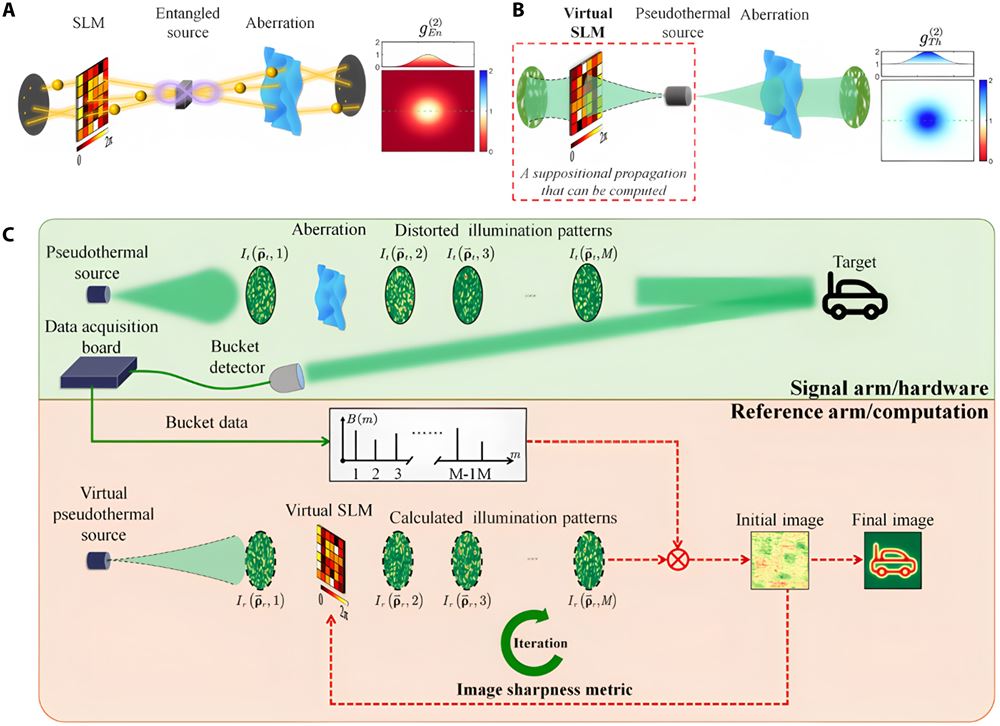
The principle of Quantum-inspired computational wavefront shaping (QiCWS) and its imaging application. (A) Quantum nonlocal wavefront shaping requires physical SLM. Aberrations on the signal photon disrupt entanglement, distorting the second-order coherence  . Restoration of a single peak requires physical phase modulation of the idler photon via an SLM. (B) Proposed QiCWS virtualizes aberration correction. The
  correlation between an aberrated signal field and the computationally propagated reference field is restored using a virtual SLM, enabling aberration cancellation without physical modulators. (C) Imaging workflow with QiCWS. An object obscured by unknown aberrations is illuminated by a sequence of pseudothermal speckles. Reflected light is collected by a bucket detector. Initial reconstructions (via cross-correlation between computed reference patterns and bucket signals) are featureless because of aberrations. QiCWS iteratively optimizes a virtual SLM by maximizing image sharpness, recovering diffraction-limited resolution without physical modulators or prior knowledge of the aberrations.