
Cooling cities from the window: Smart film reduces urban carbon footprints
As concrete jungles expand and global temperatures climb, the modern metropolis faces a stifling dilemma: how do we cool our indoor spaces without further warming the planet? The glass towers that define our urban skylines have long been a major source of energy waste, trapping solar heat and driving up the demand for air conditioning. Now, a breakthrough technology sets to transform these problematic glass facades into active, energy-saving assets.
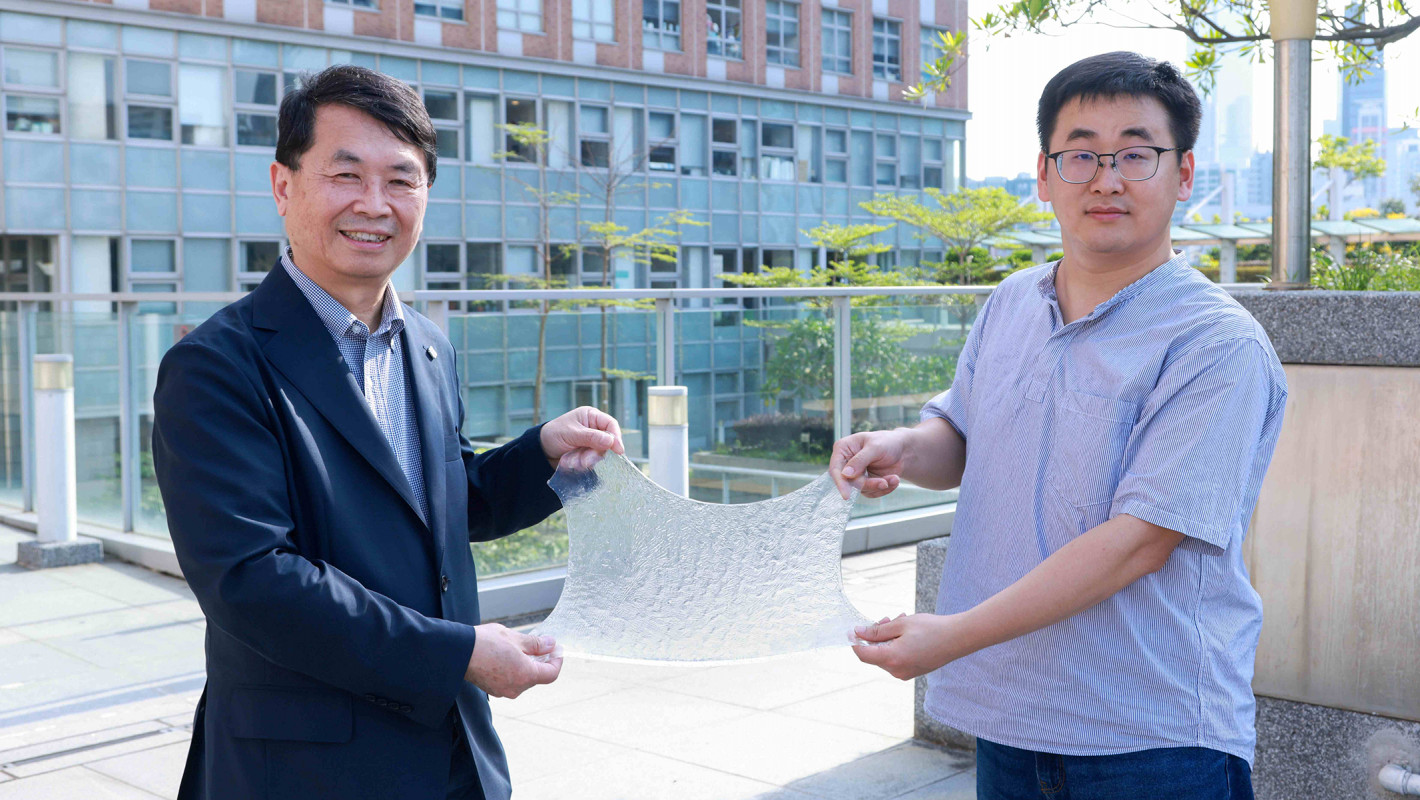
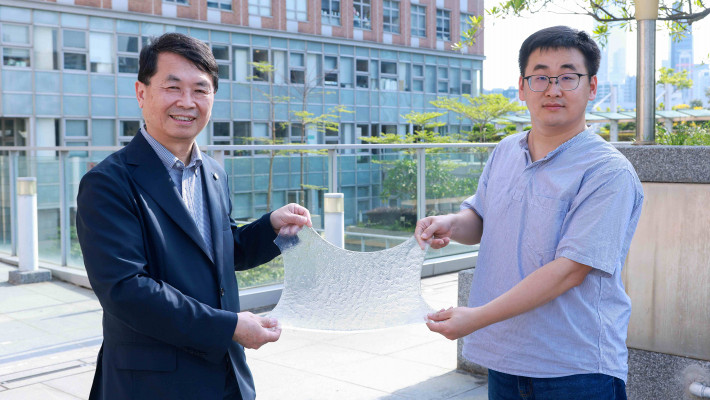
A research team at the International Centre of Urban Energy Nexus (UEX) of PolyU have engineered an ingenious “Moisture-responsive and Light-regulating” (MRLR) smart window film designed to automatically regulate indoor light, heat, and humidity. Led by Professor Yan Jinyue Jerry, Chair Professor of Energy and Buildings, and Dr Liu Junwei, Research Assistant Professor of the Department of Building Environment and Energy Engineering, the research team developed this eco-friendly film that tackles the limitations of existing smart windows. Conventional alternatives are often hindered by high manufacturing costs and poor durability. In contrast, this new dual-layer invention using a combination of a nanofiber layer and a hydrogel with excellent water-retention properties.
The technology works by adapting to day-and-night cycles. During the daytime, sunlight triggers the water stored within the film to evaporate, blocking solar radiation and lowering indoor temperatures by a remarkable 21.1°C. At night, as ambient humidity rises, the film absorbs excess moisture from the indoor air while simultaneously becoming less transparent. In tests, it successfully plummeted humidity from 91.73% to 53.76% in six hours, providing drier air alongside enhanced privacy.
This multi-tasking innovation is particularly crucial for hot, humid coastal cities like Hong Kong, where cooling systems represents a massive drain on power grids. By providing around-the-clock environmental regulation, global meteorological data indicates that the film can cut annual building energy consumption by over 20%. For every square metre installed, it is estimated to reduce global carbon emissions by more than 18kg each year.
Crucially, the film represents a practical, market-ready solution for the green building sector. It boasts excellent durability, maintaining its performance over 300 cycles of moisture adsorption and desorption tests, while resisting bacteria, fungi, and dust. With an incredibly short investment payback period of just one to two months, the commercial potential is vast.
In the long run, this scalable technology bridges the gap between economic viability and environmental responsibility, offering a powerful, accessible tool to accelerate the transition toward truly sustainable, low-carbon cities.
The research findings have been featured in the academic journal Advanced Energy Materials under the title, “Scalable moisture-responsive and light-regulating films for building energy saving and privacy protection”.