
LSGI pioneers ethical AI integration in spatial data teaching
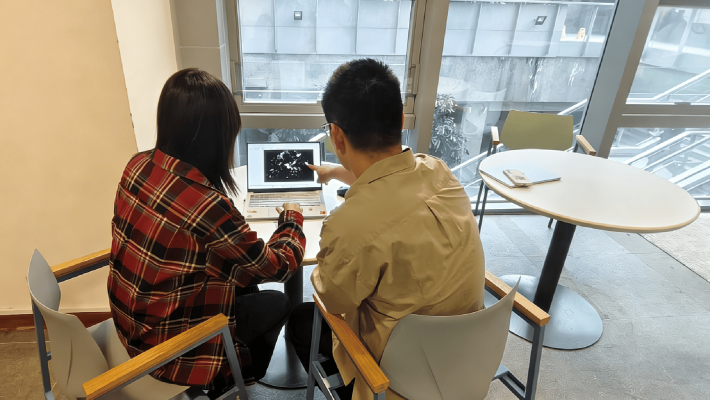
When students in the Department of Land Surveying and Geo-informatics (LSGI) at PolyU need to analyse Hong Kong’s land use, they can now use GeoAI Mentor to convert a simple question into a complete geospatial analysis with visualisations—no coding required. When they need help understanding complex geomatics concepts, an artificial intelligence (AI) tutor provides real-time support grounded in verified knowledge. This will become the new reality of geomatics education under the leadership of Professor Wu Chen, Head of LSGI, who is leading a thoughtful transformation of how spatial data professionals are trained. The department’s approach goes beyond simply adopting the latest technology—it establishes ethical guardrails whilst fundamentally reimagining how students learn to work with everything from field measurements to satellite imagery in an AI-enabled world.
Ethics first, technology second
LSGI’s AI adoption begins with clear principles. All spatial data must be handled ethically and securely, complying with applicable data management policies and legislation. Students using AI tools in their assessments must explicitly acknowledge and reference this use, with AI positioned as a supporting instrument for developing ideas rather than replacing critical analysis. This framework now guides 18 of LSGI’s 33 subjects, where AI tools have been thoughtfully incorporated into teaching and learning.
Democratising Hong Kong’s spatial data
The department’s most innovative AI initiative, GeoAI Mentor, tackles a barrier in accessibility of spatial data. Whilst the HKSAR government’s Common Spatial Data Infrastructure (CSDI) Portal consolidates valuable spatial data from public departments covering transportation, land use, and water management, accessing and processing this information requires considerable technical expertise. Data verification processes are still evolving, and non-specialist users face challenges navigating the platform.
GeoAI Mentor transforms this landscape by converting natural language queries and returning complete geospatial analyses. Students can simply ask about road network density across Hong Kong’s 18 districts and receive an immediate written report with visualisations—no longer needing complex expertise, programming knowledge, or hours spent navigating complicated datasets. This represents a fundamental shift in making spatial data governance democratic, intelligent and genuinely accessible.
A 24/7 intelligent guide through geomatics knowledge
Building on this foundation, LSGI developed the Spatial Data Science AI-Tutor in collaboration with the Department of Computing. This platform integrates geospatial knowledge with geomatics education through a comprehensive knowledge graph spanning textbooks, academic publications, examination papers, and lecture slides across domains such as Global Navigation Satellite Systems, Remote Sensing, Geographic Information Systems, and Light Detection and Ranging. A Retrieval-Augmented Generation framework ensures responses are grounded in verified geomatics knowledge rather than general AI responses. Unlike conventional large language models, the platform incorporates actual geomatics algorithms and models, enabling students to utilise CSDI data for developing, simulating, and comparing various research models—providing capabilities most existing large language models lack.
Reinventing collaborative learning
LSGI’s IntelliPBL system addresses persistent challenges in project-based learning, including uneven team dynamics, procrastination, limited feedback, and heavy instructor workloads. Its AI Grouping Engine creates balanced teams based on personality and competency profiles. A Progress Tracker and Alert System monitors milestones, predicts risks, and sends timely reminders. A Natural Language Processing Feedback Engine automatically generates formative feedback and supports grading, easing instructor burdens whilst improving the quality and consistency of student feedback.
These innovations demonstrate that LSGI is not merely reacting to AI’s rise but actively shaping how it can be used responsibly and meaningfully in geomatics education and research. By pairing innovation with ethics, accessibility, and pedagogical purpose, the department is preparing students not only to work with today’s technologies but also to lead the spatial data landscape of tomorrow.