
PolyU Education 4.0: Redefining student roles from passive learners to co-creators
Imagine an educational landscape where students don’t merely absorb information but actively shape their learning journey. At PolyU, this transformative vision has become reality through the PolyU Education 4.0 initiative that reshapes the traditional student-educator dynamic using cutting-edge artificial intelligence and advanced technologies.
Led by Dr Rodney Chu, Senior Lecturer of the Department of Applied Social Sciences, the implementation addresses a fundamental challenge in global higher education: developing learning platforms accessible to anyone, anywhere, anytime, for any discipline. Through a systematic, student-centred approach, Dr Chu and his team are proactively leveraging these frontier technologies to transform learning and teaching in line with the PolyU Education 4.0 initiative.
A new philosophy of learning
True to the vision of PolyU Education 4.0, which places students at the centre of the learning experience, Dr Chu’s pedagogy moves beyond the traditional model of attending lectures and absorbing content. Students are encouraged to work critically with AI tools and smart technologies, contribute to course design, and generate new ideas as they take greater ownership of their learning.
“We want students to move beyond being passive learners in the classroom and instead apply what they learn in real-world contexts, making meaningful contributions to the communities and issues they care about,” he emphasised.
The Student-Staff Partnership (SSP) model underpins this approach, focusing on shared responsibility and flexibility across disciplines. It promotes collaborative, community-based learning and redefines the roles of both students and educators, with students actively shaping knowledge both within and beyond the classroom.
Flexibility through the TIMS framework
The approach is supported by the TIMS framework—Technology Integration, Interdisciplinary Collaboration, Multimodal Assessment, and Student-Staff Partnership—which provides clear direction while allowing adaptability across disciplines. Dr Chu notes that different disciplines require different approaches. Social science may involve fieldwork, while computer science may not. Rather than imposing a one-size-fits-all model, this framework accommodates such differences, enabling students to see the relevance of their learning in context.
AI-powered learning with VAT
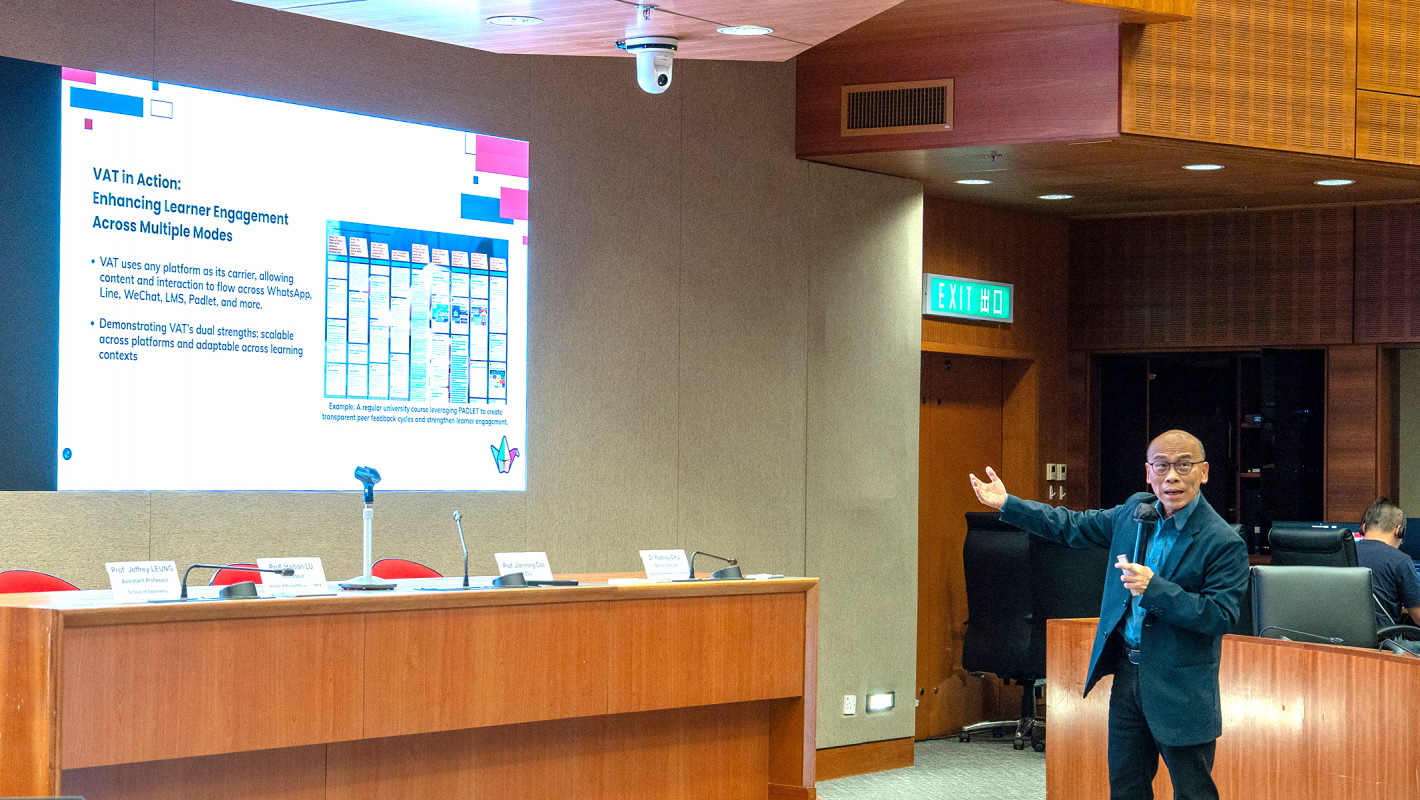
One of the most visible implementations is the Virtual Assistant TIMS (VAT), a generative AI chatbot launched in early 2024. VAT supports educators by giving students immediate access to lecture summaries, podcasts, multimodal search, and instant question-and-answer support.
Performance data shows strong engagement. VAT responds in about 11 seconds, with answers averaging 16 times more detail than students' original questions. Students engage in sustained exchanges, averaging 10.9 interactions per session. These interactions generate valuable insights into students' learning needs, which help refine courses and teaching approaches.
Students receive faster, more detailed support, while staff gain a clearer understanding of learning needs—turning student activity into continuous improvement.
Building community through collaboration
The platform becomes more impactful when students contribute as partners, not just users. Around 50 students from different departments were recruited as campus partners, helping develop the platform and support peers. This year, 12 student helpers from eight departments co-produced more than 70 podcasts, demonstrating how student-created content makes learning more connected and diverse.
“What is especially meaningful is that this model helps build a learning community beyond individual cohorts,” Dr Chu said. “Students contribute through peer mentoring—fourth-year students support newcomers—and some graduates continue to stay involved.”
Recognition through QS Awards, other awards in Asian regional competitions, and academic conferences confirms this approach is developing into a flexible, innovative model that can be applied more widely.