DLTC Seminar – Staff Development: Teaching Grant Writing Sharing Series – Secrets of Success

|
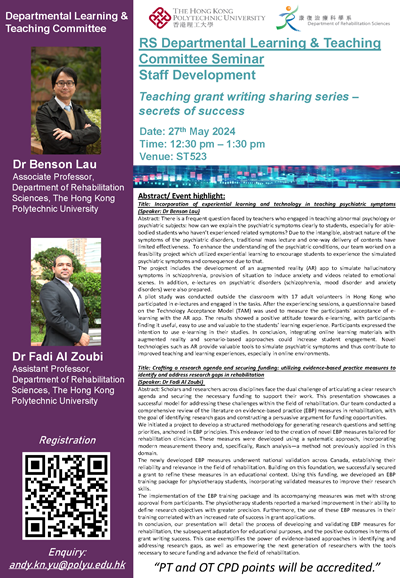
Topic: Staff Development: Teaching Grant Writing Sharing Series – Secrets of Success Dr Fadi Al Zoubi, Assistant Professor, Department of Rehabilitation Sciences There is a frequent question faced by teachers who engaged in teaching abnormal psychology or psychiatric subjects: how can we explain the psychiatric symptoms clearly to students, especially for able-bodied students who haven’t experienced related symptoms? Due to the intangible, abstract nature of the symptoms of the psychiatric disorders, traditional mass lecture and one-way delivery of contents have limited effectiveness. To enhance the understanding of the psychiatric conditions, our team worked on a feasibility project which utilized experiential learning to encourage students to experience the simulated psychiatric symptoms and consequence due to that. The project includes the development of an augmented reality (AR) app to simulate hallucinatory symptoms in schizophrenia, provision of situation to induce anxiety and videos related to emotional scenes. In addition, e-lectures on psychiatric disorders (schizophrenia, mood disorder and anxiety disorders) were also prepared. A pilot study was conducted outside the classroom with 17 adult volunteers in Hong Kong who participated in e-lectures and engaged in the tasks. After the experiencing sessions, a questionnaire based on the Technology Acceptance Model (TAM) was used to measure the participants' acceptance of e-learning with the AR app. The results showed a positive attitude towards e-learning, with participants finding it useful, easy to use and valuable to the students’ learning experience. Participants expressed the intention to use e-learning in their studies. In conclusion, integrating online learning materials with augmented reality and scenario-based approaches could increase student engagement. Novel technologies such as AR provide valuable tools to simulate psychiatric symptoms and thus contribute to improved teaching and learning experiences, especially in online environments. Title: Crafting a research agenda and securing funding: utilizing evidence-based practice measures to identify and address research gaps in rehabilitation (Speaker: Dr. Fadi Al Zoubi) Scholars and researchers across disciplines face the dual challenge of articulating a clear research agenda and securing the necessary funding to support their work. This presentation showcases a successful model for addressing these challenges within the field of rehabilitation. Our team conducted a comprehensive review of the literature on evidence-based practice (EBP) measures in rehabilitation, with the goal of identifying research gaps and constructing a persuasive argument for funding opportunities. We initiated a project to develop a structured methodology for generating research questions and setting priorities, anchored in EBP principles. This endeavor led to the creation of novel EBP measures tailored for rehabilitation clinicians. These measures were developed using a systematic approach, incorporating modern measurement theory and, specifically, Rasch analysis—a method not previously applied in this domain. The newly developed EBP measures underwent national validation across Canada, establishing their reliability and relevance in the field of rehabilitation. Building on this foundation, we successfully secured a grant to refine these measures in an educational context. Using this funding, we developed an EBP training package for physiotherapy students, incorporating validated measures to improve their research skills. The implementation of the EBP training package and its accompanying measures was met with strong approval from participants. The physiotherapy students reported a marked improvement in their ability to define research objectives with greater precision. Furthermore, the use of these EBP measures in their training correlated with an increased rate of success in grant applications. In conclusion, our presentation will detail the process of developing and validating EBP measures for rehabilitation, the subsequent adaptation for educational purposes, and the positive outcomes in terms of grant writing success. This case exemplifies the power of evidence-based approaches in identifying and addressing research gaps, as well as empowering the next generation of researchers with the tools necessary to secure funding and advance the field of rehabilitation. |
 |
|||